Independent Singapore VCC guidance
Direct answer
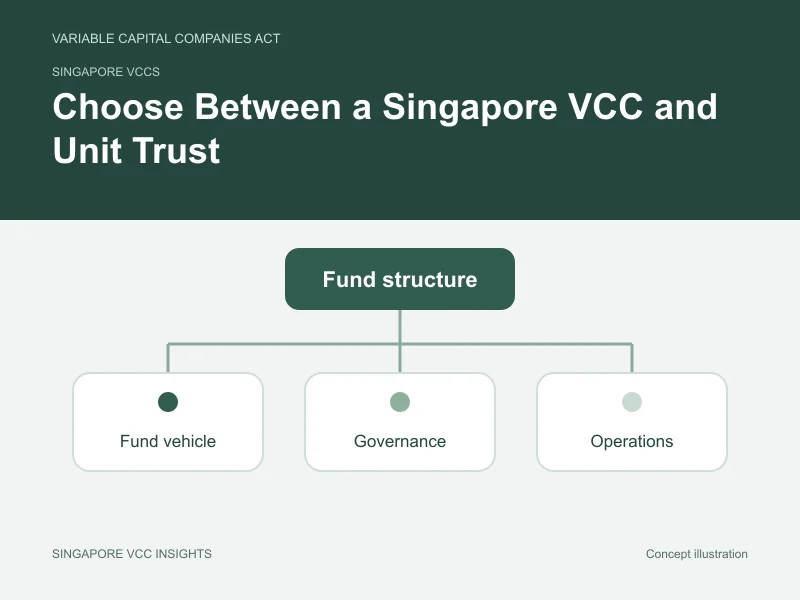
Choose a VCC when the fund needs a Singapore corporate vehicle, a board, shares and the option to operate standalone or with sub-funds. Choose a unit trust when the trust form, trustee oversight or an established trust-based product and distribution architecture is a real requirement. Neither is automatically cheaper, faster or more tax-efficient. Start with investors, offer perimeter, strategy, governance and service-provider capability, then obtain legal and tax advice on the selected structure before drafting documents.
At a glance
- Treat legal form and governance as the first decision, not a branding preference.
- Separate private-fund choices from requirements that apply to an authorised or recognised retail scheme.
- Test whether a board-led company or trustee-led trust architecture fits the accountable operating model.
- Compare full implementation dependencies rather than unsupported headline cost claims.
Who this is for
- Fund sponsors and advisers comparing two Singapore-domiciled collective investment scheme forms before establishment.
Important exclusions
- Personal investment product selection, a tax conclusion, an offer classification or a claim that one vehicle is best for every fund.
Start with legal form and accountability
A VCC is a Singapore corporate structure for investment funds. ACRA describes it as a separate legal entity whose shareholders own shares, with standalone and umbrella forms available. A unit trust is constituted through a trust arrangement: the trustee holds the fund property under the trust framework while the manager operates under the scheme documents and applicable regulatory perimeter. That difference changes document architecture, ownership of assets, governance reporting, signing authority and the way investors understand their interests. It should be resolved before discussing tax labels or provider quotations.
Sources: ACRA · ACRA and MAS · Monetary Authority of Singapore| Decision point | Singapore VCC | Singapore unit trust |
|---|---|---|
| Legal form | Corporate investment-fund vehicle with separate legal personality | Trust arrangement governed by its trust deed and trust framework |
| Investor interest | Shares in the VCC or relevant sub-fund and class | Units in the relevant trust or sub-fund |
| Primary governance architecture | Board, fund manager and required VCC officers | Trustee and manager roles under the trust and scheme documents |
| Multi-pool design | May use an umbrella VCC with registered sub-funds | May use umbrella or sub-fund arrangements if the trust documents create them |
| Public offer analysis | Depends on the scheme and offer perimeter | Depends on the scheme and offer perimeter |
Related guidance: Singapore VCC guide
Choose the governance model deliberately
The useful question is who must hold, challenge and evidence each decision. In a VCC, the board governs the corporate vehicle while the fund manager performs its mandate and VCC officers support statutory administration. In a unit trust, the trustee is a distinct control point with duties shaped by the trust and regulatory framework, alongside the manager. Do not reduce the choice to whether the sponsor prefers directors or a trustee. Map investment decisions, asset holding, valuation oversight, investor records, conflicts, document amendments, provider replacement and incident escalation across the proposed roles.
Sources: ACRA · ACRA · Monetary Authority of Singapore · Monetary Authority of SingaporeGovernance-fit questions
- Which body owns vehicle-level decisions and how will it challenge the manager?
- Who holds or controls fund property and account authority in the proposed form?
- Which party maintains investor interests and approves document or provider changes?
- How are conflicts, valuation issues and investor complaints escalated?
- Can every role produce evidence suitable for the intended investor and offer perimeter?
Related guidance: VCC directors and key providers guide
Use investor and distribution requirements as a gate
Identify the intended investors, jurisdictions, channels and whether the scheme is private, restricted, authorised or recognised before selecting the wrapper. MAS systems distinguish scheme structures and collect trustee information for a Singapore-constituted unit trust in relevant notifications. The MAS OPERA register also shows current authorised and recognised schemes and their managers. Those systems demonstrate why a retail or restricted-offer analysis cannot be inferred from the words VCC or unit trust alone. The legal form and the offer route are related workstreams, not substitutes for one another.
Sources: Monetary Authority of Singapore · Monetary Authority of Singapore · ACRA and MASVehicle-selection gate
- Investor or mandate requires a trustTest a unit trust first and confirm trustee, document, custody and distribution dependencies for the actual scheme.
- Sponsor needs a corporate fund platformTest a VCC, including board capability, manager eligibility, officer appointments and any umbrella operating model.
- Retail distribution is plannedRun the full authorisation, product, trustee or VCC and offer-document analysis before choosing on convenience.
- Private investors are flexible on formCompare governance, service providers, asset strategy, investor familiarity and future platform needs without assuming a default.
- The answer depends only on taxPause and commission a separate tax analysis because legal form alone does not establish the intended treatment.
Related guidance: accredited-investor offer readiness
Compare platform and operating dependencies
For a platform strategy, model how later funds or strategies would be added, governed, accounted for and closed. ACRA confirms that a VCC may be non-umbrella or umbrella, while the trust deed determines the unit trust architecture. In both cases, ask whether the administrator, custody or trustee model, bank accounts, investor registry, audit, valuation and reporting systems support multiple pools without data leakage. Shared providers may create efficiencies, but they can also create concentration and transition risk. Compare the complete operating design rather than counting legal entities alone.
Sources: ACRA · ACRA · Monetary Authority of Singapore · Monetary Authority of Singapore| Workstream | VCC diligence focus | Unit trust diligence focus |
|---|---|---|
| Governance | Board information, reserved matters and manager oversight | Trustee-manager allocation and trust-deed controls |
| Assets and cash | VCC or sub-fund account and authority design | Trustee holding and account-control model |
| Investor records | Share register, classes and sub-fund attribution | Unit register and trust or sub-fund attribution |
| Platform expansion | Umbrella change, sub-fund registration and shared controls | Trust-deed authority, new sub-fund documentation and trustee process |
| Provider change | Corporate approvals, contracts, filings and data transition | Trustee or manager approvals, deed terms, contracts and data transition |
Related guidance: standalone versus umbrella VCC guide
Record a decision that can survive scrutiny
The decision paper should state the intended investors and offer perimeter, strategy, liquidity model, legal form, governance roles, asset-holding approach, service-provider availability, platform plan, tax questions, implementation risks and rejected alternatives. Attach a responsibility map and a source-based assumptions log. Do not fill gaps with claims that one structure always costs less, secures better tax outcomes or carries greater prestige. Obtain scoped legal, regulatory and tax advice on the chosen design, then revisit the decision if the investor base, distribution plan or strategy changes before launch.
Sources: ACRA · ACRA and MAS · Monetary Authority of Singapore · Monetary Authority of SingaporeRelated guidance: VCC comparison hub
Frequently asked questions
Is a VCC always better than a unit trust?
No. A VCC may fit a corporate, board-led fund platform, while a unit trust may fit a mandate or distribution architecture that needs trust form and trustee oversight. The answer depends on the actual scheme.
Does a unit trust have separate legal personality?
A unit trust is a trust arrangement rather than a corporate person like a VCC. The trustee holds fund property under the trust framework, so the ownership and contracting analysis differs from a VCC.
Can both structures have more than one sub-fund?
A VCC may operate as an umbrella with registered sub-funds. A unit trust can also use umbrella or sub-fund arrangements where its trust documents establish them. Compare the actual documents and operating model.
Which structure is cheaper to run?
There is no responsible universal answer. Compare the full provider, governance, trustee or officer, administration, custody, audit, legal, tax and system scope for the specific strategy and investor base.
Does choosing a VCC determine the offer route?
No. The vehicle and the offer perimeter are separate decisions. Analyse whether the scheme and proposed investors fall within the relevant private, restricted, authorised or recognised route before distribution.
Official sources and further reading
- Understanding VCC features and eligibility requirements (ACRA)
- MAS and ACRA launch the Variable Capital Companies framework (ACRA and MAS)
- Overview of managing a variable capital company (ACRA)
- Legal obligations of a VCC director (ACRA)
- CISNet notification structure guide (Monetary Authority of Singapore)
- OPERA collective investment scheme register (Monetary Authority of Singapore)
- FAQs on the Trust Companies Act and Regulations (Monetary Authority of Singapore)
- Governance and Management of Variable Capital Companies (Monetary Authority of Singapore)
- Variable Capital Companies Act 2018 (Singapore Statutes Online)
Discuss a Singapore VCC structure
For help coordinating a Singapore VCC setup or corporate administration, contact Raffles Corporate Services.
General information only. This article is not legal, tax, regulatory or investment advice and does not imply affiliation with or endorsement by ACRA, MAS or IRAS.