Singapore VCC insights
VCC master-feeder structures — Timeline and processing benchmarks
Raffles Corporate Services works with a panel of corporate and employment law firms; this article is general information, not legal advice.
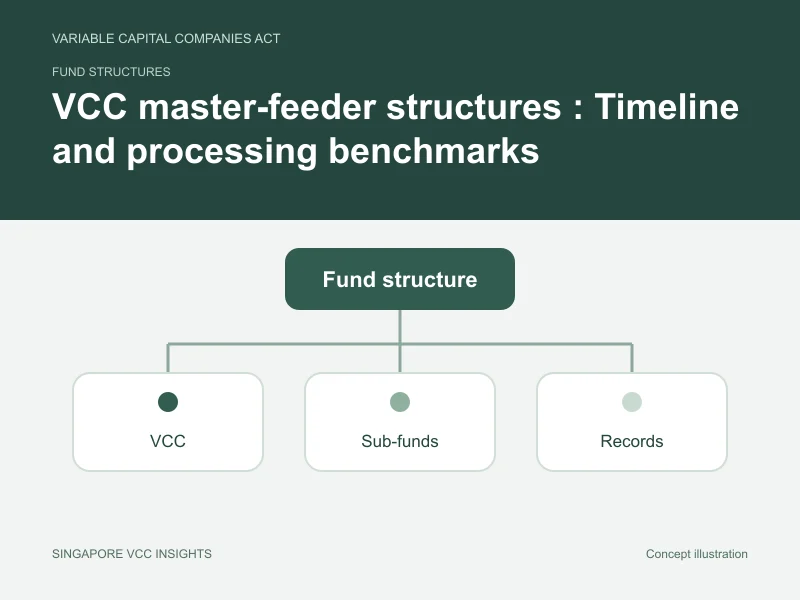
A VCC master-feeder structure uses one or more feeder funds to pool investor capital that is then invested into a single master fund, all housed within Singapore’s Variable Capital Company framework. Feeders can be separate VCCs or sub-funds of an umbrella VCC, while the master holds the portfolio, giving managers a tax-efficient way to consolidate trading across different investor pools.
What VCC master-feeder structures do
In a master-feeder arrangement, investors subscribe into a feeder fund, and the feeder invests substantially all of its assets into a master fund that carries out the actual investment strategy. This lets a manager run one trading book while offering different feeders , for example an onshore and an offshore feeder , tailored to different investor tax profiles. The Variable Capital Companies Act 2018 makes this efficient because a VCC has separate legal personality; Section 17 of the Variable Capital Companies Act 2018 establishes that a VCC is a body corporate, so it can hold assets, contract and sue in its own name. The MAS explainer on the VCC sets out the regime’s design.
Who uses master-feeder VCCs
Master-feeder structures suit managers raising capital from investors in different jurisdictions, funds seeking to separate taxable and tax-exempt pools, and strategies that benefit from consolidating trades in one master vehicle. Hedge funds and private funds are typical users. Managers migrating from a Cayman master-feeder often re-domicile or re-platform onto a VCC; our cross-site comparison of the VCC versus Cayman Islands SPC explains why. The fund manager must be a Permissible Fund Manager, so the manager’s own licensing sits at the centre of any structure.
Eligibility and requirements checklist
- A Permissible Fund Manager , a MAS-regulated or exempt fund manager , appointed to manage the VCC.
- At least three directors, one of whom is ordinarily resident in Singapore, and at least one who is a director or qualified representative of the fund manager.
- A Singapore-based company secretary, registered office and an ACRA-approved auditor.
- A custodian or prime broker for the master fund’s assets.
- AML/CFT arrangements, since the VCC must comply with MAS anti-money-laundering notices.
- Fund documents defining the feeder-to-master flows, fees and redemption terms.
- Consideration of tax-incentive eligibility under the Section 13O or 13U schemes.
Tax treatment and the 13O/13U question
A key attraction of the VCC is access to Singapore’s fund tax incentives. Feeder and master VCCs can be structured to qualify for the Onshore Fund (Section 13O) or Enhanced-Tier Fund (Section 13U) exemptions, which exempt specified income from tax where the conditions on managers, spending and, for 13U, assets under management are met. Because the feeder invests into the master, the incentive planning must look through the structure. For an adjacent offshore option, see our note on the Section 13D offshore fund scheme. Getting the tax wrapper right at set-up avoids costly restructuring later.
Timeline, costs and processing benchmarks
Incorporating a VCC with ACRA typically takes around 14 to 60 days once the fund manager, directors and documents are ready, with the name and structure reviewed by ACRA in consultation with MAS. Set-up costs commonly run from S$8,000 to S$20,000+ in professional fees per fund, plus ongoing audit, administration and directorship costs. A tax-incentive application to MAS adds further lead time, often two to four months. A detailed fee walkthrough sits in our VCC master-feeder costs and fees breakdown.
Common mistakes and gotchas
Frequent pitfalls include appointing a manager who is not a Permissible Fund Manager, under-documenting the feeder-to-master arrangements, and applying for a tax incentive without meeting the business-spending or headcount conditions. Managers also sometimes overlook that each feeder, if set up as a separate VCC rather than a sub-fund, carries its own compliance burden. Segregation of assets and liabilities between sub-funds must be respected. Confirm the manager’s licensing and the incentive fit before incorporation, not after.
Step-by-step: standing up a master-feeder VCC
Building a master-feeder structure in Singapore runs through a defined set of stages once the manager and strategy are settled:
- Confirm the fund manager. Ensure the manager is a Permissible Fund Manager , MAS-licensed or exempt , since this is the gating requirement for any VCC.
- Design the structure. Decide whether feeders are standalone VCCs or sub-funds of an umbrella VCC, and define the master into which they invest.
- Appoint the officers. Put in place at least three directors, including a resident director and one connected to the fund manager, a company secretary, and an ACRA-approved auditor.
- Engage service providers. Appoint a fund administrator, and a custodian or prime broker for the master’s assets.
- Draft the fund documents. Define the feeder-to-master flows, subscription and redemption terms, fees and AML arrangements.
- Incorporate and, if relevant, apply for tax incentives. Register the VCC with ACRA, then apply to MAS for the Section 13O or 13U exemption where the fund qualifies.
The critical path is usually the tax-incentive application and investor due diligence rather than the incorporation itself. Managers weighing Singapore against an offshore master-feeder should read our VCC versus Cayman comparison.
Substance, segregation and governance in practice
A master-feeder VCC only delivers its benefits if the substance and segregation are respected in operation. Where feeders are sub-funds of an umbrella, the assets and liabilities of each sub-fund are segregated, so a liability of one sub-fund cannot be met from the assets of another , a protection that must be maintained through disciplined bookkeeping and separate accounts. The board must exercise genuine oversight, meeting to approve valuations, subscriptions and redemptions, and cannot simply rubber-stamp the manager. For tax-incentive funds, the economic-substance conditions , local business spending and, for 13U, the assets-under-management threshold and headcount , must be met and evidenced each year. The regulator’s expectations here are set out in the MAS VCC explainer, and the corporate mechanics flow from the VCC’s separate legal personality. Getting substance and segregation right from day one is far cheaper than remediating after a review.
FAQs
What is a VCC master-feeder structure?
Investors subscribe into a feeder fund, which invests substantially all its assets into a master fund that runs the strategy , all within Singapore’s VCC framework.
Can feeders be sub-funds of an umbrella VCC?
Yes. Feeders can be standalone VCCs or sub-funds of an umbrella VCC, each with segregated assets and liabilities.
Do master-feeder VCCs get tax incentives?
They can qualify for the Section 13O or 13U fund exemptions where the manager, spending and asset conditions are met; planning must look through the feeder to the master.
How long does it take to set up?
Incorporation typically takes 14 to 60 days; a MAS tax-incentive application adds roughly two to four months.
Related guides
See our master-feeder costs breakdown, the VCC versus Cayman comparison and the Section 13D offshore fund scheme note. The Variable Capital Companies Act 2018 is on Singapore Statutes Online, and registration is via ACRA.
Need help with this? Call, SMS or WhatsApp +65 8501 7133, or email hello@rafflescorporateservices.com. Raffles Corporate Services works with a panel of corporate and employment law firms; this article is general information, not legal advice.