Independent Singapore VCC guidance
Direct answer
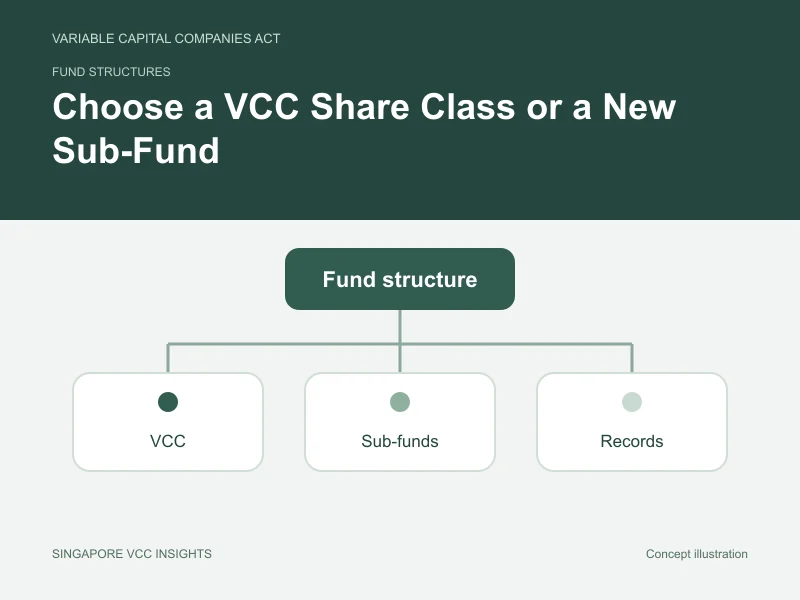
Use a share class when investors participate in the same asset pool and strategy but need different economic or dealing terms that the governing documents and systems can administer reliably. Use a new sub-fund when the proposition needs its own segregated asset-and-liability pool, strategy boundary, contracting identity or failure perimeter. Do not let a cheaper launch path decide the issue: map the legal documents, books, bank and custody records, valuation, fees and investor reporting before approval.
At a glance
- Start with the asset-and-liability perimeter, not the proposed label.
- A share class changes participation in one pool; a sub-fund creates a distinct operating compartment.
- Test valuation, dealing and expense allocation before signing documents.
- Use a stop condition when providers cannot represent the design consistently.
- Record why the rejected structure would not meet the reader task.
Who this is for
- Sponsors adding an investor group, currency, fee arrangement, strategy sleeve or family allocation to an existing VCC.
Important exclusions
- A substitute for legal, regulatory, accounting or tax advice on a proposed live structure.
Start with the pool that bears the outcome
Write one sentence identifying which assets produce returns, which obligations may reduce those returns and which investors bear the result. A class is ordinarily an interest in the same fund pool, even when its currency, fee, distribution or dealing terms differ. An umbrella VCC, by contrast, is designed to contain sub-funds whose assets and liabilities are segregated. The governing documents and current official framework therefore make the pool boundary the first structural question, ahead of price, naming or implementation speed.
Sources: ACRA · Singapore Statutes OnlinePool-boundary questions
- Will every participating investor have economic exposure to the same portfolio after class-level adjustments?
- Could a contract, borrowing, claim or expense belong only to the proposed proposition?
- Does the strategy require a separate bank, custody, accounting or counterparty record?
- Would one valuation or dealing failure affect investors who were meant to remain outside the proposition?
- Can the administrator explain the allocation without relying on an offline spreadsheet?
Related guidance: standalone and umbrella VCC decision guide
Use a class for controlled economic variation
A class can be appropriate when the underlying portfolio and core strategy remain common and the variation concerns investor-facing economics or access. Examples may include a different fee schedule, distribution policy, dealing currency, hedging approach or eligibility term, but only where the constitution, offering terms and administration model support that variation. The design should state which items are truly class-specific, how they are accrued, how they affect net asset value and how investors see them. A class should not become an informal container for assets or obligations that the documents treat as belonging to the wider pool.
Sources: Singapore Statutes Online · MAS| Question | Evidence of a workable class | Warning sign |
|---|---|---|
| Common portfolio | All classes participate in the same defined asset pool | A class is promised exclusive exposure to separate assets |
| Class economics | Fees, currency effects and distributions are allocated by documented rules | Manual adjustments decide who bears an item after the event |
| Dealing | Cut-offs, pricing and settlement differences are configured and disclosed | The administrator cannot reproduce class treatment consistently |
| Reporting | Statements distinguish class results from fund results | Investor reports imply legal segregation that does not exist |
Use a sub-fund for a separate risk perimeter
Choose the sub-fund route when the proposition needs a separately attributable portfolio, liabilities, contracts, investor group or operating history. Official VCC materials describe the umbrella model through distinct sub-funds and require their records and accounts to preserve separation. This makes a sub-fund a stronger candidate for a new strategy, vintage, financing arrangement, family branch or counterparty set whose risks should not be pooled with an existing strategy. Registration alone does not complete the separation; contracts, invoices, cash accounts, custody, books and reporting must all identify the relevant sub-fund.
Sources: ACRA · Singapore Statutes OnlineSub-fund operating proof
- DefineWrite the strategy, investor, asset, liability and counterparty perimeter in terms every provider can apply.
- RepresentShow how the umbrella and sub-fund names will appear in contracts, accounts, registers, invoices and reports.
- ConfigureCreate distinct accounting, valuation, banking, custody and workflow identifiers before live transactions begin.
- ReconcileTrace one sample subscription, investment, expense and report through the intended sub-fund records.
- ApproveGive directors a record of the design, unresolved dependencies and the evidence supporting launch.
Related guidance: VCC sub-funds guide
Run the decision before drafting
Hold a short design session before counsel or providers begin final documents. Give the team a worked scenario involving a subscription, a fee accrual, an investment loss, a counterparty claim and an investor exit. Ask where each amount lands and which record proves the answer. If the proposed class depends on segregating a liability or exclusive asset pool, revisit the sub-fund route. If the proposed sub-fund differs only by a fee or currency term and creates avoidable operational duplication, test whether a class can express the difference. The result should be a reasoned choice, not a preference disguised as architecture.
Sources: Singapore Statutes Online · MASClose with an implementation record
The approval pack should retain the purpose of the change, the alternatives considered, the chosen perimeter, affected documents, system configuration, provider confirmations, investor communication plan and launch tests. For a class, include class-specific allocation and dealing rules. For a sub-fund, include registration status and the identifiers used across contracts and records. Assign an owner to every dependency and make launch conditional on evidence rather than assurances. After the first live cycle, reconcile the approved design to cash, holdings, fees, investor records and reporting, then close any exception through the same governance route.
Sources: ACRA · Singapore Statutes Online · MASApproval-pack minimum
- Decision memorandum explaining why the selected perimeter fits the commercial task.
- Document matrix covering constitution, offering terms, subscriptions and provider agreements.
- System map showing ledgers, identifiers, bank and custody records, and reporting outputs.
- Test evidence for one normal cycle and at least one exception scenario.
- Named owners for launch, post-launch reconciliation and unresolved advice points.
Related guidance: closing a VCC share class
Frequently asked questions
Can different fees always be handled through share classes?
Different fees often point toward a class, but the documents, valuation model, administrator and investor reporting must all support the allocation. A fee label alone is not enough. Test how accruals, rebates, equalisation, crystallisation and corrections affect each investor group, and obtain advice where the change alters rights or disclosures.
Does a new strategy always need a new sub-fund?
Not automatically. The decision turns on whether the strategy creates a distinct portfolio, liability, contracting or governance perimeter. A modest mandate variation inside one coherent pool may be handled differently from a proposition marketed and operated as an independent fund. Document the facts before selecting the legal and operational form.
Can one family branch use a separate share class?
It may be possible where the branch participates in the same underlying pool and only its economic or access terms differ. If the intention is to isolate assets, liabilities, borrowing, succession decisions or counterparties, a class may not express that boundary. The family governance plan and fund documents should be tested together.
Who should approve the class-or-sub-fund choice?
Use the authority in the VCC documents and manager arrangements, with directors receiving enough information to understand the proposed perimeter and risks. Counsel, tax advisers, the administrator, auditor, bank and custodian may each need to confirm their part. No provider confirmation replaces the approval required by the governing records.
What should be tested after launch?
Reconcile the first subscription or commitment, asset booking, expense, valuation, investor statement and cash movement. Confirm that every output names and attributes the class or sub-fund as approved. A discrepancy should be treated as a design or control exception, corrected across all affected records and retested.
Official sources and further reading
- Understanding VCC features, eligibility and requirements (ACRA)
- Variable Capital Companies Act 2018 (Singapore Statutes Online)
- Governance and management of variable capital companies (MAS)
Discuss a Singapore VCC structure
For help coordinating a Singapore VCC setup or corporate administration, contact Raffles Corporate Services.
General information only. This article is not legal, tax, regulatory or investment advice and does not imply affiliation with or endorsement by ACRA, MAS or IRAS.