Independent Singapore VCC guidance
Direct answer
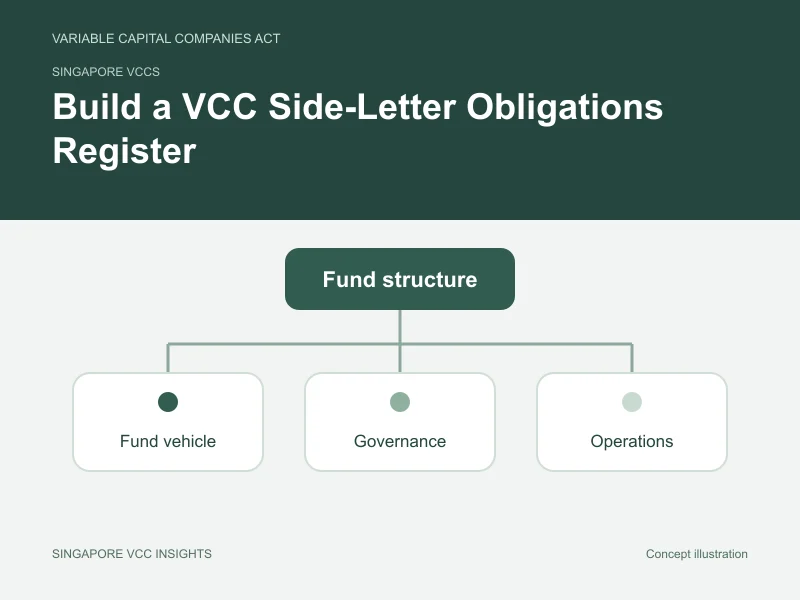
Build the register from executed documents, not negotiation summaries. Give each obligation a unique record showing the investor, VCC and sub-fund scope, right or restriction, trigger, frequency, calculation basis, data owner, preparer, reviewer, delivery route, confidentiality rule, expiry and evidence location. Compare each term with governing and offering documents, other investor arrangements and provider capabilities. Route conflicts or unequal treatment questions to the proper decision-makers before operating the term, and test the register whenever subscriptions, redemptions, reports, fees or amendments occur.
At a glance
- Use executed language and preserve the source clause.
- Scope every right to the correct investor, share class, VCC and sub-fund.
- Translate prose into triggers, owners, controls and evidence.
- Check interactions with other investors and governing documents.
- Retest obligations when facts, providers or documents change.
Who this is for
- Private-fund VCC operations teams maintaining negotiated investor rights and restrictions.
Important exclusions
- Drafting or interpreting a side letter, deciding whether a term is lawful, or assuming a private-fund process applies to an authorised retail scheme.
Create one record for every operative term
A VCC is a separate legal entity and an umbrella may operate several sub-funds with separate portfolios and investor groups. The register should therefore identify the contracting entity, relevant sub-fund and share class before describing the investor right. A broad label such as reporting, fee or consent is not enough for operations to act safely.
Sources: Accounting and Corporate Regulatory Authority · Accounting and Corporate Regulatory Authority · Monetary Authority of Singapore| Field group | Fields to capture | Control purpose |
|---|---|---|
| Identity and scope | Investor legal name, executed document, VCC, sub-fund, share class and effective period | Prevents a right from being applied to the wrong holder or compartment. |
| Obligation | Clause reference, plain-language action, trigger, frequency, deadline basis and calculation rule | Converts legal prose into a repeatable operating task. |
| Ownership | Data owner, preparer, reviewer, approver, delivery channel and backup | Makes responsibility visible across the manager and providers. |
| Evidence and change | Source data, output, delivery proof, exceptions, expiry and amendment links | Supports review, audit and later interpretation. |
Keep the executed clause and a controlled plain-language summary side by side. The summary helps operators, but it should never replace the signed source. Where interpretation is uncertain, flag the record and obtain advice before converting the ambiguity into a recurring process that may be difficult to reverse.
Sources: Monetary Authority of Singapore · Accounting and Corporate Regulatory AuthorityRelated guidance: VCC sub-funds guide
Classify the operating obligation
- Information rights: portfolio, exposure, valuation, risk, environmental, tax or other agreed reporting.
- Economic terms: fee rates, rebates, equalisation, expense limits, most-favoured treatment or other negotiated economics.
- Liquidity and dealing: notice, capacity, gates, priority, transfer, redemption or consultation mechanics.
- Governance and consent: notice, consultation, excuse, restriction, key-person, change or termination rights.
- Confidentiality and use: permitted recipients, secure channel, aggregation, redaction and onward-disclosure limits.
Classification should drive workflow, not merely reporting. An information right needs data lineage, review and delivery proof. An economic term needs a calculation control and reconciliation. A dealing term needs calendar and order-routing integration. A consent right needs an event-detection path. A confidentiality restriction needs recipient and channel controls.
Sources: Monetary Authority of SingaporeCheck interactions before activation
Before activating a term, compare it with the VCC constitution, offering and subscription documents, the relevant share-class terms, existing side letters and provider contracts. The goal is to identify inconsistent instructions, missing authority, operational impossibility, confidentiality conflicts and terms that may affect other investors. Record the resolution rather than leaving it in negotiation email.
Sources: Accounting and Corporate Regulatory Authority · Accounting and Corporate Regulatory Authority · Monetary Authority of Singapore- The term matches existing authority and capabilityActivate the workflow, assign owners and complete a dry run before the first live trigger.
- The term conflicts with another documentPause activation and obtain a documented interpretation, amendment or approved priority rule.
- The provider cannot perform the termEscalate the capability gap, redesign the workflow or amend the arrangement before relying on manual memory.
- The term may affect other investorsRoute the issue through the applicable governance and disclosure process before implementation.
For an umbrella, perform the interaction check at both umbrella and sub-fund levels. A side letter for one sub-fund may request data sourced from a shared provider, but that does not justify disclosing another sub-fund's information or charging its costs without an approved basis.
Sources: Accounting and Corporate Regulatory Authority · Accounting and Corporate Regulatory Authority · Monetary Authority of SingaporeRelated guidance: VCC offering-document change control · share classes versus sub-funds decision
Connect triggers to the operating calendar
Map each obligation to the event that starts work. Common triggers include month end, quarter end, a valuation point, a proposed investment, a key-person event, a change of manager, an amendment, an investor request, a subscription, a redemption or termination. The register should distinguish an event date from the due-date calculation and show the time zone and business-day convention where the document uses them.
Sources: Monetary Authority of Singapore- Trigger detectedLog the event and identify every obligation, investor, VCC, sub-fund and provider touched by it.
- Data and calculation preparedUse authoritative source data, apply the executed rule and preserve assumptions or exclusions.
- Review and delivery completedObtain the required approval, use the permitted channel and retain the final delivered version.
- Evidence and exceptions closedStore receipt or acknowledgement, record questions and link corrections to the original delivery.
Avoid copying dates into a separate spreadsheet without links. The calendar record should point back to the obligation ID and source clause, while the obligation record should show the next trigger and recent evidence. That two-way connection lets the team find both what is due and why it is due.
Sources: Monetary Authority of SingaporeRelated guidance: VCC investor reporting calendar
Test, review and retire obligations
Run sample tests before the first live due date and after changes to documents, investors, providers, systems or data sources. Test the hardest case, not only a clean report. Include a late data feed, disputed calculation, absent reviewer or confidentiality conflict so the escalation path is usable under pressure.
Sources: Monetary Authority of Singapore- Reconcile the register periodically to all executed side letters and amendments held in the controlled document repository.
- Compare upcoming obligations with the dealing, valuation, reporting and governance calendars.
- Review open exceptions, late deliveries, manual calculations and terms dependent on one person.
- Confirm expired or terminated terms have a supported end date and no continuing confidentiality or record duty was overlooked.
- Preserve superseded records and link them to the current term rather than overwriting the history.
Related guidance: VCC investor complaint response workflow
Frequently asked questions
Should the register contain the full side letter?
Keep the executed document in the controlled repository and link each register record to the exact clause. The register should contain an operational summary, but the signed language remains the source for interpretation.
Can one obligation apply across several sub-funds?
Only if the executed scope and governing documents support that treatment. Record each affected sub-fund explicitly and prevent shared provider data from exposing or charging unrelated sub-funds.
Who should own the obligations register?
Assign an accountable fund operations owner, with legal or compliance interpretation and provider data owners clearly separated. No single provider should become the only keeper of the complete obligation set.
How are most-favoured treatment terms controlled?
Capture the trigger, comparison population, exclusions, decision owner, notification path, deadline basis and evidence. Obtain advice on interpretation rather than using a label that does not show which terms must actually be compared.
When may an obligation be retired?
Retire it only when the executed end condition, transfer, amendment or termination is supported. Check for continuing confidentiality, record, reporting or final-calculation duties, and preserve the superseded history.
Official sources and further reading
- Understanding VCC features, eligibility and requirements (Accounting and Corporate Regulatory Authority)
- Overview of managing a variable capital company (Accounting and Corporate Regulatory Authority)
- Legal obligations of a VCC director (Accounting and Corporate Regulatory Authority)
- Governance and Management of Variable Capital Companies (Monetary Authority of Singapore)
Discuss a Singapore VCC structure
For help coordinating a Singapore VCC setup or corporate administration, contact Raffles Corporate Services.
General information only. This article is not legal, tax, regulatory or investment advice and does not imply affiliation with or endorsement by ACRA, MAS or IRAS.