Independent Singapore VCC guidance
Direct answer
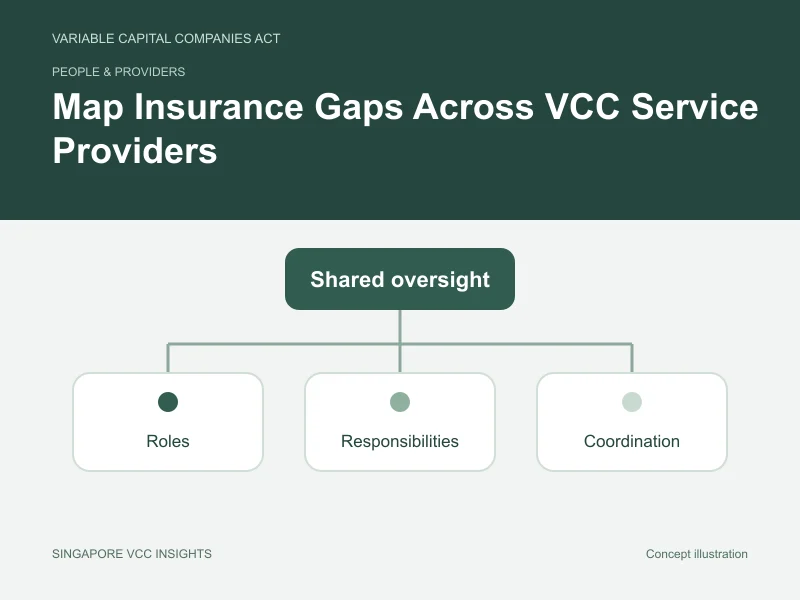
Review provider insurance as evidence of one possible recovery route, not as a substitute for governance or a promise that a loss will be paid. Map each critical service and failure scenario to the responsible entity, contract terms, policyholder, policy type, insured activity, limit, retention, exclusions, notification route and renewal date. Then identify overlaps, uninsured dependencies and amounts or events retained by the VCC. Assign operational controls, contractual actions and escalation owners to each residual gap, and repeat the review when providers, scope or policies change.
At a glance
- Start from services and loss scenarios, not policy names.
- Match the insured legal entity and activity to the VCC contract.
- Separate insurance evidence from contractual liability and operational control.
- Map exclusions, retentions, aggregation and notification dependencies.
- Assign a control and decision owner to every residual gap.
Who this is for
- VCC boards and operating teams reviewing insurance evidence from critical service providers.
Important exclusions
- Insurance broking, policy interpretation, a coverage opinion, a claim decision or advice on the amount or type of insurance any party should buy.
Start with the provider responsibility map
ACRA separates the roles of the VCC's directors, manager, secretary and auditor, while MAS emphasises governance and management responsibilities across the VCC operating model. Begin by listing each critical service, the contracting legal entity, affected VCC or sub-funds, responsible provider, subcontractors, data location, decision owner and foreseeable failure scenario.
Sources: Accounting and Corporate Regulatory Authority · Monetary Authority of Singapore · Accounting and Corporate Regulatory Authority- Include the fund manager, administrator, company secretary, auditor, custodian or bank, technology vendors and material delegates.
- Describe the actual service and data flow instead of relying on a provider-category label.
- Identify whether the provider decides, advises, calculates, executes, holds assets, stores data or merely transmits information.
- Record subcontractors and group entities that perform work even when they are not the named contracting party.
- Link each failure scenario to investor, sub-fund, financial, data, filing, valuation and continuity impacts.
The map should reveal concentration. Several providers may rely on the same manager data, administrator platform, cloud environment or individual approver. Separate contracts and certificates do not remove a common dependency. Record the point where one failure could affect several sub-funds or providers at once.
Sources: Monetary Authority of Singapore · Accounting and Corporate Regulatory AuthorityRelated guidance: VCC provider directory
Request evidence that can be compared
| Evidence item | Question to answer | Common gap |
|---|---|---|
| Certificate or broker evidence | Which legal entity, policy period, type and headline limit are shown? | The named insured differs from the VCC contracting entity. |
| Relevant policy wording or summary | Does the insured activity match the service actually performed? | The activity, territory or service sits outside the description. |
| Retention and aggregation information | What amount is retained and how may several claims share one limit? | The headline limit appears available but is eroded by aggregation or defence costs. |
| Notification and change process | Who must notify, by what route, and how will lapse or material change be communicated? | The VCC learns of a problem after a notice period or policy renewal has passed. |
Use a consistent request across providers, then record qualifications. A certificate can help confirm a policy period and named entity, but it rarely proves how wording, exclusions, deductibles, aggregation, territorial scope or notification conditions apply to a specific event. Escalate interpretation to appropriately qualified advisers rather than filling gaps with assumptions.
Sources: Monetary Authority of SingaporeRelated guidance: evidence-based VCC provider review
Compare insurance, contract and control
Build three columns for every scenario. The contract column explains who owes what to whom and any liability conditions. The insurance column records the possible policy response without promising coverage. The control column shows how the VCC prevents, detects, contains and recovers from the failure. A weakness in one column should not be hidden by strength in another.
Sources: Monetary Authority of Singapore · Accounting and Corporate Regulatory Authority| Scenario | Evidence to compare | Residual-control question |
|---|---|---|
| Incorrect NAV or allocation | Administration scope, review duties, liability terms and relevant professional cover evidence | Can the VCC detect, contain, correct and communicate the error promptly? |
| Fraudulent or mistaken payment | Authority matrix, bank terms, crime or cyber evidence and exclusions | Are payment approval, callback, access and recovery controls independent enough? |
| Data breach or platform outage | Data clauses, subcontractors, cyber evidence, response services and notification path | Can the VCC identify affected records and continue critical work outside the failed platform? |
| Missed filing or investor notice | Responsibility schedule, limitation terms and professional cover evidence | Does the VCC calendar detect the miss before the provider's own escalation? |
Do not add limits together unless the policies and event structure support it. Two providers may each show insurance, but one loss can fall outside both, trigger overlapping exclusions or consume an aggregated limit. Conversely, a provider may accept contractual responsibility that exceeds, differs from or is not matched by disclosed insurance. Treat each mismatch as a decision item.
Sources: Monetary Authority of SingaporeRelated guidance: licence-verified VCC manager RFP · VCC cyber incident response across providers
Decide how to treat each residual gap
- Evidence and controls alignRecord the conclusion, renewal trigger and monitoring owner while preserving the underlying documents.
- Evidence is incompleteRequest clarification, narrow reliance and keep the gap open rather than assuming the missing wording is favourable.
- Contract and insurance differObtain legal or insurance advice, assess financial capacity and decide whether terms or controls need to change.
- The exposure is intentionally retainedDocument the approving body, rationale, limits, controls, monitoring and event that will trigger reconsideration.
Possible responses include strengthening maker-checker controls, adding independent reconciliation, reducing access, changing data flow, revising a contract, requiring notice of policy changes, testing recovery, diversifying a dependency or replacing the provider. Choose the response from the loss scenario and control objective, not from a desire to make every matrix cell green.
Sources: Monetary Authority of SingaporeEscalate gaps that could affect investor dealing, asset safety, valuation, statutory records, personal data or continuity. The board should understand which exposures remain with the VCC even after providers and insurers are considered, and it should record what evidence would cause the decision to change.
Sources: Accounting and Corporate Regulatory Authority · Monetary Authority of SingaporeRelated guidance: VCC provider exit and handover plan
Refresh the map before renewal dates
Set review triggers from both contracts and policy periods. Refresh when a provider renews or changes a policy, the contracted scope changes, a new sub-fund launches, a subcontractor or platform changes, a claim or incident occurs, a limit is eroded, or the VCC adds a new strategy, asset class or jurisdiction. A certificate collected at onboarding should not remain the evidence for an unchanged conclusion years later.
Sources: Monetary Authority of Singapore · Accounting and Corporate Regulatory Authority- Maintain renewal dates, evidence-request dates, provider responses, open qualifications and decision owners in one register.
- Sample the named insured, activity, period and limit against the current contract and service map.
- Review incidents, near misses and service-level breaches for facts that change the scenario or control assessment.
- Test notification contacts and secure document access before a claim or urgent event.
- Report material gaps, accepted residual exposures and overdue actions to the proper VCC decision-makers.
Frequently asked questions
Does an insurance certificate prove that a VCC loss is covered?
No. It may evidence selected policy details, but coverage depends on the insured entity, activity, wording, exclusions, retention, aggregation, notification and event facts. Obtain qualified advice for an actual coverage question.
Should the VCC rely on the provider's policy limit?
No. The limit is only one input. Compare the contract, insured activity, exclusions, aggregation, financial capacity, operational controls and the VCC's own retained exposure before deciding how much reliance is reasonable.
Which providers belong in the review?
Include every provider or delegate whose failure could materially affect assets, cash, valuation, data, filings, investor dealing or continuity. Follow the actual service and data chain, including material subcontractors and group entities.
How often should insurance evidence be refreshed?
Refresh it before expiry or renewal and when service scope, legal entity, subcontractor, platform, strategy or risk changes. Also reassess after an incident, claim, limit erosion or material service failure.
What if a provider refuses to share policy wording?
Record the limitation, request alternative evidence or clarification, narrow any reliance placed on coverage, assess contractual and financial protections, and strengthen operational controls. Keep the unresolved gap visible to the appropriate decision-makers.
Official sources and further reading
- Choosing directors and key officers for a VCC (Accounting and Corporate Regulatory Authority)
- Governance and Management of Variable Capital Companies (Monetary Authority of Singapore)
- Understanding VCC features, eligibility and requirements (Accounting and Corporate Regulatory Authority)
- Legal obligations of a VCC director (Accounting and Corporate Regulatory Authority)
- Overview of managing a variable capital company (Accounting and Corporate Regulatory Authority)
Discuss a Singapore VCC structure
For help coordinating a Singapore VCC setup or corporate administration, contact Raffles Corporate Services.
General information only. This article is not legal, tax, regulatory or investment advice and does not imply affiliation with or endorsement by ACRA, MAS or IRAS.