Independent Singapore VCC guidance
Direct answer
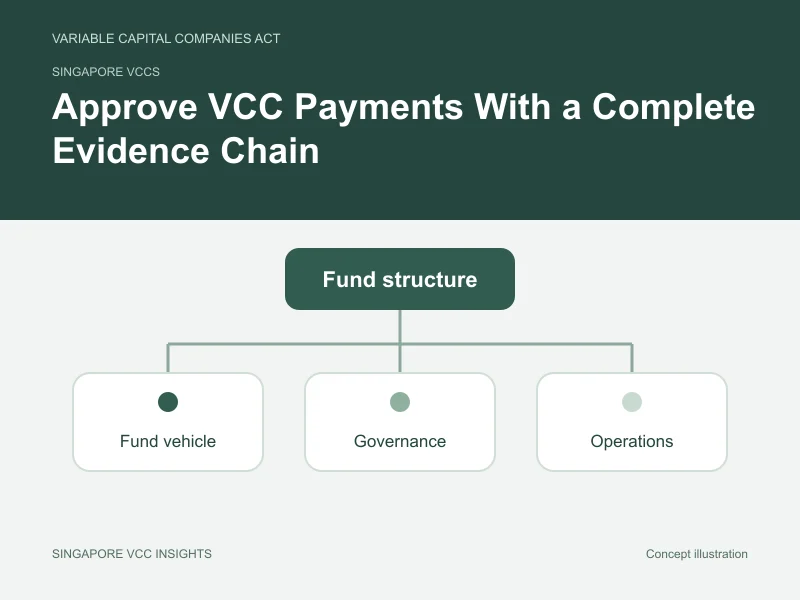
Approve a VCC payment only after proving the liability belongs to the named VCC or sub-fund, the amount and beneficiary match reliable evidence, and the expense or asset treatment is clear. Keep invoice validation, payment approval and bank release as distinct control steps. Verify changed beneficiary details outside the payment request, use the current authority matrix, preserve bank acceptance, and close the item only after cash and accounting records match the authorised payment.
At a glance
- Prove the legal and economic owner before choosing the paying account.
- Validate scope, amount, duplicate risk and beneficiary independently.
- Separate preparation, approval and release wherever the operating model allows.
- Treat changed bank details and urgent requests as higher-risk events.
- Reconcile bank evidence to the ledger and supporting liability before closure.
Who this is for
- VCC finance, operations, directors and managers controlling provider, investment, tax or operating payments.
Important exclusions
- A replacement for the bank mandate, operative contracts, tax advice, sanctions controls or the VCC’s documented emergency procedure.
Prove which entity owes the payment
Start with the liability, not the bank account. Identify the contracting party, service or asset, affected period, invoice or instruction, and the VCC or sub-fund that received the benefit. For an umbrella VCC, do not assume a shared provider invoice belongs at umbrella level or can be paid from whichever account has cash. The legal document, approved allocation method and accounting record should point to the same owner before a payment is prepared.
Sources: Accounting and Corporate Regulatory Authority · Singapore Statutes Online · Inland Revenue Authority of Singapore| Question | Evidence | Stop condition |
|---|---|---|
| Who contracted? | Executed agreement, order or approved instruction | Counterparty or entity is unclear |
| Who benefited? | Service period, portfolio or sub-fund support | No supported beneficiary |
| How was it allocated? | Approved direct charge or allocation method | Convenient cash source drives allocation |
| What is recorded? | Liability, asset or expense entry | Ledger and request describe different items |
| Which account pays? | Current account and authority map | Account does not belong to the liable pool |
If the invoice combines several services or sub-funds, split it using the approved basis and retain the calculation. Do not create a balancing allocation after payment merely to clear cash. Where another entity initially bears a cost, identify the reimbursement basis and obtain appropriate advice for related-party, tax or legal issues. The payment file should make ownership understandable without asking the preparer to explain an undocumented commercial arrangement.
Sources: Inland Revenue Authority of Singapore · Monetary Authority of Singapore · Singapore Statutes OnlineRelated guidance: VCC shared-expense allocation method
Validate the request and beneficiary
Match the payment request to the executed scope, accepted deliverable, agreed charging basis and supported amount. Check invoice identifiers, service period, taxes or charges shown, prior credits and duplicate history. Confirm the beneficiary name and account against controlled standing data. If bank details changed, use an independently sourced contact route and record the verification. Do not confirm through the same email thread that requested the change.
Sources: Inland Revenue Authority of Singapore · Monetary Authority of Singapore · Accounting and Corporate Regulatory Authority- Match supplier, contract, service period, deliverable and charging basis to the request.
- Search invoice number, amount, beneficiary and reference history for possible duplicates.
- Recalculate extensions, allocations, credits and currency instructions from source evidence.
- Verify new or changed beneficiary details through an independent controlled channel.
- Record missing purchase, legal, tax, investment or provider approvals before bank entry.
- Confirm the accounting code, VCC or sub-fund, value date and cash forecast treatment.
A payment can be arithmetically correct and still be unauthorised or misdirected. Separate evidence of a valid liability from evidence of the correct bank destination. For investment settlements, use the trade or transaction record and custody instructions appropriate to the operating model. For recurring providers, do not rely on familiarity; confirm that scope, rate, period and entity remain current. Record exceptions instead of editing the invoice description to fit the ledger.
Sources: Monetary Authority of Singapore · Inland Revenue Authority of SingaporeRelated guidance: related-party VCC provider appointment review
Route approval and bank release separately
Use an authority matrix that covers payment type, account, entity, amount band or qualitative risk, conflicts, emergency cases and delegated substitutes. The preparer should assemble evidence, the approver should decide whether the payment is valid and authorised, and the bank releaser should verify that the entered instruction matches the approval. Where one person holds more than one role in a lean structure, add compensating review and make the concentration visible.
Sources: Accounting and Corporate Regulatory Authority · Accounting and Corporate Regulatory Authority · Monetary Authority of Singapore- Liability and owner supported?If no, return the request before it enters the bank platform or payment file.
- Beneficiary independently verified?If no, stop changed or first-time details until controlled confirmation is complete.
- Approver authorised and unconflicted?If no, route to an alternate or higher authority under the current matrix.
- Bank instruction matches approval?If no, reject the entry and rebuild it from the approved evidence.
- Cash and ledger reconcile?If yes, close the payment; if no, open and own an exception immediately.
Do not use shared credentials or approval screenshots as substitutes for the bank audit trail. Preserve the payment reference, users, timestamps, approved amount, beneficiary and final status. If a bank mandate or approver changed, confirm the effective record before release. An urgent payment is not permission to weaken evidence; it is a reason to use the pre-agreed emergency route, record why normal timing failed, and add prompt independent review.
Sources: Accounting and Corporate Regulatory Authority · Monetary Authority of Singapore · Inland Revenue Authority of SingaporeRelated guidance: VCC bank mandate change controls
Control urgent, changed and rejected payments
Define higher-risk triggers before they occur: first-time beneficiary, changed account, unusual currency, split amount, request outside the normal channel, late value date, manual bank repair, related party, approver conflict or inconsistent invoice. The trigger should cause additional evidence or authority, not an automatic rejection where the payment is legitimate. Keep the original request intact and record every change so the final bank instruction can be compared with the version that was initially approved.
Sources: Monetary Authority of Singapore · Accounting and Corporate Regulatory Authority · Inland Revenue Authority of Singapore- ContainPause the affected instruction while preserving the original request, bank entry and communication history.
- VerifyConfirm liability, beneficiary, authority and change reason through sources independent of the request.
- DecideUse the documented escalation route to approve, revise, reject or defer the payment.
- ReleaseTransmit only the final approved instruction and retain the bank acceptance or rejection evidence.
- ReviewComplete independent post-payment review and record why the higher-risk trigger arose.
A rejected bank payment remains open. Classify whether the cause is beneficiary validation, account status, mandate, balance, format, cut-off, compliance review or provider error. Do not simply re-enter the item with a slightly different description. Link the replacement instruction to the rejected reference and confirm that only one amount settled. Repeated rejection patterns should feed bank, provider and process oversight rather than being treated as isolated inconvenience.
Sources: Monetary Authority of Singapore · Inland Revenue Authority of SingaporeReconcile cash and accounting before closure
After release, match the authorised instruction to the bank debit, value date, currency, beneficiary and reference. Then trace the payment to the liability, asset or expense record in the administrator books and confirm the correct VCC or sub-fund. Check fees, exchange differences, partial settlements, rejected duplicates and any reversing entries. A bank debit proves money moved; it does not prove the books, allocation and underlying obligation are correct.
Sources: Inland Revenue Authority of Singapore · Monetary Authority of Singapore · Accounting and Corporate Regulatory Authority- Match approved and settled beneficiary, account, currency, amount, value date and bank reference.
- Clear the supported liability without obscuring differences in charges or exchange rates.
- Confirm the correct VCC, sub-fund, expense or asset code and accounting period.
- Investigate partial, duplicate, reversed, rejected or unexpectedly delayed settlements.
- Retain the complete request, approval, bank and ledger chain with exception closure evidence.
Related guidance: VCC cash exception reconciliation
Frequently asked questions
Is dual approval enough to make a VCC payment safe?
No. Two approvals do not help if both reviewers see incomplete or manipulated evidence. The control also needs a supported liability, correct VCC or sub-fund, verified beneficiary, accurate bank entry and post-payment reconciliation. Define what each approver checks and preserve independent evidence rather than treating the number of clicks as the control objective.
Can one sub-fund pay a shared umbrella invoice?
Only use a paying and allocation method supported by the operative arrangements and accounting policy. Identify who contracted, who benefited and how the charge is attributed before payment. Do not choose the sub-fund with available cash and repair the allocation later. Where reimbursement or related-party issues arise, obtain the appropriate legal or tax advice.
How should changed bank details be verified?
Use a trusted contact route obtained independently from the change request, confirm the beneficiary and account, and document who performed the check. Avoid replying only within the requesting email chain. Apply enhanced review to urgent or first-time changes, then update controlled standing data under an authorised process so future payments do not rely on personal address books.
Who should approve a related-party payment?
Follow the VCC’s documented conflict and authority arrangements. Disclose the relationship, separate validation from the interested person, and use an unconflicted approver with enough information to assess scope, price, benefit and allocation. The payment file should link to the appointment or transaction approval and show that ordinary invoice and beneficiary controls still operated.
What if the bank debits a different amount because of charges?
Reconcile the gross instruction, bank debit, beneficiary receipt where available, charges and accounting treatment separately. Determine whether the contract, payment terms or fund policy assigns the charge to the VCC, sub-fund, beneficiary or provider. Do not force the liability to clear by hiding the difference in a miscellaneous account. Record and approve the supported treatment.
Official sources and further reading
- Legal Obligations of a VCC Director (Accounting and Corporate Regulatory Authority)
- Choosing Directors and Key Officers for a VCC (Accounting and Corporate Regulatory Authority)
- Understanding VCC Features, Eligibility and Requirements (Accounting and Corporate Regulatory Authority)
- Governance and Management of Variable Capital Companies (Monetary Authority of Singapore)
- Record Keeping Requirements (Inland Revenue Authority of Singapore)
- Variable Capital Companies Act 2018 (Singapore Statutes Online)
Discuss a Singapore VCC structure
For help coordinating a Singapore VCC setup or corporate administration, contact Raffles Corporate Services.
General information only. This article is not legal, tax, regulatory or investment advice and does not imply affiliation with or endorsement by ACRA, MAS or IRAS.