Singapore VCC insights
Sub-fund creation, valuation and ring-fencing mechanics — Eligibility and requirements checklist
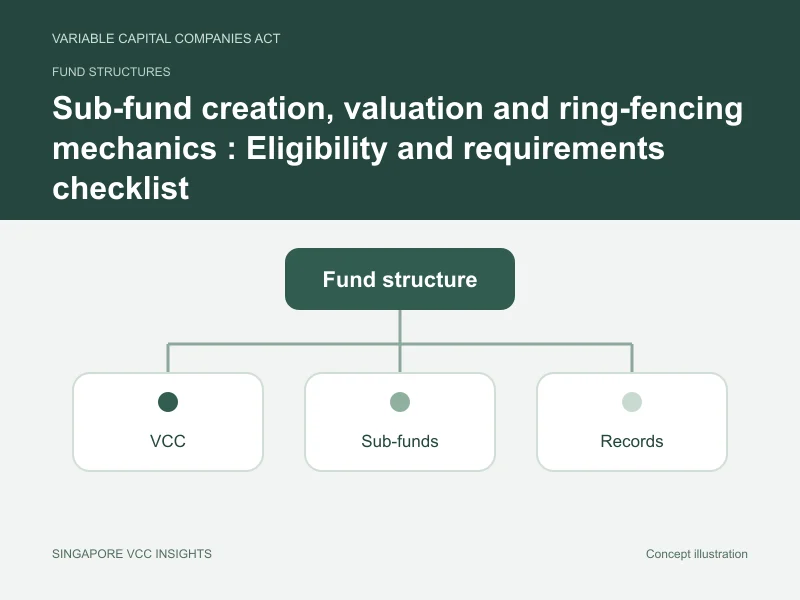
Sub-fund creation, valuation and ring-fencing mechanics under a Singapore umbrella Variable Capital Company let a single VCC hold multiple sub-funds whose assets and liabilities are legally segregated. This checklist explains how a sub-fund is created, how its net asset value is struck, and how ring-fencing is meant to work in practice.
Raffles Corporate Services works with a panel of corporate and employment law firms; this article is general information, not legal advice.
What a sub-fund is and why the structure exists
An umbrella VCC is one legal entity that can operate several sub-funds under it. Each sub-fund runs its own portfolio, investor register and net asset value, while sharing the umbrella’s directors, fund manager and service providers. The appeal is efficiency: one incorporation, one board and one auditor engagement can support many strategies or investor classes, with segregation provided by statute rather than by contract alone.
Ring-fencing , the legal mechanics
The heart of the structure is segregation. Section 29 of the Variable Capital Companies Act 2018 provides that the assets of a sub-fund are not available to meet the liabilities of another sub-fund, so that each sub-fund is ring-fenced from the others. Section 17 of the same Act gives the VCC legal personality, which is what allows the umbrella to contract and hold assets on behalf of each sub-fund. In practice, ring-fencing only holds if it is operationally respected: separate bank and custody accounts, clean books per sub-fund, and contracts that name the correct sub-fund. Our note on VCC Act 2018 Section 29 sub-fund segregation goes deeper on the statutory test.
Eligibility and requirements checklist
Before creating a sub-fund, confirm: the umbrella VCC is validly incorporated and registered with ACRA; a MAS-regulated or otherwise permitted fund manager is appointed; the constitution permits the new sub-fund and its share classes; the sub-fund has its own investment mandate and offering document; separate accounts and a NAV policy are in place; and the anti-money-laundering and know-your-client framework covers the new investors. Each sub-fund must also be notified to ACRA so that the register reflects it.
Valuation , striking a defensible NAV
Each sub-fund values independently. A robust NAV policy states the valuation frequency, the pricing sources for each asset class, the treatment of illiquid positions, and who signs off. For a typical private-markets sub-fund, quarterly valuation with an annual audit is common; for liquid strategies, monthly or even daily NAV may apply. The administrator usually strikes the NAV and the fund manager reviews it, with the board retaining ultimate responsibility.
Cost and timeline
Adding a sub-fund to an existing umbrella is far cheaper than a standalone launch. Expect professional and set-up costs in the region of S$5,000 to S$15,000 per sub-fund, plus the sub-fund’s share of ongoing audit, administration and tax filing. Timeline is typically two to six weeks once the offering document and mandate are settled, since the umbrella and its service providers already exist. A brand-new umbrella VCC, by contrast, usually takes several weeks and higher set-up fees before the first sub-fund can launch.
Common mistakes and gotchas
The most damaging error is treating ring-fencing as automatic. Commingled bank accounts, a shared custody wallet or a contract signed in the umbrella’s name without identifying the sub-fund can all undermine segregation if ever tested. Others under-document the NAV policy, or forget that cross-sub-fund investments need careful structuring. Tax treatment is another trap: fund incentives under the Income Tax Act 1947, such as the 13O and 13U schemes, apply at defined levels and conditions, so confirm how they map to each sub-fund. For the wider structuring view, see our sister guide on Private Trust Company setup and the corporate-governance angle in the corporate secretary’s role in venture capital.
Official sources to check
Work from the primary materials: the Monetary Authority of Singapore explainer on the VCC, the Variable Capital Companies Act 2018 on Singapore Statutes Online, and the registration and filing guidance from the Accounting and Corporate Regulatory Authority.
Sub-fund creation, valuation and ring-fencing mechanics: the takeaways
Sound sub-fund creation, valuation and ring-fencing mechanics rest on one idea: statutory segregation only protects investors if it is respected operationally. Keep separate accounts and custody per sub-fund, document the NAV policy, and name the correct sub-fund on every contract.
FAQs
Are sub-fund assets really protected from each other? Yes, by statute, provided the ring-fencing is respected operationally with separate accounts and correctly named contracts.
Does each sub-fund need its own auditor? The umbrella appoints one auditor, but each sub-fund is audited and its accounts are prepared separately.
Can sub-funds have different investors and currencies? Yes. Each sub-fund can have its own investors, share classes, base currency and mandate.
How often must a sub-fund be valued? As set in its NAV policy; quarterly is common for private markets, monthly or daily for liquid strategies.
Is a fund manager mandatory? Yes. A VCC must have a permissible fund manager; the sub-fund operates under that appointment.
Need help with this? Call, SMS or WhatsApp +65 8501 7133, or email hello@rafflescorporateservices.com. Raffles Corporate Services works with a panel of corporate and employment law firms; this article is general information, not legal advice.