Singapore VCC insights
Multi-class share VCC for performance allocation: eligibility and requirements checklist
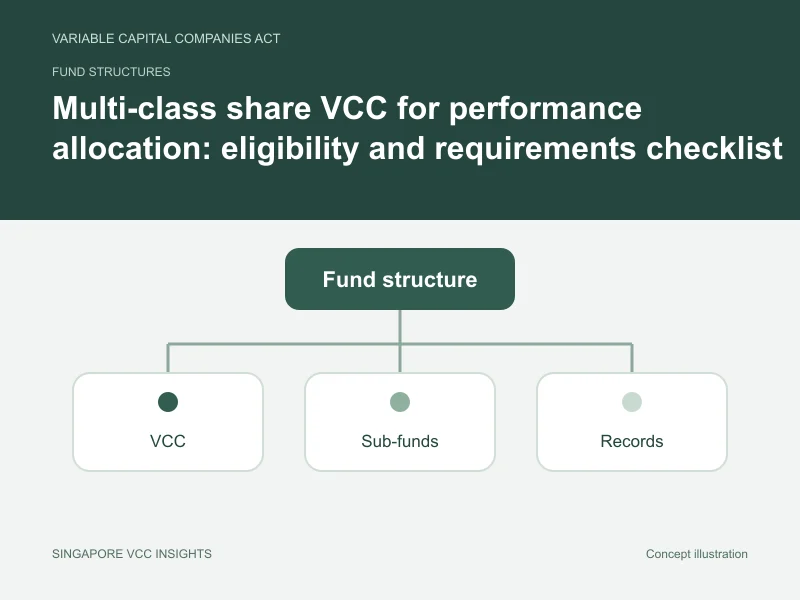
A multi-class share VCC for performance allocation is a Singapore Variable Capital Company that issues different classes of shares within one fund so that carried interest, management fees and performance fees can be allocated precisely to the right investors. A multi-class share VCC for performance allocation keeps a single legal entity and licensed fund manager while giving founders, early investors and later investors their own economics through class rights rather than side letters alone.
Raffles Corporate Services works with a panel of corporate and employment law firms; this article is general information, not legal advice.
What a multi-class share VCC for performance allocation is
The Variable Capital Company (VCC) is a corporate fund vehicle whose capital always equals its net assets, so shares are issued and redeemed at net asset value without the capital-maintenance machinery that constrains ordinary companies. Section 17 of the Variable Capital Companies Act 2018 establishes the incorporation of a VCC as a body corporate, and the Act allows a VCC to issue shares of different classes with different rights. Those class rights are the engine of performance allocation: each class can carry its own fee load, hurdle rate, high-water mark, distribution waterfall and carry entitlement.
In practice this lets a manager run, for example, a founders’ class bearing carried interest, a seed class with a reduced management fee in exchange for early commitment, and a standard class for later investors, all inside one fund, with the net asset value of each class tracked separately.
Who it suits
Multi-class performance allocation suits managers whose investors have genuinely different economics: a fund with a carry-bearing GP class and fee-paying LP classes, a strategy offering founder-share discounts, or a family-and-friends class alongside institutional money. It also suits managers who want to consolidate what used to be several parallel vehicles into one VCC to save on administration. Where investors need fully segregated assets and liabilities rather than just different economics, an umbrella VCC with sub-funds is the stronger tool; classes share the fund’s asset pool, whereas sub-funds ring-fence it.
Eligibility and requirements checklist
- The VCC must be managed by a Permissible Fund Manager. The Variable Capital Companies Act 2018 requires a VCC to appoint a fund manager that is regulated by the Monetary Authority of Singapore, whether a licensed or registered fund management company or an exempt financial institution.
- At least one director must be ordinarily resident in Singapore, and at least one director must also be a director or qualified representative of the fund manager.
- The VCC must have a Singapore-based company secretary and a registered office in Singapore.
- The constitution must expressly authorise multiple share classes and set out how class rights, fees and performance allocations operate.
- The fund must appoint an approved auditor and prepare financial statements using a recognised accounting standard.
Documents required
- A constitution providing for multiple classes and the allocation mechanics.
- A private placement memorandum or offering document describing each class, its fees, hurdle and carry.
- The fund manager’s regulatory particulars and the resident-director and secretary details.
- Anti-money-laundering and know-your-client files for subscribers, and the appointment of an AML/CFT officer.
- Subscription agreements referencing the relevant class and its high-water mark and hurdle terms.
Cost and timeline
ACRA’s incorporation fee for a VCC is S$8,000, materially higher than an ordinary company because of the specialised regime. Set-up professional fees, including constitution drafting for the class structure, fund administrator onboarding and AML framework, commonly run S$15,000 to S$40,000. Annual running costs, covering fund administration, audit, the corporate secretary and the resident director, typically start around S$20,000 and rise with the number of classes and investors. Incorporation itself is usually completed within one to two weeks once the fund manager and constitution are in place; the longer lead time is agreeing the class economics and drafting the offering document.
For a granular view, see the sibling guides on the costs and fees breakdown and the timeline and processing benchmarks.
Step-by-step process
First, confirm the fund manager arrangement, since a VCC cannot exist without a Permissible Fund Manager. Second, design the class matrix: which investors sit in which class, and each class’s fee, hurdle, high-water mark and carry. Third, draft the constitution and offering document to reflect that matrix precisely. Fourth, incorporate the VCC through a registered filing agent and appoint the fund administrator, auditor and AML officer. Fifth, onboard subscribers into the correct classes with matching subscription agreements. Sixth, run the fund so that net asset value, fees and performance are calculated and booked at class level each period.
Numerical specifics that matter
Performance allocation typically applies a carry of 10% to 20% above a hurdle rate of around 6% to 8%, subject to a high-water mark so a class only pays performance fees on genuine new gains. Management fees on institutional classes often sit near 1.5% to 2% of net asset value, with founder or seed classes discounted. Getting these numbers into the constitution and the offering document, not just into side letters, is what makes the allocation robust and auditable.
Common mistakes and gotchas
The recurring errors are: relying on side letters instead of class rights, which creates administration and enforceability risk; blurring the difference between classes (shared assets) and sub-funds (segregated assets); underestimating the fund administrator’s role in calculating class-level net asset value; and neglecting the AML/CFT obligations that MAS enforces on VCCs. Managers structuring family capital alongside external money should also weigh the family office tax incentives; our colleagues cover related planning in the note on Private Trust Company (PTC) setup, and the corporate-secretarial angle on raising outside capital in the guide to the corporate secretary’s role when a company raises venture capital.
Classes versus sub-funds: choosing the right tool
Managers frequently conflate share classes with sub-funds, but they solve different problems. Share classes within a single VCC (or within a single sub-fund) share the same underlying pool of assets; they differ only in economics, such as fees, hurdles, carry, currency or distribution policy. Sub-funds within an umbrella VCC, by contrast, legally segregate assets and liabilities, so a creditor of one sub-fund cannot reach the assets of another. If the goal is purely to give different investors different fee and carry terms while they invest in the same portfolio, classes are the correct and cheaper tool. If the goal is to run genuinely different portfolios or to protect one investor group’s assets from another’s liabilities, sub-funds are required.
Many real-world structures combine the two: an umbrella VCC with several strategy sub-funds, each of which then issues multiple classes for founders, seed and standard investors. This layering gives both legal segregation between strategies and economic differentiation within each strategy, at the cost of more administration and more careful net-asset-value bookkeeping.
How performance allocation is actually calculated
Performance allocation is only as good as the mechanics behind it. A high-water mark ensures a class pays a performance fee only when its net asset value exceeds the highest level at which it previously paid, so investors are not charged twice for recovering the same losses. A hurdle rate sets a minimum return the class must clear before carry accrues; a hard hurdle applies carry only to returns above the hurdle, while a soft hurdle, once cleared, allows a catch-up so the manager earns carry on the whole gain. Equalisation methods, such as the equalisation-credit or series-of-shares approach, ensure that investors subscribing at different times and net asset values bear performance fees fairly rather than subsidising or being subsidised by others.
These rules must be specified in the constitution and the offering document and implemented by the fund administrator, who strikes net asset value at class level each dealing period. Weak drafting here is the single most common source of disputes at distribution, so it is worth the legal and administrative investment up front.
Governance and ongoing compliance
A VCC carries real governance obligations. Directors owe duties to the VCC and must act in the interests of all classes fairly, which can create tension where classes have divergent economics; a clear conflicts framework in the constitution helps. The VCC must keep proper accounting records, appoint an approved auditor, prepare financial statements under a recognised standard, and maintain a register of members. AML and countering the financing of terrorism duties apply, and the VCC or its delegate must perform investor due diligence and file suspicious-transaction reports where required. MAS supervises these obligations, and lapses, particularly in AML files, are a standing enforcement focus.
FAQs
What is a multi-class share VCC for performance allocation? It is a single VCC that issues different share classes so that fees, hurdles and carried interest can be allocated separately to different investors.
How is a class different from a sub-fund? Classes share the fund’s asset pool but carry different economics; sub-funds in an umbrella VCC legally segregate assets and liabilities.
Does a VCC need a licensed fund manager? Yes. The VCC must appoint a Permissible Fund Manager regulated by the Monetary Authority of Singapore.
How much does a VCC cost to set up? ACRA’s incorporation fee is S$8,000, with set-up professional fees commonly S$15,000 to S$40,000 and annual costs from around S$20,000.
Can classes have different carry and hurdles? Yes. Each class can carry its own carry percentage, hurdle rate and high-water mark, defined in the constitution and offering document.
Need help with this? Call, SMS or WhatsApp +65 8501 7133, or email hello@rafflescorporateservices.com. Raffles Corporate Services works with a panel of corporate and employment law firms; this article is general information, not legal advice.