Independent Singapore VCC guidance
Direct answer
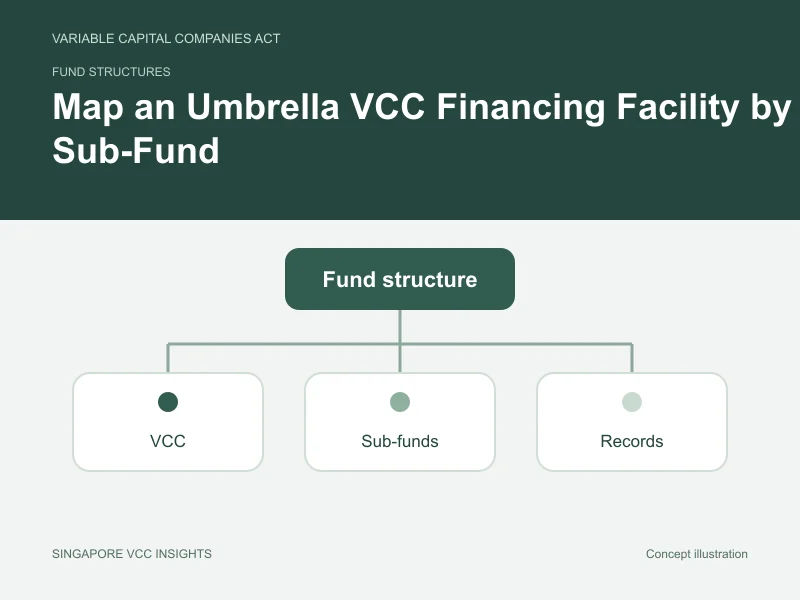
Before an umbrella VCC signs a financing facility, map every borrowing purpose, liability, collateral item, cash account, fee and repayment source to the sub-fund that will use and bear it. The legal documents, bank instructions, accounting records and monitoring reports should identify the same allocation. Shared or cross-pool terms need explicit legal review; convenience at umbrella level should never become an undocumented movement of risk between sub-funds.
At a glance
- Begin with the economic purpose and owning sub-fund before negotiating document labels.
- Make facility, security, cash and accounting records use the same sub-fund identifiers.
- Separate directly attributable costs from genuinely shared facility costs.
- Treat filings and lender notices as outputs of the signed structure, not the design process.
Who this is for
- Umbrella VCCs considering a loan, subscription facility, asset-backed borrowing or other secured financing
Important exclusions
- Determining enforceability, insolvency priority, tax treatment or the validity and filing deadline of a particular charge
Identify the economic borrower before drafting
Start with the investment or liquidity purpose, the assets financed, the investors who benefit and the cash flows expected to repay the facility. Record the VCC sub-fund to which those elements belong. Although the umbrella is the corporate vehicle, current official materials emphasise separation between sub-funds. The structure map should therefore precede term-sheet negotiation and provider setup.
Sources: Accounting and Corporate Regulatory Authority · Ministry of Finance| Field | Decision to record | Evidence owner |
|---|---|---|
| Facility purpose | Investment, bridge, working capital or another defined use | Fund manager |
| Benefiting pool | Named sub-fund and investor population | Directors and manager |
| Repayment source | Cash flows and accounts expected to service the debt | Finance lead |
| Assets at risk | Proposed collateral and operational restrictions | Counsel and custodian |
| Accounting owner | Ledger, cost centre and reporting population | Administrator |
Related guidance: VCC sub-fund segregation and operating controls
Align the document and account identifiers
Use the registered VCC and sub-fund names, identifiers and acting capacity consistently across the facility agreement, security documents, notices, bank accounts, draw requests, invoices and administrator records. Ask counsel to confirm the legally appropriate form. A mismatch can cause operational teams to post cash or liabilities at umbrella level even when the financing was designed for one sub-fund.
Sources: Singapore Statutes Online · Accounting and Corporate Regulatory AuthorityIdentifier test
- Executed documents use the approved VCC and sub-fund description consistently.
- Bank and custody instructions point to accounts assigned to the financing purpose.
- Draw requests and lender notices identify the same borrower capacity.
- Administrator ledgers and cost centres can record principal, interest, fees and collateral.
- The document matrix includes every amendment, accession, notice and security item.
Related guidance: VCC sub-fund contract identification checklist
Map liabilities, collateral and cash flows
| Element | Primary mapping question | Ongoing control |
|---|---|---|
| Principal | Which sub-fund receives and owes the drawn amount? | Draw-to-ledger reconciliation |
| Interest | Which pool incurs the financing cost? | Accrual and lender statement review |
| Fees | Directly attributable or genuinely shared? | Approved allocation and true-up |
| Collateral | Which assets support the facility? | Custody and security schedule reconciliation |
| Cash | Which accounts receive draws and make repayments? | Bank account and payment control |
| Covenants | Which assets, NAV or activities are tested? | Calendar, owner and breach workflow |
Do not assume that a facility described as umbrella-wide can be allocated later through accounting entries. The legal and operational effect needs specialist review before signing. Where a cost or service truly supports several sub-funds, document the allocation basis, approval, recalculation trigger and treatment of a sub-fund that joins or leaves the arrangement.
Sources: Singapore Statutes Online · Ministry of FinanceRelated guidance: umbrella VCC account architecture guide
Run a pre-signing control meeting
Pre-signing sequence
- Manager confirms purposeConfirm the investment, liquidity and risk rationale and the sub-fund expected to benefit from each facility component.
- Counsel confirms structureReview borrower capacity, security, disclosures, restrictions, notices and the intended allocation before documents are finalised.
- Providers test operationsAdministrator, bank and custodian confirm that accounts, ledgers, collateral records and reports can support the proposed design.
- Directors approve knowinglyThe board receives a single map of purpose, liabilities, collateral, cash, costs, conflicts and unresolved conditions.
- Owner locks the closing listAssign every condition, filing, notice, setup task and post-close reconciliation to a named role with evidence.
Minutes should capture the allocation conclusion and open dependencies, not only the headline facility amount. If a provider cannot support sub-fund-level records, resolve that design gap before signing or change the structure. A manual workaround should have an owner, independent check and retirement plan rather than becoming an invisible permanent process.
Sources: Accounting and Corporate Regulatory Authority · Ministry of FinanceClose filings and post-signing setup
After execution, counsel and the company-secretarial owner should assess the applicable registration and notice steps using the final documents and current ACRA process. Operations should then reconcile lender confirmations, cash accounts, collateral records, administrator ledgers and the approved allocation map before the first draw. Keep filing receipts and setup evidence with the facility record without treating them as proof that the economic allocation itself is sound.
Sources: Accounting and Corporate Regulatory AuthorityPost-signing pack
- Executed facility, security, fee and notice documents with final document list.
- Approved allocation map for principal, interest, fees, collateral and cash.
- ACRA and other filing assessments, instructions and receipts where applicable.
- Bank, custody and administrator setup confirmations using consistent identifiers.
- First-draw reconciliation and covenant calendar with named owners.
Related guidance: VCC charge registration workflow
Monitor changes through one facility register
Maintain a register for draws, repayments, interest, fees, collateral substitutions, covenant tests, waivers, amendments and filing consequences. Every change should identify the affected sub-fund and the evidence updated across legal, cash, custody and accounting records. Reconcile the register to lender statements and the administrator ledger at the agreed close frequency, then escalate differences before another draw or repayment.
Sources: Accounting and Corporate Regulatory Authority · Singapore Statutes OnlineChange triggers
- A new sub-fund seeks access to the facility or an existing participant exits.
- Collateral, repayment accounts or borrowing purpose changes.
- The lender amends limits, covenants, pricing or security terms.
- A fee allocation no longer reflects who benefits from the arrangement.
- A repayment, refinancing or release changes the status of a registered charge.
Related guidance: VCC cash counterparty limit framework
Frequently asked questions
Can an umbrella VCC borrow for more than one sub-fund?
The proposed arrangement needs legal and operational analysis against the VCC structure and final documents. Do not rely on an umbrella label alone. Map each liability, collateral item, cost and cash flow to the benefiting pools, then obtain advice on whether and how a shared facility can preserve the intended separation.
Who should own the financing allocation map?
A finance or operations owner can maintain it, but the inputs require the manager, directors, counsel, administrator, bank and custodian. The board should approve the structure with unresolved dependencies visible. Maintenance should follow amendments and operational changes, not wait until annual reporting.
Are financing fees always charged to the borrowing sub-fund?
Directly attributable costs normally point to the pool that benefits, while genuinely shared costs need an approved allocation basis. The final treatment depends on documents, accounting and advice. Preserve invoices, allocation drivers, approvals and true-ups so the result can be reproduced.
Does registering a charge prove the allocation is correct?
No. Registration is a separate compliance step based on the final security structure. The allocation map must also align economic purpose, legal documents, collateral, cash, accounting and monitoring. Keep the filing evidence, but do not use it as a substitute for those design and reconciliation controls.
What should happen before the first draw?
Confirm that conditions are met, filings and notices have been assessed, accounts and ledgers are ready, authorised signers are clear, collateral records agree and the draw instruction identifies the correct sub-fund purpose. Reconcile the lender confirmation, bank receipt and administrator posting immediately after funding.
Official sources and further reading
- Understanding VCC Features, Eligibility and Requirements (Accounting and Corporate Regulatory Authority)
- Registering a Charge for a VCC (Accounting and Corporate Regulatory Authority)
- Legal Obligations of a VCC Director (Accounting and Corporate Regulatory Authority)
- Variable Capital Companies Act 2018 (Singapore Statutes Online)
- Second Reading Speech on the Variable Capital Companies Bill (Ministry of Finance)
Discuss a Singapore VCC structure
For help coordinating a Singapore VCC setup or corporate administration, contact Raffles Corporate Services.
General information only. This article is not legal, tax, regulatory or investment advice and does not imply affiliation with or endorsement by ACRA, MAS or IRAS.