Articles

VCC Banking, Custody and Fund Administration Checklist
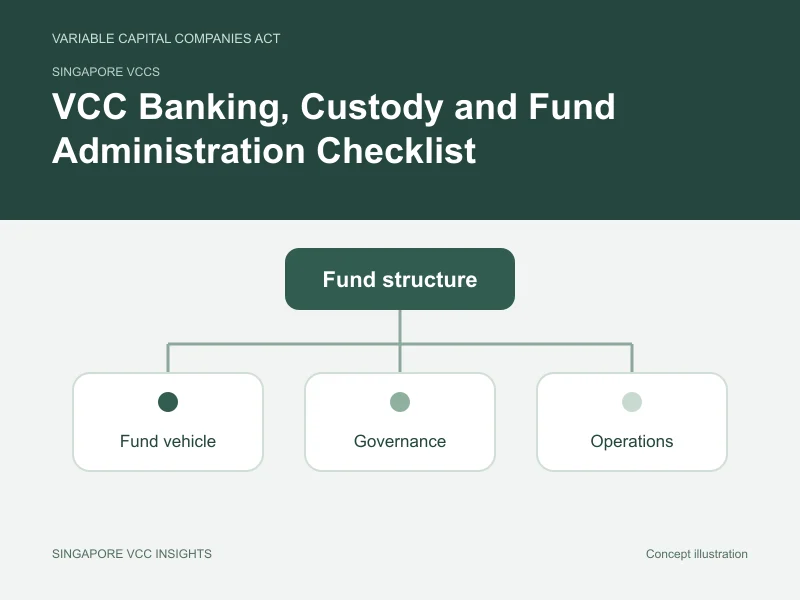
VCC Banking, Custody and Fund Administration Checklist requires more than a short answer. A Singapore VCC is a regulated fund vehicle with statutory capital mechanics, a permissible fund manager requirement, optional sub-funds, privacy features and ongoing filings. The analysis should begin with the Variable Capital Companies Act 2018 and the relevant subsidiary legislation, then move to the fund structure, tax position, service-provider responsibilities and practical implementation steps.

Quick Answer

  • VCC Banking, Custody and Fund Administration Checklist should be analysed through service scope, accountability and practical provider selection, not treated as a generic company incorporation topic.
  • The practical starting point is which provider owns filing, legal documents, tax analysis, administration, investor onboarding, audit coordination, AML/CFT work and annual compliance.
  • The tax workstream should consider providers should state whether tax review includes income tax, incentives, GST, stamp duty, FATCA, CRS and investor reporting.
  • Provider selection matters because quotes should be converted into a common matrix so sponsors can compare scope, exclusions, timelines, team experience and escalation arrangements.
  • The main risk is assuming a single provider has covered all workstreams, missing exclusions, or failing to ask how sub-funds, changes and annual compliance will be priced.

In This Article

  1. Statutory Context and Commercial Significance
  2. Legal and regulatory starting point
  3. Structure choices before implementation
  4. Tax, accounting and reporting implications
  5. Provider scope and responsibility mapping
  6. Risk points and due diligence questions
  7. Implementation checklist

Statutory Context and Commercial Significance

VCC Banking, Custody and Fund Administration Checklist should be approached as a Singapore fund-structuring question, not as a generic company incorporation topic. The Variable Capital Company is a statutory fund vehicle created under the Variable Capital Companies Act 2018. Its legal design affects capital, investor records, sub-funds, accounts, governance and the relationship between the VCC, its manager and its service providers.

The immediate question for provider reviews is whether the VCC advances the sponsor’s commercial objective without creating avoidable regulatory, tax or operating risk. That requires an analysis of service scope, accountability and practical provider selection. A short promotional explanation is not sufficient where the vehicle will hold investor money, operate sub-funds or rely on Singapore tax and regulatory treatment.

A senior Singapore adviser would usually begin by identifying the governing legislation, the regulatory perimeter, the proposed fund structure, the service-provider responsibilities and the first-year compliance timetable. That is the discipline this article applies to VCC Banking, Custody and Fund Administration Checklist.

Structure choices before implementation

Before acting on VCC Banking, Custody and Fund Administration Checklist, the sponsor should prepare a short launch memorandum. It should state the investment strategy, target investors, expected assets, jurisdictions, liquidity terms, fund manager, proposed VCC type, planned sub-funds, financial year end, tax route, service providers and launch timetable. This document becomes the shared reference point for legal, tax, filing and administration work.

The standalone-versus-umbrella decision is central. A standalone VCC is usually easier where there is one strategy, one investor pool and no realistic plan to add compartments. An umbrella VCC may be stronger where the manager expects multiple strategies, vintages, asset classes, co-investment pools or family branches. The tradeoff is that sub-funds require more disciplined records and provider coordination.

The constitution should be drafted or reviewed in light of the actual fund economics. It should not be a detached template. Rights attaching to shares, redemptions, distributions, voting, valuation, sub-fund powers and operating rules should match the offering documents and the investment management arrangement. Inconsistency between documents is one of the most common causes of expensive post-launch remediation.

Tax, accounting and reporting implications

Tax analysis should run in parallel with legal structuring. The Income Tax Act 1947, Goods and Services Tax Act 1993 and Stamp Duties Act 1929 should be considered with the IRAS VCC tax framework. IRAS guidance treats VCCs as companies for Singapore income tax purposes. For umbrella VCCs, income tax treatment is generally considered at the VCC level unless specific rules state otherwise, while GST and stamp duty can require closer sub-fund-level analysis. That difference matters for how records are designed.

Fund tax incentives such as 13O or 13U should never be described as automatic consequences of incorporation. The sponsor must test the fund, manager, investment activity, spending, asset level, investor profile and approval conditions. The offering documents and administration records should support the intended tax position before investors are admitted.

Accounting and audit should also be considered before launch. A VCC is not an ordinary small company with a light compliance footprint. The audit, accounts timetable, annual return, AGM position, XBRL requirements where applicable, GST position, FATCA and CRS classification should be mapped into the first-year calendar. The administrator and auditor should be able to produce records that support both investor reporting and statutory compliance.

Provider scope and responsibility mapping

The provider model should be written down. The fund manager should own investment strategy and regulated management. Fund counsel should own the legal documents. The corporate service provider or company secretary should own ACRA filings, registers and annual-return coordination. The tax adviser should own tax-incentive, GST and stamp-duty analysis. The administrator should own NAV, investor records and reporting workflows. The auditor should own audit procedures and financial statement review.

A strong provider proposal does not merely say that a VCC can be incorporated. It explains what information is required, what assumptions affect timing, which documents are included, what is excluded, how sub-funds change the fee schedule, who deals with ACRA queries and what happens after the notice of incorporation is issued. This is the standard set by better practitioner articles and service-provider guides.

For provider reviews, the sponsor should ask each provider to identify its responsibility in writing. If a company secretary excludes tax work, that is acceptable if it is clear. If a fund administrator does not perform legal review, that is also acceptable if counsel is appointed. The risk is not specialisation; the risk is a gap no one owns.

Risk points and due diligence questions

The first due diligence question is whether the VCC is being used for the correct purpose. If the commercial aim is simply to own one asset, run an operating business or act as a passive holding company, another Singapore vehicle may be more appropriate. The VCC should earn its place in the structure by solving a fund problem.

The second question is whether the manager, directors and service providers can evidence substance. MAS supervisory attention has made clear that VCC managers should be able to demonstrate real fund management activity, appropriate governance and proper control over regulated functions. The board minutes, policies, contracts and registers should reflect that substance.

The third question is whether the documents and operations tell the same story. If the constitution describes an umbrella platform but the bank accounts, contracts and investor statements do not identify sub-funds clearly, the intended segregation becomes harder to evidence. If the tax memo assumes one structure while the offering documents describe another, the launch is not ready.

Implementation checklist

Start with structure: confirm fund purpose, VCC type, sub-fund plan, investor profile, asset class, liquidity terms and jurisdictional touchpoints. Then confirm eligibility: permissible fund manager, director requirements, secretary, auditor, registered office, subscribers and constitution.

Move next to documents: constitution, offering document, subscription agreement, investment management agreement, administration agreement, custody or banking documents, AML/CFT procedures, tax memo, FATCA and CRS classification and first board approvals. Each document should identify the VCC and, where applicable, the relevant sub-fund.

Finally, build the calendar: name reservation, ACRA registration, sub-fund registration, Corppass, registers, company secretary appointment, auditor appointment, bank or custody onboarding, investor admission, financial year end, accounts, AGM, annual return, tax filing and recurring provider reviews. A VCC launch is successful only when the vehicle can operate cleanly after incorporation.

Frequently Asked Questions

What is the first issue to check for VCC Banking, Custody and Fund Administration Checklist?

Start by confirming which provider owns filing, legal documents, tax analysis, administration, investor onboarding, audit coordination, AML/CFT work and annual compliance. That determines whether the issue is a filing task, a tax issue, a governance issue or a full fund-structuring decision.

Which advisers should be involved?

At minimum, the fund manager, company secretary, fund counsel, tax adviser, auditor and administrator should be aligned. Depending on the strategy, bank, custodian and AML/CFT support may also be required.

Should this be decided before incorporation?

Usually yes. The VCC constitution, fund documents, manager appointment, tax analysis and service-provider model are easier to align before ACRA filing than after subscriptions or asset transfers begin.

How should provider quotes be compared?

Convert each quote into a common matrix covering government fees, professional fees, annual recurring fees, sub-fund pricing, tax work, exclusions and the owner of each filing or document.

Related Guides

VCC Basics

Singapore VCC Guide 2026

A practical guide to Singapore Variable Capital Companies, covering incorporation, fund structure, sub-funds, family offices, tax treatment, costs and ongoing compliance.

Incorporation and Registration

VCC Incorporation in Singapore

The step-by-step route to incorporating a Singapore VCC, including eligibility, required officers, name reservation, ACRA filing and post-registration work.

Family Offices

VCC for Family Offices

How families and advisers can think about using a Singapore VCC within a family office or family fund structure.

Related Singapore Resources

Useful References

Speak to a Singapore VCC Adviser

If you require advice on legal, tax or corporate secretarial matters relating to a Singapore VCC, or assistance with setting up, maintaining or restructuring a VCC, contact +65 8501 7133 by call, SMS or WhatsApp.

You may also review Raffles Corporate Services and Singapore Secretary Services for related Singapore corporate services and company secretarial support.