Singapore VCC insights
Sub-fund creation, valuation and ring-fencing mechanics — Complete 2026 guide
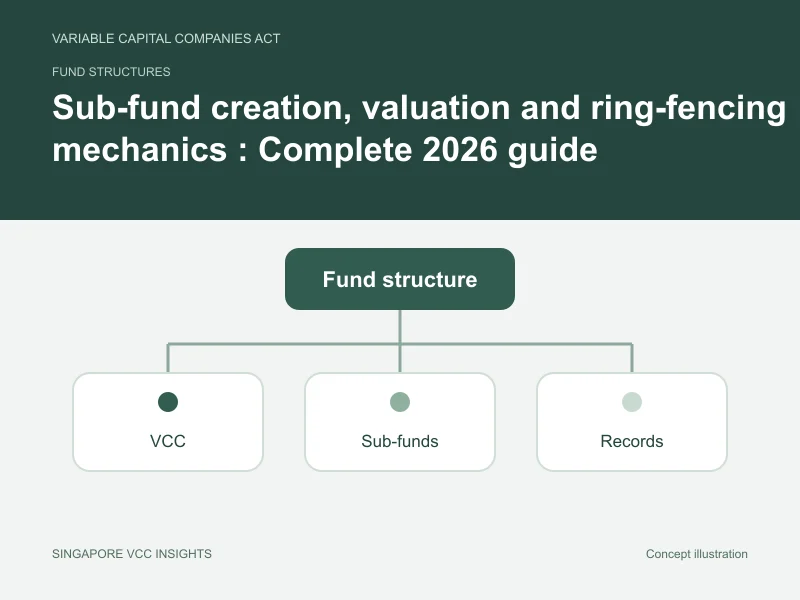
Sub-fund creation, valuation and ring-fencing mechanics sit at the operational heart of an umbrella VCC. Sub-funds are the statutory ring-fenced pools within a single corporate VCC, each with their own assets, liabilities, investor register and net asset value. The VCC Act 2018 governs the legal mechanics; the day-to-day operation of sub-funds is driven by the fund manager, fund administrator, custodian and auditor working to agreed valuation and segregation policies.
Raffles Corporate Services works with a panel of corporate and employment law firms; this article is general information, not legal advice.
Creating a new sub-fund , the statutory steps
Section 29 of the VCC Act 2018 establishes the sub-fund segregation framework, and Sections 18 and 19 set out the mechanics by which sub-funds are constituted within an umbrella VCC. A new sub-fund is created by: (a) a board resolution of the umbrella VCC approving the sub-fund’s establishment and constitution exhibit; (b) preparation of the sub-fund’s PPM and subscription documents; (c) ACRA notification of the new sub-fund via BizFile+; and (d) operational onboarding of the sub-fund with the fund administrator, custodian and auditor.
The umbrella constitution typically contains a generic sub-fund creation power, with each new sub-fund’s specific terms added as a constitutional exhibit. This streamlines the process , a new sub-fund does not require a fresh constitution amendment, just a board resolution adding the exhibit.
Eligibility and structural choices for a new sub-fund
Each sub-fund must have a defined investment policy, an identified fund manager (typically the same as the umbrella’s permissible fund manager under Section 46 of the VCC Act 2018), a defined investor class profile (retail, accredited or institutional), and a defined economic terms package (fee structure, hurdle rate, distribution waterfall, redemption mechanics). Sub-funds can be open-ended (with periodic subscription and redemption) or closed-ended (single-vintage with defined commitment period and term).
Closed-ended private market sub-funds (typical of PE, VC, real estate and credit strategies) tend to mirror Cayman ELP economic terms, with commitment-based subscriptions, capital calls and waterfall distributions. Open-ended sub-funds (typical of hedge fund strategies) operate on NAV-based subscription and redemption cycles with high water marks and crystallisation periodicity.
Valuation mechanics , frequency and methodology
Sub-fund valuation must be performed by the fund manager (or by the fund administrator under delegation) at intervals defined in the sub-fund’s PPM. Open-ended sub-funds typically calculate NAV monthly or quarterly; some hedge fund strategies calculate weekly. Closed-ended private market sub-funds calculate NAV quarterly or semi-annually, with year-end audited NAV as the anchor.
The valuation methodology must be consistent with the relevant accounting framework (typically Singapore Financial Reporting Standards or IFRS), with policies addressing: marketable securities valued at quoted prices on the principal exchange; unlisted equity valued under the IPEV Valuation Guidelines or equivalent methodology; private debt valued at amortised cost or fair value; real estate valued at independent appraised value; and derivatives valued at mark-to-market with appropriate adjustments. Conflicts of interest are managed through an independent valuation committee or external valuer for material or hard-to-value positions.
The Section 29 ring-fencing framework
Section 29 of the VCC Act 2018 establishes that the assets and liabilities of each sub-fund are segregated and ring-fenced. The legal effect is fourfold. First, the assets of a sub-fund are available only to satisfy the liabilities of that sub-fund. Second, the liabilities of a sub-fund are payable only out of the assets of that sub-fund, unless the umbrella has expressly assumed cross-sub-fund liability (which is rare). Third, on insolvency or winding up, each sub-fund’s assets are distributed to its own creditors and investors without dilution from sibling sub-funds. Fourth, contracts entered into on behalf of a specific sub-fund are enforceable only against that sub-fund’s assets.
The ring-fencing framework was designed to mirror the segregated portfolio company model used in Cayman Islands and other offshore jurisdictions. For practitioners moving from Cayman to Singapore, the substantive framework is broadly familiar, with Singapore-specific drafting nuances around how contracts are entered into “in respect of” a sub-fund. The legal personality framework underpinning this is set out in VCC Act 2018 Section 29 sub-fund segregation , Complete 2026 guide.
Contracting on behalf of a sub-fund
Contracts must be entered into “in respect of” the specific sub-fund. Practical drafting follows a standard pattern: the counterparty is described as “ABC VCC, acting in respect of XYZ Sub-Fund”, and the contract recites that the counterparty’s recourse is limited to the assets of XYZ Sub-Fund. Custodian agreements, prime brokerage agreements, IMAs, fund admin agreements, distribution agreements and subscription documents all follow this pattern.
Where the umbrella holds general or shared services (umbrella-level fund manager fee, board fees, audit and corporate secretarial), these costs are allocated to sub-funds on a defined basis (typically pro rata by AUM, time-weighted) and recorded in the umbrella’s accounting books with allocation traceable to each sub-fund.
Cross-sub-fund issues and exceptions to ring-fencing
Section 29 ring-fencing is robust but not absolute. Limited exceptions include: fraudulent transactions where assets have been mischaracterised between sub-funds; tax liabilities that operate at entity level under specific provisions; and contractual arrangements where the umbrella has expressly assumed cross-sub-fund liability (rare but possible , usually flagged in the PPM). The most common practical issue is misattribution of assets or liabilities during operations (e.g. a trade booked to the wrong sub-fund), which is resolved through correction-and-allocation entries by the fund administrator.
Tax incentive applications (Section 13O or 13U) operate at sub-fund level , see Section 13D offshore fund scheme , Complete 2026 guide for the related offshore framework, and our broader VCC platform resources. Each sub-fund must independently satisfy the incentive’s qualifying conditions.
Sub-fund winding up and termination
A sub-fund can be wound up without winding up the umbrella. The board resolves to wind up the sub-fund, an orderly distribution of assets is undertaken (after settling sub-fund-level liabilities), and an ACRA notification deregisters the sub-fund. The umbrella VCC and its remaining sub-funds continue uninterrupted.
Winding up follows two pathways depending on solvency. Solvent winding up is a straightforward orderly distribution. Insolvent winding up triggers the application of the Insolvency, Restructuring and Dissolution Act 2018 at sub-fund level , assets are distributed to creditors in priority order under the Act, with limited recourse to umbrella or sibling-sub-fund assets. The interaction of the IRDA with the VCC Act 2018 ring-fencing is a developing area of Singapore insolvency practice.
Cost and timeline for new sub-fund creation
Incremental cost for a new sub-fund within an existing umbrella: corporate secretarial fees S$5,000 to S$12,000; fund admin and custody onboarding S$8,000 to S$20,000; legal fees for sub-fund constitution exhibit and PPM updates S$15,000 to S$40,000; ACRA filing fees approximately S$400. Total typically S$30,000 to S$70,000 incremental cost.
Timeline: 3 to 6 weeks from instruction to operational launch, assuming clean board approvals and counterpart capacity. Sub-funds for complex strategies (real estate, infrastructure, multi-asset hybrid) take longer (6 to 10 weeks) given the additional due diligence required by fund admin and custody providers.
Common mistakes and gotchas
First mistake: failing to draft contracts as “in respect of” a specific sub-fund , generic “VCC” contracts create ambiguity on ring-fencing. Second mistake: under-documenting valuation policies , the absence of a clear, written valuation policy creates audit and investor-relations friction, particularly for hard-to-value private market positions. Third mistake: failing to allocate umbrella-level costs to sub-funds on a defined basis , fund-administrator allocation methodologies should be set in advance and disclosed in the PPM. Fourth mistake: treating sub-fund insolvency as an umbrella-level event , Section 29 segregation means a sub-fund insolvency is contained, but practical management of fund manager, board and counterpart obligations across the umbrella is still important. Fifth mistake: misalignment of investor onboarding documents between umbrella and sub-fund , investors should subscribe to specific sub-funds, not “to the VCC”, to preserve the segregation analysis.
For practitioners structuring a VCC alongside Singapore corporate services, see also nominee director services , foreigner essentials for the corporate-secretarial board composition dimension.
FAQs
Can investors hold shares in multiple sub-funds simultaneously? Yes. An investor can subscribe to any number of sub-funds within the umbrella, each subscription operating as a separate economic relationship.
Is each sub-fund a separate “tax person”? Sub-funds are not separate legal persons (the umbrella VCC is the legal person), but for Section 13O/13U incentive purposes, each sub-fund applies and reports separately, and IRAS treats sub-fund-level tax events accordingly.
Can a sub-fund issue debt to third parties? Yes, subject to the umbrella constitution and the PPM. The debt is recourse only to the sub-fund’s assets under Section 29.
What happens to a sub-fund’s PPM when the strategy changes materially? A material change requires updated PPM disclosures and, depending on the change, investor consent. Material changes that exceed the PPM’s permitted variation are typically structured as a new sub-fund.
Can sub-fund NAV be calculated by an in-house fund admin team? Yes, subject to governance safeguards (independent valuation committee, external valuer for material positions, auditor validation at year-end). Most institutional investors prefer independent fund admin for credibility and operational hygiene.
Need help with this? Call, SMS or WhatsApp +65 8501 7133, or email hello@rafflescorporateservices.com. Raffles Corporate Services helps sponsors launch new sub-funds, draft valuation policies and operationalise ring-fencing across umbrella VCC platforms , book a sub-fund scoping call.