Singapore VCC insights
Sub-fund creation, valuation and ring-fencing mechanics — Step-by-step walkthrough
Raffles Corporate Services works with a panel of corporate and employment law firms; this article is general information, not legal advice.
Sub-fund creation, valuation and ring-fencing mechanics are the operational core of an umbrella Variable Capital Company. Each sub-fund is established under the umbrella, valued at its own net asset value, and legally ring-fenced so its assets and liabilities are segregated. This step-by-step walkthrough explains how each works.
What sub-fund creation, valuation and ring-fencing mechanics are
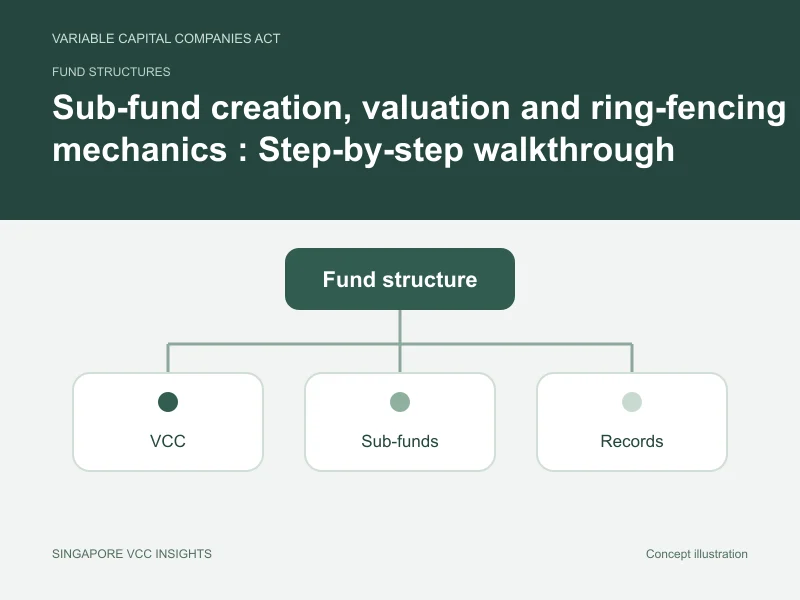
An umbrella Variable Capital Company (VCC) holds multiple sub-funds under a single legal entity. Each sub-fund pursues its own strategy, has its own portfolio and investors, and is accounted for separately, yet the umbrella is the single entity registered with ACRA. The three mechanics that make this work are creation (how a sub-fund comes into existence), valuation (how its net asset value is struck) and ring-fencing (how its assets and liabilities are legally segregated from other sub-funds).
The regime is set out in the Variable Capital Companies Act 2018. For the tax-incentive context that often drives VCC structuring, see Single vs Multi-Family Office in Singapore (2026): Costs, Pros and Cons; for the incorporation mechanics in Singapore more broadly, Drag-Along and Tag-Along Rights in Singapore Shareholder Agreements: Complete Guide is a useful companion.
This article is general information, not legal or tax advice; Raffles Corporate Services works with a panel of corporate and employment law firms.
Sub-fund creation
A sub-fund is created by the umbrella VCC and must be registered with ACRA before it can operate. Each sub-fund is given its own name and registration, must appoint a permissible fund manager regulated by MAS, and follows the constitution of the umbrella as supplemented by sub-fund terms. Although a sub-fund is not a separate legal person, Section 29 of the Variable Capital Companies Act 2018 provides that it may sue and be sued in its own name and that its property is to be applied only to its own liabilities.
Valuation and net asset value
Each sub-fund is valued independently at its own net asset value (NAV), being the value of its assets less its liabilities, divided by the number of shares in issue for that sub-fund. Shares are issued and redeemed at NAV, which is what gives a VCC its variable capital character: capital moves with subscriptions and redemptions without the capital-maintenance constraints that bind ordinary companies. Valuation must follow the accounting standards adopted by the VCC, typically a recognised international or Singapore standard, and the frequency set in the fund’s constitution.
Ring-fencing mechanics
Ring-fencing is the legal segregation of each sub-fund’s assets and liabilities. Section 29 of the Variable Capital Companies Act 2018 establishes that the assets of a sub-fund cannot be used to discharge the liabilities of another sub-fund or of the umbrella generally, even on insolvency. This statutory segregation is the central protection for investors and the reason an umbrella structure can hold unrelated strategies side by side. Records and bank accounts must be kept so the segregation is demonstrable in practice, not merely on paper.
Cost, timeline and step-by-step process
Indicative anchors and sequence:
- Sub-fund registration with ACRA: from S$400 per sub-fund.
- Umbrella incorporation: from S$8,000 to S$15,000 in professional fees, plus ACRA fees.
- Typical set-up timeline: 4 to 8 weeks for a sub-fund once the umbrella exists and the manager is appointed.
- Annual servicing per sub-fund: audit, administration and corporate-secretarial fees, commonly from S$15,000.
Steps: (1) confirm the umbrella VCC and its MAS-regulated manager; (2) draft sub-fund terms and segregation arrangements; (3) register the sub-fund with ACRA; (4) open segregated bank and custody accounts; (5) strike the opening NAV; (6) maintain separate records and audits. Our deeper companion at Sub-fund creation, valuation and ring-fencing mechanics , Complete 2026 guide sets out the documentation for each step.
Common mistakes and gotchas
The most serious error is failing to operate the ring-fence in practice, for example commingling cash across sub-funds, which can undermine the statutory segregation. Others mis-strike NAV by applying inconsistent valuation policies, forget that each sub-fund needs separate ACRA registration, or appoint a manager that is not a permissible fund manager. The authoritative overview is the MAS VCC framework, the registry mechanics run through ACRA, and the statutory text is on Variable Capital Companies Act 2018.
Standalone versus umbrella: why sub-fund mechanics matter
A VCC can be a standalone vehicle holding a single fund, or an umbrella holding many sub-funds. The sub-fund mechanics described here only arise in the umbrella form, and that is precisely where most of the operational value of the regime lies. An umbrella lets a manager launch new strategies under one legal entity, sharing a board, a constitution and a service-provider stack, while keeping each strategy’s assets and investors legally segregated. The cost saving and speed-to-launch are real, but they depend on getting creation, valuation and ring-fencing right for every sub-fund.
The decision to use an umbrella rather than a series of standalones turns on how many strategies you expect to run and how important shared infrastructure is. Where a manager plans a single long-life fund, a standalone may be simpler. Where a platform of strategies is envisaged, the umbrella’s ability to add ring-fenced sub-funds quickly is compelling, provided the manager commits to disciplined segregation in practice.
Operating the ring-fence in practice, not just on paper
Statutory segregation under Section 29 of the Variable Capital Companies Act 2018 is powerful, but it protects investors only if the manager operates the structure consistently with it. That means separate bank accounts and custody arrangements for each sub-fund, no commingling of cash, allocation of shared expenses on a fair and documented basis, and records that allow the assets and liabilities of each sub-fund to be identified at any time. A court or liquidator will look at how the structure was actually run, so sloppy operational practice can undermine the very protection the Act provides.
Shared costs are a common friction point. Umbrella-level expenses, such as the audit of the VCC or directors’ fees, must be apportioned across sub-funds on a reasonable and consistent basis set out in the constitution or an expense policy. Documenting the basis protects the manager if an investor later questions whether one sub-fund subsidised another.
Valuation policy and NAV discipline
Each sub-fund’s NAV is the figure on which subscriptions and redemptions are priced, so a consistent, well-documented valuation policy is central to fair treatment of investors. The policy should specify the valuation frequency, the pricing sources for each asset class, the treatment of hard-to-value assets, and who signs off the NAV. For illiquid strategies, an independent valuation input reduces the risk of disputes. Because VCC capital is variable, an inaccurate NAV directly transfers value between subscribing and redeeming investors, which is why fund administrators apply such rigour to the process.
Worked example: launching a second sub-fund
Suppose an umbrella VCC already runs an equities sub-fund and wants to add a private-credit sub-fund. The manager drafts sub-fund terms, registers the new sub-fund with ACRA from S$400, opens dedicated bank and custody accounts, and strikes an opening NAV. Shared umbrella costs are apportioned under the existing expense policy. Because the private-credit assets are ring-fenced under Section 29, a default in that sub-fund cannot reach the equities sub-fund’s assets, and vice versa. The new strategy is live within weeks rather than the months a fresh standalone would take, illustrating the umbrella’s core advantage.
Related guides and where to go next
Sub-fund mechanics connect to fund tax incentives and to incorporation choices. For the incentive context, Single vs Multi-Family Office in Singapore (2026): Costs, Pros and Cons is a useful companion, and for the incorporation backdrop, Drag-Along and Tag-Along Rights in Singapore Shareholder Agreements: Complete Guide is relevant. Our deeper explainer at Sub-fund creation, valuation and ring-fencing mechanics , Complete 2026 guide sets out the sub-fund documentation pack in detail.
FAQs
Is a sub-fund a separate legal entity? No. A sub-fund is part of the umbrella VCC, but it can sue and be sued in its own name and its assets are statutorily ring-fenced.
How is a sub-fund’s NAV calculated? Assets less liabilities of that sub-fund, divided by its shares in issue, valued under the fund’s adopted accounting standard.
Can one sub-fund’s losses hit another? No. Section 29 segregation means a sub-fund’s assets answer only for its own liabilities.
Does each sub-fund register separately? Yes. Each sub-fund must be registered with ACRA before operating.
Who can manage a VCC sub-fund? A permissible fund manager regulated by MAS; see the MAS VCC framework for current criteria.
Need help with this? Call, SMS or WhatsApp +65 8501 7133, or email hello@rafflescorporateservices.com. Raffles Corporate Services works with a panel of corporate and employment law firms; this article is general information, not legal advice.