Singapore VCC insights
VCC for accredited-investor-only feeder funds — Step-by-step walkthrough
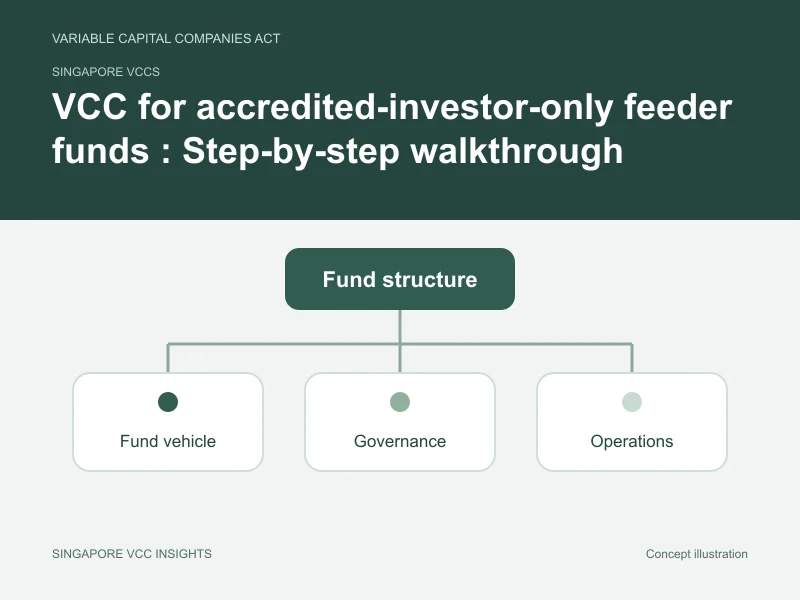
A VCC for accredited-investor-only feeder funds is a Singapore Variable Capital Company that pools capital from accredited investors and channels it into a master fund, relying on the accredited-investor offering exemption so the feeder is not marketed to the retail public. It combines NAV-based flexible capital, a Singapore fund manager and a restricted investor base.
Raffles Corporate Services works with a panel of corporate and employment law firms; this article is general information, not legal advice.
What an accredited-investor feeder VCC is
In a master-feeder structure, investors subscribe into a feeder fund, and the feeder in turn invests substantially all of its assets into a single master fund that does the actual investing. The feeder is, in effect, a conduit. Building that feeder as a Variable Capital Company under the Variable Capital Companies Act 2018 gives the manager NAV-based share capital that can be issued and redeemed as investors come and go, without the capital maintenance rules that constrain an ordinary Companies Act 1967 company. That is well suited to a feeder, where subscriptions and redemptions are frequent and must always transact at net asset value.
Restricting the feeder to accredited investors lets the offer rely on the accredited-investor exemption, which avoids the prospectus and authorisation requirements that apply to retail collective investment schemes. An accredited investor is broadly an individual or entity meeting the income, net asset or net worth thresholds defined under the Securities and Futures Act 2001. The Securities and Futures Act 2001 sets out the offer exemptions and the accredited-investor definition that this structure depends on, so the offering must be confined to that investor class to stay within the exemption.
Who the structure is for
This structure suits managers raising from a small, sophisticated investor base who want a clean Singapore-domiciled feeder into an existing master fund, often an offshore master. It works for managers who want to avoid the cost and timeline of a retail authorisation, for spin-out teams launching a first institutional product, and for sponsors who want a feeder that can later add sub-funds for different investor pools under one umbrella VCC.
It is a poor fit where the manager genuinely wants to reach retail investors, where there is no master fund to feed into, or where the manager is unwilling to engage a regulated Singapore fund manager and meet the accredited-investor verification obligations on every subscriber.
A common scenario is a manager with an existing offshore master fund, say in the Cayman Islands, who wants a Singapore-domiciled feeder to attract Asian capital and to bring substance onshore. The VCC feeder gives those investors a regulated, locally administered vehicle while the master continues to run the strategy. Another scenario is a manager launching afresh who builds both the master and the feeder in Singapore, with the feeder taking in the accredited-investor capital and the master holding the portfolio, so that the entire structure sits within one jurisdiction and one regulatory framework.
Eligibility and requirements for a feeder VCC
The feeder follows the general VCC requirements. The VCC must have at least one director ordinarily resident in Singapore, and at least one director who is also a director or qualified representative of the fund manager, or who is the fund manager itself, as required by the Variable Capital Companies Act 2018. Funds applying for tax incentives commonly appoint at least three directors in line with the incentive conditions.
A permissible fund manager is mandatory. The Variable Capital Companies Act 2018 requires every VCC to be managed by a fund manager that is licensed, registered or exempt under the framework administered by the Monetary Authority of Singapore. Alongside that, the feeder’s offering must be operated within the accredited-investor exemption under the Securities and Futures Act 2001, which means each investor’s accredited status should be verified and documented and the offer should not stray into retail distribution. The VCC must also keep a Singapore registered office and appoint a company secretary and an auditor.
Where a tax incentive under the Income Tax Act 1947 is sought, the Section 13O or Section 13U conditions on fund size, local spending and headcount apply, and the feeder-into-master flow should be reviewed so that the incentive analysis correctly reflects where income arises and is managed.
Cost and timeline
Registration costs match the general VCC schedule. The ACRA name application fee is S$15, the VCC incorporation fee is S$8,000, and each additional sub-fund within an umbrella costs S$400. A single feeder launched as a standalone VCC therefore faces S$8,015 in core ACRA fees; a feeder launched inside an umbrella that registers two further sub-funds would add S$800. Always confirm the current figures against the schedule published by the Accounting and Corporate Regulatory Authority before filing.
Professional set-up for an accredited-investor feeder commonly ranges from S$15,000 to S$45,000, covering the constitution, the offering memorandum, the accredited-investor subscription documents, the feeder-master agreements and any tax incentive application. Recurring annual costs, including fund administration, audit, the company secretary and the resident director, typically run from S$35,000 a year, scaling with investor numbers and reporting demands.
On timeline, the VCC can be incorporated within one to two weeks of name reservation once the documents are ready. Because the feeder relies on an exemption rather than a retail authorisation, there is no prospectus registration to wait on, but a Section 13O or 13U tax incentive application reviewed by MAS still commonly takes around three to six months, which usually sets the critical path where an incentive is in scope.
Step-by-step setup process
Step 1: Confirm the master and the offering basis. Identify the master fund the feeder will invest into, and confirm the offer will be confined to accredited investors so it sits within the Securities and Futures Act 2001 exemption.
Step 2: Appoint the fund manager. Establish or engage the Singapore fund management entity and confirm its MAS regulatory status, since the VCC cannot operate without a permissible manager.
Step 3: Reserve the name. Apply via ACRA’s BizFile portal and pay the S$15 fee. The name must end with “VCC” or “Variable Capital Company”.
Step 4: Prepare documents. Draft the constitution, the offering memorandum, the accredited-investor subscription and verification pack, and the feeder-master investment arrangements, then appoint directors, company secretary and auditor.
Step 5: Incorporate. File with ACRA, pay the S$8,000 incorporation fee, and pay S$400 for each sub-fund if launching as an umbrella.
Step 6: Set up administration and banking. Appoint the fund administrator, agree dealing and NAV procedures, and open the bank and custody accounts for subscriptions and the onward investment into the master.
Step 7: Onboard investors and apply for any incentive. Verify each subscriber’s accredited status, complete onboarding, submit the Section 13O or 13U application if relevant, then deploy capital into the master.
The accredited-investor verification step deserves emphasis because it is where feeders most often slip. Each subscriber’s status should be assessed against the income, net asset or net worth thresholds before their subscription is accepted, and the supporting evidence retained. Where an investor opts in or opts out of accredited-investor treatment, that election should be recorded. Subscription documents should make the accredited-investor basis explicit, and the manager’s onboarding checklist should treat verification as a gating condition rather than a formality completed after money has been received. Getting this right at the outset protects the exemption the entire structure depends on.
Governance, compliance and resolutions
The feeder carries the usual VCC obligations: statutory registers, the required meetings, accounting records, financial statements and the ACRA annual return. The accredited-investor restriction is a continuing compliance item rather than a one-off check at launch, so ongoing subscriptions must continue to be confined to accredited investors and the verification records kept current. Changes to the feeder’s terms or to a sub-fund are usually effected by resolution, and choosing the correct resolution type matters; our partner guide on ordinary versus special resolutions in Singapore companies sets out where the higher threshold is needed.
Tax residency is significant where the feeder relies on a Singapore incentive, because residency follows where central management and control is exercised. Managers with teams or master funds offshore should read our guide to the Singapore tax residency control and management test before fixing board composition and meeting practice, as a board that meets and decides abroad can put the intended residency in doubt.
The feeder-master relationship also creates its own reporting and reconciliation work. The feeder’s NAV depends on the master’s NAV, so the administrator needs a clean line of sight into the master’s valuation, and the audit of the VCC will examine how the feeder accounts for its interest in the master and how fees are charged across the two layers to avoid double counting. Where the master is offshore, the manager should confirm how the master’s information will reach the Singapore administrator and auditor on a timely basis. As with any VCC, the feeder must keep statutory registers and file its annual return and audited financial statements with ACRA, and where an incentive applies, the conditions imposed by MAS continue to be tested year on year.
Common mistakes and gotchas
The frequent errors are these. Marketing the feeder beyond accredited investors, which breaches the exemption it relies on. Failing to verify or re-verify accredited status, leaving the offering basis exposed. Operating without a permissible Singapore fund manager, which is not permitted for any VCC. Mismatching the feeder and master terms, so dealing days, fees or redemption gates do not line up and investors are caught between the two layers. And assuming the tax incentive is automatic, when it is granted by MAS on application and on continuing conditions, including local spend and headcount, that the feeder structure must be designed to meet.
Two further points catch managers out. The first is the assumption that an accredited-investor offering involves no ongoing obligations once an investor is onboarded; in practice the manager should keep verification records current and should be alert to changes in an investor’s circumstances. The second is fee transparency across the feeder and master. Where the master also charges a management or performance fee, the feeder’s investors are exposed to fees at both layers, and this should be disclosed plainly in the offering memorandum so that the headline feeder fee does not mislead. Drafting the feeder and master documents in tandem, rather than treating the feeder as an afterthought bolted onto an existing master, prevents most of these mismatches.
Related guides
Sponsors comparing feeder structures with other VCC use cases will find the broader treatment useful. Our complete 2026 guide to VCC accredited-investor-only feeder funds goes further on the master-feeder mechanics, the accredited-investor verification process and the incentive modelling, and is the natural next read after this walkthrough. Pair it with the tax-residency and resolutions guides linked above for the full governance picture.
FAQs
What makes a feeder fund accredited-investor-only? The offer is confined to investors who meet the accredited-investor thresholds under the Securities and Futures Act 2001, which lets the feeder rely on the accredited-investor exemption and avoid the prospectus and authorisation steps required for retail funds.
Does an accredited-investor feeder VCC still need a fund manager? Yes. Every VCC, including a feeder, must be managed by a permissible fund manager that is licensed, registered or exempt under the MAS framework, and that arrangement continues for the life of the VCC.
How much does it cost to set up a feeder VCC? A standalone feeder faces core ACRA fees of S$8,015 (S$8,000 incorporation plus the S$15 name fee), with S$400 per additional sub-fund. Professional set-up commonly adds S$15,000 to S$45,000, with annual running costs from around S$35,000.
Do I need a prospectus for an accredited-investor feeder? Generally no, because confining the offer to accredited investors lets the feeder rely on an exemption from the prospectus and authorisation requirements. The offering must stay within that exemption to keep the benefit.
How long does the set-up take? Incorporation is usually one to two weeks once documents are ready. Where a Section 13O or 13U tax incentive is sought, the MAS review commonly takes around three to six months and typically sets the critical path.
Need help with this? Call, SMS or WhatsApp +65 8501 7133, or email hello@rafflescorporateservices.com. Raffles Corporate Services works with a panel of corporate and employment law firms; this article is general information, not legal advice.