Singapore VCC insights
VCC for real-asset and infrastructure funds — Costs and fees breakdown
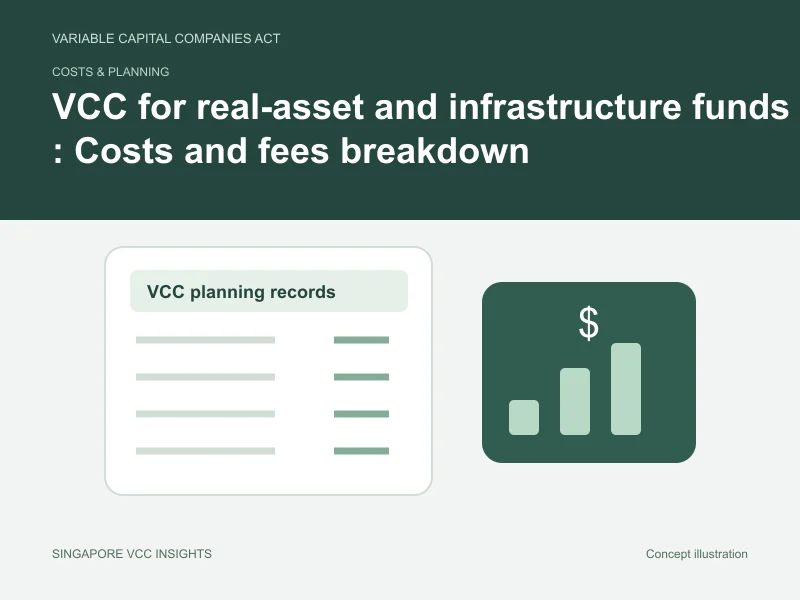
A vcc for real-asset and infrastructure funds applies Singapore’s Variable Capital Companies Act 2018 to long-duration strategies holding property, infrastructure and other physical assets. Set-up professional fees are typically S$10,000-S$25,000, with ACRA incorporation in about two to four weeks, and the umbrella structure suits multi-asset or multi-vintage programmes.
Raffles Corporate Services works with a panel of corporate and employment law firms; this article is general information, not legal advice.
Why a vcc for real-asset and infrastructure funds works
A VCC for real-asset and infrastructure funds is a fund vehicle under the Variable Capital Companies Act 2018 used to hold real estate, infrastructure, renewables and similar physical assets, usually through underlying holding entities. Section 17 of the Variable Capital Companies Act 2018 establishes the VCC as a body corporate separate from its members, and the Act’s sub-fund segregation lets a manager isolate each asset or programme within one umbrella. For long-duration, capital-intensive strategies, the VCC offers closed-ended flexibility, ring-fencing of asset-level risk, and a Singapore-domiciled structure recognised across the region.
Who uses this structure
Real-asset and infrastructure sponsors, developers and institutional allocators, as well as family offices with direct real-asset programmes. The VCC is generally paired with a fund tax incentive and a management company; this related guide covers the fund tax schemes and this related guide the incorporation landscape for the manager. Because these strategies hold illiquid, long-life assets, the governance and valuation framework matters more here than in a liquid fund.
Structuring long-duration and multi-asset programmes
Infrastructure and real-asset funds are usually closed-ended with long lives and staged capital calls, which the VCC accommodates through its flexible capital account. Under an umbrella VCC, each sub-fund can hold a distinct asset, geography or vintage, with segregation ensuring the liabilities of one project do not reach the assets of another. A VCC must be managed by a permissible fund manager and appoint a Singapore-based auditor, and for illiquid assets an independent valuation process is usually built into the structure from the start.
Vcc for real-asset and infrastructure funds costs and fees breakdown
- VCC incorporation (ACRA): S$8,000, plus S$400 per sub-fund.
- Set-up professional fees: S$10,000-S$25,000, reflecting the added complexity of real-asset holding structures.
- Annual running costs: S$20,000-S$50,000 for administration, valuation support, secretary, accounting and audit.
- Timeline: incorporation two to four weeks; asset-level and tax-incentive work extend the overall lead time.
Step-by-step process
1. Appoint a permissible fund manager. 2. Map the asset-holding structure, including any underlying special-purpose vehicles, and decide standalone or umbrella. 3. Appoint directors, secretary, administrator, custodian, valuer and auditor. 4. Incorporate the VCC and any sub-funds. 5. Apply for a fund tax incentive if it is used. 6. Draw capital and acquire assets, keeping each sub-fund’s records and accounts separate.
Common mistakes and gotchas
Real-asset sponsors sometimes overlook the interaction between the VCC and the underlying asset SPVs, or underestimate the valuation and audit demands of illiquid holdings. Segregation must be backed by separate records and accounts per sub-fund, and a long fund life means governance has to be durable, not just adequate at launch. For a costed comparison across fund types, see the companion article.
Official resources
FAQs
Can a VCC hold real estate and infrastructure?
Yes, typically through underlying holding entities. The VCC provides the fund layer with closed-ended flexibility and sub-fund segregation for multi-asset programmes.
What does a real-asset VCC cost to set up?
Professional fees are usually S$10,000-S$25,000, plus the S$8,000 ACRA incorporation fee and S$400 for each sub-fund.
Why use an umbrella VCC for infrastructure?
It lets a sponsor ring-fence each asset, geography or vintage as a segregated sub-fund under one legal entity, cutting the marginal cost of each new fund.
How long does set-up take?
The VCC incorporates in about two to four weeks, with asset-level structuring and any tax-incentive application adding to the overall timeline.
How are illiquid assets valued?
An independent valuation process is usually built into the structure, and the VCC's Singapore-based auditor reviews the financial statements each year.
Need help with this? Call, SMS or WhatsApp +65 8501 7133, or email hello@rafflescorporateservices.com. Raffles Corporate Services works with a panel of corporate and employment law firms; this article is general information, not legal advice.