Independent Singapore VCC guidance
Direct answer
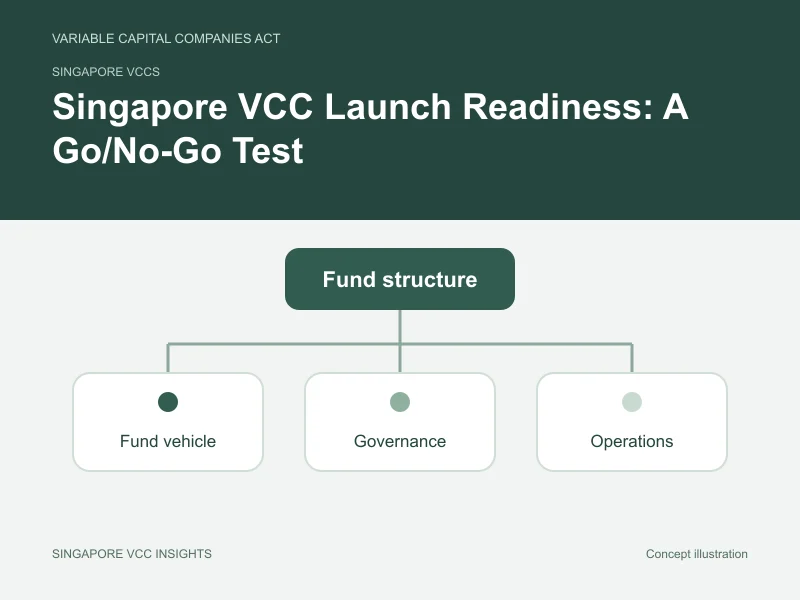
A Singapore VCC is ready to file only when the sponsor can show that the vehicle matches the investment strategy, the manager route is settled, the officers can perform their roles, the constitution and offering terms agree, and the operating model can support subscriptions, assets, valuation and reporting. Use a go/hold/redesign decision rather than a simple checklist: a missing filing detail can be fixed, while an unresolved manager, investor or operating-model issue should stop the launch.
At a glance
- Readiness is an evidence test, not a target-date exercise.
- The fund vehicle, manager, investor terms and operating model must describe the same fund.
- A standalone or umbrella choice should follow the strategy pipeline, not presentation preferences.
- Any red issue should have an owner, remedy and retest date before filing.
Who this is for
- Sponsors, managers and family-office executives deciding whether a proposed Singapore fund is ready to become a VCC.
Important exclusions
- A promise of registration, licensing, bank onboarding, investor commitment or any tax outcome.
Score readiness before choosing a filing date
A useful launch test separates structural blockers from ordinary drafting work. Mark each domain green only when evidence exists and the responsible person has accepted it. Amber means the decision is made but an execution item remains open. Red means the proposed VCC may be the wrong vehicle, may lack a workable manager or governance route, or may be unable to operate the promised investor terms. The board should not convert red to amber merely because a commercial launch date is approaching.
Sources: ACRA · ACRA · ACRA| Domain | Green evidence | Hold signal | Decision owner |
|---|---|---|---|
| Investment mandate | Defined assets, liquidity, valuation and dealing model | The strategy description changes between documents | Sponsor and investment lead |
| Investor design | Target investors, rights and information needs are documented | The offer route or investor eligibility is unresolved | Sponsor and counsel |
| Vehicle architecture | Standalone or umbrella choice is tied to an actual pipeline | Sub-funds are proposed without separate mandates or controls | Board and operations lead |
| Fund manager | Exact legal entity and current status are verified | Appointment depends on an unconfirmed permission or outdated category | Board and manager |
| Officers | Named people understand their authority, information and time commitments | Roles exist only on an organisation chart | Board chair |
| Documents | Constitution, offering terms and service agreements use one structure map | Names, powers, fees or dealing terms conflict | Counsel and company secretary |
| Operations | Administrator, banking, custody, AML, valuation and reporting flows are designed | A critical provider or data source is assumed but not engaged | Operations lead |
| First close | Subscription, approval, cash and unit or share records can be reconciled | No dry run has shown who releases each step | Manager and administrator |
Related guidance: Singapore VCC guide for sponsors
Test the mandate and investor proposition
Begin with the economic fund, not the company form. Write a one-page mandate covering permitted and excluded assets, expected liquidity, valuation frequency, concentration, borrowing, subscriptions, redemptions or drawdowns, distributions and reporting. Then write the target-investor statement without marketing language. The two documents should make the operating burden visible. A strategy with difficult-to-value assets and frequent dealing, for example, needs a valuation and liquidity design that can actually support those promises.
Sources: ACRA · ACRAMandate evidence pack
- A plain-language strategy statement that names what the fund will and will not hold.
- A dealing model showing subscriptions, redemptions, drawdowns or distributions as applicable.
- A valuation ownership map showing data sources, challenge rights and escalation for stale or disputed values.
- An investor profile that separates legal eligibility, commercial suitability and operational onboarding evidence.
- A conflict inventory covering sponsor interests, related parties, allocations, side arrangements and provider relationships.
- A first-close scenario using realistic documents, cash movements and approvals rather than an idealised process diagram.
Choose architecture and financial year deliberately
ACRA recognises non-umbrella and umbrella VCC types and asks the applicant to choose a financial year end. The readiness question is not which label sounds more scalable. It is whether the sponsor can operate the records, contracts, accounts and investor rights that the chosen architecture implies. An umbrella should have a credible pipeline of distinct strategies or investor pools and a sub-fund control model. A single genuine mandate may be clearer in a non-umbrella structure until expansion becomes real.
Sources: ACRA · ACRAArchitecture decision
- One durable mandatePrefer the simpler non-umbrella route when one strategy and investor pool are expected and no funded expansion plan exists.
- Several distinct mandatesTest an umbrella when separate strategies or investor pools have their own records, contracts, assets, liabilities and launch owners.
- Uncertain pipelineDo not create operational complexity for hypothetical sub-funds; document the conversion or future-platform question for later review.
- Year-end congestionChoose the financial year end with audit, administrator, investor reporting and tax workloads in view, not only the incorporation month.
Related guidance: standalone and umbrella VCC decision guide
Verify the manager and officer model
The application needs a fund-manager and officer structure that exists in substance. Confirm the exact manager entity in current MAS records, then align its mandate, delegated activities, access to information and escalation rights with the proposed fund. Directors should receive enough reporting to challenge decisions and oversee service providers. The company secretary needs a complete corporate-action map, while the auditor and administrator need records that can be reconciled rather than reconstructed after year end.
Sources: ACRA · MAS| Role | Evidence before filing | Red flag |
|---|---|---|
| Board | Reserved matters, meeting cadence, reporting pack and conflict process | A nominee role without defined information or challenge rights |
| Fund manager | Verified legal identity, status, scope, contract and operating responsibilities | Reliance on an old label, proposal or group-company credential |
| Company secretary | Filing calendar, register ownership, resolution workflow and secure record access | Secretarial work begins only after a transaction has occurred |
| Administrator | Data inputs, valuation calendar, investor record, reconciliation and exception process | Core data ownership remains undefined between provider and manager |
| Auditor | Engagement scope, accounting framework, evidence expectations and timetable | The launch assumes records can be remediated at the first audit |
Related guidance: VCC directors, manager and officer guide
Reconcile the filing and first-close document sets
ACRA's registration guide identifies the corporate information needed for incorporation, including the approved name, VCC details, office, officers, manager information, subscribers and constitution. That filing set should be one layer of a broader launch record. The constitution, offering document, subscription package, management agreement, administration and custody arrangements, banking mandates, valuation policy and compliance procedures should use the same legal names, architecture, decision powers and dealing model. A document is not final merely because it has been signed if related documents still contradict it.
Sources: ACRA · ACRARun a pre-filing consistency review
- Freeze the structure mapApprove one diagram naming the VCC, any sub-funds, manager, officers, service providers, accounts and contracting relationships.
- Build the term matrixCompare mandate, valuation, dealing, fees, expenses, conflicts, powers and notices across every document that describes them.
- Resolve exceptionsAssign every mismatch to a named drafter and record the approved wording or operating change before signature.
- Dry-run first closeWalk one hypothetical investor from onboarding through approval, cash receipt, record creation and confirmation using the proposed controls.
- Release the filingPermit submission only after the board receives the exception log, material decisions and evidence that critical providers are ready.
Related guidance: VCC name and constitution checklist
Make the go, hold or redesign decision
The final memorandum should be short enough to decide. List each readiness domain, its colour, the evidence reviewed, the unresolved item, the owner and the retest date. A go decision means no structural red items remain and all amber items have bounded execution plans that do not undermine investor terms or regulatory eligibility. Hold means the proposed design still works but a critical dependency is incomplete. Redesign means the vehicle, manager, governance or operating model does not support the fund that has been promised.
Sources: ACRA · ACRA · ACRA| Decision | When to use it | Required record |
|---|---|---|
| Go | The chosen structure is eligible and operationally coherent, with controlled execution items only | Approved readiness memo, exception log and filing authority |
| Hold | A critical provider, approval, document or evidence item is incomplete but the design remains sound | Named blocker, owner, remedy, retest date and revised launch assumption |
| Redesign | The manager, vehicle, investor terms or operating model cannot support the proposed fund | Decision paper comparing viable alternatives and the implications of each |
| Stop | The purpose, investor proposition or governance cannot be made credible within the sponsor's constraints | Closure record preserving the analysis and any reusable work product |
Related guidance: VCC setup cost planning tool
Frequently asked questions
Can a VCC be incorporated before every service provider is appointed?
A filing sequence and an operational readiness decision are not the same thing. Even where an appointment can occur later in the legal sequence, the sponsor should know who will perform the work, what information they need and whether the first-close model depends on them before authorising launch.
Is an umbrella VCC automatically more future-proof?
No. An umbrella is useful when there is a credible platform plan and the sponsor can maintain genuine separation of strategy records, contracts, assets, liabilities and investor rights. Hypothetical scalability is not enough if the team cannot operate the additional control layer reliably.
What is the most serious launch-readiness blocker?
A manager or operating model that does not support the promised fund is more serious than an incomplete administrative form. The former changes whether the structure is viable; the latter can usually be assigned, corrected and retested without changing the fund's core proposition.
Who should sign off the readiness assessment?
The sponsor should nominate an accountable owner, but the board should receive and decide the final memorandum. Manager, legal, tax, operations and service-provider inputs can be attached as evidence without implying that any one contributor has approved matters outside its actual scope.
Does a green score ensure a successful launch?
No. It shows that the sponsor made a structured decision using the evidence available on the review date. Registration, regulated permissions, banking, provider onboarding and investor subscriptions remain subject to their own processes and should never be presented as certain outcomes.
Official sources and further reading
- Understanding VCC features, eligibility and requirements (ACRA)
- Choosing a VCC type and financial year end (ACRA)
- Choosing directors and key officers for a VCC (ACRA)
- Registering a variable capital company (ACRA)
- Post-registration guide for variable capital companies (ACRA)
- Financial Institutions Directory (MAS)
Discuss a Singapore VCC structure
For help coordinating a Singapore VCC setup or corporate administration, contact Raffles Corporate Services.
General information only. This article is not legal, tax, regulatory or investment advice and does not imply affiliation with or endorsement by ACRA, MAS or IRAS.