Independent Singapore VCC guidance
Direct answer
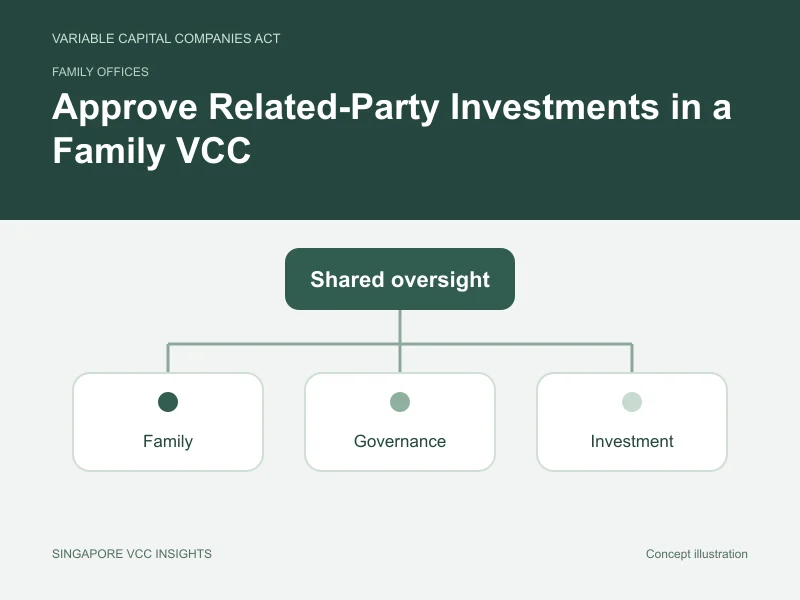
A family VCC should treat a related-party investment as a conflicted transaction, not as an ordinary expression of the principal’s preference. Identify every relationship and economic interest, test whether the proposal fits the fund mandate, obtain evidence independent of the interested party, separate recommendation from approval and execution, and record recusals. If decision-makers cannot obtain a credible arm’s-length basis, the proposal should stop or be redesigned.
At a glance
- Map relationships and indirect benefits before debating the merits of the investment.
- Use independent evidence for valuation, terms, risks and mandate fit.
- Keep family preference, investment advice, board approval and manager execution distinct.
- Record who received papers, declared interests, left the discussion, voted and followed up.
Who this is for
- Family principals, family-office executives, VCC directors and managers reviewing an investment involving a family-connected party.
Important exclusions
- A tax, transfer-pricing or fiduciary opinion, or a conclusion that any particular related-party investment is permissible.
Define the conflict before the opportunity
Start with a relationship map covering the target company, sellers, advisers, lenders, co-investors, family members, trusts, holding entities and anyone receiving a fee or other benefit. Ask each participant to declare direct and indirect interests before papers are circulated. The purpose is not to assume wrongdoing; it is to prevent an interested person from defining the facts, evidence and approval route. Use the VCC documents and governance framework to identify who receives the declaration and which people must step away from recommendation or decision-making.
Sources: Monetary Authority of Singapore · ACRAConflict intake record
- Identity and role of every family-connected person or entity in the proposal.
- Direct and indirect ownership, fees, guarantees, employment and other economic benefits.
- Prior involvement in sourcing, negotiating, valuing or recommending the transaction.
- Mandate, concentration, liquidity and valuation questions raised by the investment.
- Proposed recusals, independent reviewers and accountable decision body.
Related guidance: VCC guide for family offices
Test mandate fit without family influence
The fund manager should assess the opportunity against the same mandate, risk and portfolio criteria applied to an unrelated transaction. Prepare a short deviation analysis showing where the proposal fits and where it depends on exceptions. The family principal may explain strategic context, but that explanation should not replace investment evidence. If the mandate, offering terms or concentration controls do not support the transaction, the governance process cannot cure the mismatch merely by obtaining a favourable vote.
Sources: Monetary Authority of Singapore · Singapore Statutes Online| Issue | Evidence independent of the interested party | Stop signal |
|---|---|---|
| Valuation | Comparable transactions, external valuation or supported model | Price relies only on the seller’s forecast |
| Commercial terms | Market term comparison and negotiated alternatives | VCC accepts terms no outside investor would accept |
| Mandate fit | Documented strategy and portfolio analysis | Proposal needs an undocumented exception |
| Liquidity and exit | Cash-flow case, rights and realistic exit paths | Repayment depends mainly on family support |
| Conflicts | Complete relationship and benefit map | A material interest remains undisclosed or unclear |
Related guidance: VCC director and fund-manager roles
Separate recommendation, approval and execution
Label each meeting and paper by legal capacity. The family investment committee may advise within its mandate; the VCC board considers the VCC’s interests and reserved decisions; the appointed manager performs its fund-management role. Dual-hatted people should declare which capacity they are acting in and recuse where the conflict policy requires. A single combined meeting can still preserve separation if the agenda, attendance, chairing, papers and minutes show the transition between capacities and the interested person does not control every stage.
Sources: Monetary Authority of Singapore · ACRAConflicted-deal decision chain
- DeclareCollect relationship and economic-interest declarations before recommendation papers or negotiations are finalised.
- ChallengeHave unconflicted reviewers test valuation, terms, mandate fit, downside, alternatives and portfolio consequences.
- RecommendRecord the advisory view, dissent and assumptions without presenting it as corporate approval.
- Approve or rejectUse the documented VCC decision route with recusals, quorum and conditions clearly recorded.
- Execute and monitorLet the manager implement only the approved terms and report deviations or new conflicts promptly.
Related guidance: family VCC board versus investment committee
Work through an illustrative proposal
Assume a family-controlled operating company asks the VCC to subscribe for a private credit instrument. The family principal chairs the investment committee, a sibling sits on the VCC board, and the manager has also been asked to help negotiate terms. The conflict map shows benefits to the operating company and reputational pressure on several decision-makers. The unconflicted reviewers commission a credit assessment, compare pricing and covenants with external opportunities, and test the VCC mandate and liquidity plan before any recommendation is made.
Sources: Monetary Authority of Singapore · ACRA| Stage | Action | Evidence produced |
|---|---|---|
| Intake | Principal and sibling declare interests; manager records negotiation role | Signed conflict map |
| Independent review | External credit and term comparison prepared | Valuation and downside memorandum |
| Recommendation | Unconflicted committee members state conditions and dissent | Advisory minute and condition list |
| Board decision | Interested director leaves the relevant discussion and vote | Board minute and approval limits |
| Execution | Manager confirms final instrument matches approved terms | Closing checklist and deviation confirmation |
| Monitoring | Credit, covenant and conflict indicators enter recurring reporting | Portfolio report and action log |
Preserve a reviewable decision file
The file should let a later reviewer understand the relationship, mandate analysis, independent evidence, alternatives, recusals, decision and post-close monitoring without relying on family memory. Keep drafts only where they explain material changes or challenge. Record conditions as measurable actions with owners and evidence, and do not close them merely because the transaction completed. Any new family benefit, refinancing request, covenant waiver or valuation uncertainty should reopen the conflict assessment rather than being treated as ordinary portfolio administration.
Sources: Monetary Authority of Singapore · ACRARelated guidance: VCC board evidence-pack framework
Frequently asked questions
Is every investment in a family-owned business prohibited?
Not necessarily, but it should not bypass the VCC mandate, conflict controls or independent challenge. The facts, documents and applicable duties determine whether the proposal can proceed and on what conditions.
Can the family principal present the opportunity?
Yes, if the governance process permits it, but the principal’s presentation should be identified as interested input. Independent reviewers should test valuation, terms, risk, alternatives and mandate fit without relying solely on that presentation.
Must every interested person leave the whole meeting?
Use the conflict policy and governing documents. A person may provide factual context, then leave the relevant deliberation and decision. Minutes should distinguish participation, departure, return and any continuing restrictions.
What if no independent valuation is available?
Do not treat absence of evidence as evidence of fairness. Consider alternative benchmarks, a different structure, a smaller exposure, additional protections or stopping the proposal until a credible basis can be obtained.
Does board approval end the conflict review?
No. Monitor new benefits, waivers, refinancing, valuation changes and deviations from approved terms. A material change should reopen the assessment and follow the documented decision route again.
Official sources and further reading
- Governance and Management of Variable Capital Companies (Monetary Authority of Singapore)
- Legal obligations of a VCC director (ACRA)
- Choosing directors and key officers for a VCC (ACRA)
- Variable Capital Companies Act 2018 (Singapore Statutes Online)
Discuss a Singapore VCC structure
For help coordinating a Singapore VCC setup or corporate administration, contact Raffles Corporate Services.
General information only. This article is not legal, tax, regulatory or investment advice and does not imply affiliation with or endorsement by ACRA, MAS or IRAS.