Independent Singapore VCC guidance
Direct answer
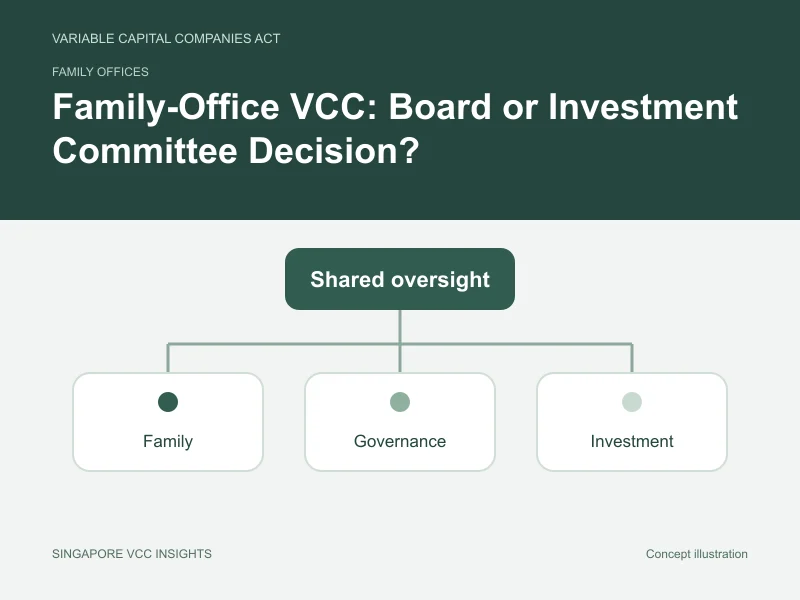
The VCC board, family investment committee and fund manager should not be treated as interchangeable names for the same meeting. The board governs the VCC and approves matters reserved by law and the fund’s documents. The investment committee applies the family’s agreed decision process and may recommend allocations within its mandate. The appointed fund manager performs and remains accountable for the fund-management role. One person may wear more than one hat, but every paper and minute should identify which hat is acting.
At a glance
- Assign decisions by legal capacity and mandate, not family seniority.
- Keep recommendations distinct from board approvals and manager execution.
- Use written conflict and recusal rules for dual-hatted participants.
- Record the decision chain from family objective to portfolio implementation.
Who this is for
- Family principals, family-office executives and VCC directors designing a practical investment decision workflow.
Important exclusions
- Tax-incentive eligibility, family succession advice, a substitute for the manager’s licence conditions or a specific constitution.
Separate the three decision capacities
Start with capacities, not job titles. The VCC is a corporate fund vehicle with directors and an appointed permissible fund manager. A family investment committee is a governance arrangement created by the family or its office; its authority comes from its charter and the documents that recognise or constrain it. MAS governance expectations focus on genuine oversight and clear accountability, while ACRA identifies the VCC’s required officers and manager. The operating model should therefore show where advice ends, corporate approval begins and regulated management occurs.
Sources: Monetary Authority of Singapore · ACRA · Singapore Statutes Online| Body | Primary lens | Typical output |
|---|---|---|
| VCC board | Corporate governance, governing documents, conflicts and oversight | Resolution, challenge, condition, delegation or escalation |
| Investment committee | Family objectives, allocation framework, risk appetite and recommendation quality | Recommendation, allocation view, watch item or escalation |
| Fund manager | Portfolio management within its mandate and regulatory responsibilities | Investment decision, execution instruction, monitoring and manager record |
| Family council or principal | Purpose, liquidity needs, family policy and reserved family matters | Mandate input, family policy or instruction through the recognised route |
Related guidance: VCC for family offices guide
Create a decision-rights map
Build the map from the constitution, offering documents, investment-management agreement, committee charter, delegation schedule and conflict policy. For each decision, identify who proposes, who supplies analysis, who approves, who executes and who monitors. The same answer will not fit every family-office VCC. The point is to remove ambiguity before a live opportunity, liquidity event or related-party proposal puts time pressure on the structure.
Sources: Monetary Authority of Singapore · Singapore Statutes Online| Decision | Lead analysis | Approval route | Execution and evidence |
|---|---|---|---|
| Strategic asset allocation | Investment committee and manager | Route set by the mandate and reserved-matter schedule | Manager implements permitted portfolio changes and records them |
| New sub-fund or material mandate change | Sponsor, manager and providers | VCC board and any other approvals required by the documents | Corporate, offering and operational workstreams launch together |
| Individual security purchase | Manager under the investment process | Manager unless a valid mandate requires escalation | Trade, allocation, compliance and valuation records |
| Related-party investment | Independent analysis and conflict review | Conflict-aware route with recusals and any required board action | Conditions, monitoring and full decision trail |
| Family liquidity request | Family office and manager | Route depends on dealing terms and governing documents | Investor instruction, liquidity analysis and correct fund processing |
| Provider appointment or replacement | Operations, manager and due diligence owners | VCC board where the documents or appointment require it | Contract, access, filing and transition evidence |
Related guidance: VCC director and fund-manager roles
Control dual hats and conflicts
Dual-hat controls
- The agenda labels whether the person is acting as director, committee member, manager representative or family principal.
- Conflicts are declared before papers are circulated and updated when circumstances change.
- Recusal rules address access to papers, participation in discussion, voting and receipt of minutes.
- Independent information is obtained when the conflicted person controls the primary analysis or relationship.
- Delegations identify limits, escalation triggers, duration and who reviews use of the authority.
- Minutes use the vocabulary of the acting body and do not convert a recommendation into a retroactive approval.
Related guidance: MAS VCC governance expectations guide
Preserve the complete decision trail
The evidence file should connect the family objective, committee recommendation, board action, manager decision, execution, accounting treatment and monitoring result. Store source analysis separately from minutes so later reviewers can see what information was available at each point. For umbrella VCCs, identify the exact sub-fund in every approval, contract and report. If the structure changes an officer, manager or auditor, ACRA’s current guidance says the recorded change must be reported within fourteen days.
Sources: Monetary Authority of Singapore · ACRA · ACRADecision-file index
- Mandate provision, family policy or reserved matter that initiated the decision.
- Conflict declarations, recusals and evidence of independent review where needed.
- Investment analysis, alternatives, valuation evidence, risk assessment and recommendation.
- Committee record, board resolution and manager decision kept as distinct artifacts.
- Execution confirmation, correct sub-fund attribution and accounting or register evidence.
- Monitoring owner, review trigger, reporting cadence and documented closure or exit.
Related guidance: VCC sub-fund guide · Singapore VCC guide
Frequently asked questions
Can the family principal chair both the VCC board and investment committee?
It may be possible depending on eligibility, appointments and the governing documents, but it increases the need for capacity labels, conflict rules and independent challenge. Holding two titles does not merge the duties or approval routes of the two bodies.
Does the investment committee replace the fund manager?
No. A committee can advise or exercise authority given by valid documents, but calling it an investment committee does not remove the appointed manager’s role or regulatory responsibilities. Map recommendations, approvals and execution precisely and obtain advice for the intended model.
Should every family investment require VCC board approval?
Not necessarily. Individual investments may fall within the manager’s delegated mandate, while material conflicts, mandate changes or reserved matters may follow another route. The decision-rights map should be derived from the actual documents instead of imposing board approval on every trade.
How should recusals be documented?
Record the conflict, when it was declared, which papers the person received, whether the person left the discussion, whether the person voted and how quorum was maintained. The remaining decision-makers should still receive sufficient independent information to reach a reasoned conclusion.
What if the family wants to act faster than the governance process?
Design proportionate emergency and delegated authorities in advance, with clear limits and prompt reporting. Do not invent authority during a transaction. If the requested action falls outside the mandate or approval route, pause and obtain the necessary advice and decision.
Official sources and further reading
- Governance and Management of Variable Capital Companies (Monetary Authority of Singapore)
- Choosing directors and key officers for a VCC (ACRA)
- Updating VCC information and officers (ACRA)
- Understanding VCC features and eligibility requirements (ACRA)
- Variable Capital Companies Act 2018 (Singapore Statutes Online)
Discuss a Singapore VCC structure
For help coordinating a Singapore VCC setup or corporate administration, contact Raffles Corporate Services.
General information only. This article is not legal, tax, regulatory or investment advice and does not imply affiliation with or endorsement by ACRA, MAS or IRAS.