Independent Singapore VCC guidance
Direct answer
For each foreign receipt, identify the income type, the sub-fund that earned it, when and how it was received in Singapore, and the evidence for every exemption condition. IRAS updated its VCC tax framework in April 2026 to state that qualifying foreign-income exemptions may apply to VCC sub-funds when the relevant conditions are met. The update does not make foreign income automatically exempt. Record uncertain items separately and obtain a tax conclusion before the return is prepared.
At a glance
- Test the receipt, not merely the umbrella or bank account label.
- Attribute income and supporting evidence to the sub-fund that earned it.
- Separate factual evidence from the tax conclusion and filing treatment.
- Escalate mixed cash, uncertain source and incomplete foreign-tax evidence early.
Who this is for
- Umbrella and standalone VCC teams reviewing foreign dividends, branch profits or service income received in Singapore
Important exclusions
- A conclusion on foreign law, treaty entitlement or an automatic exemption for every overseas receipt
Understand the April 2026 clarification
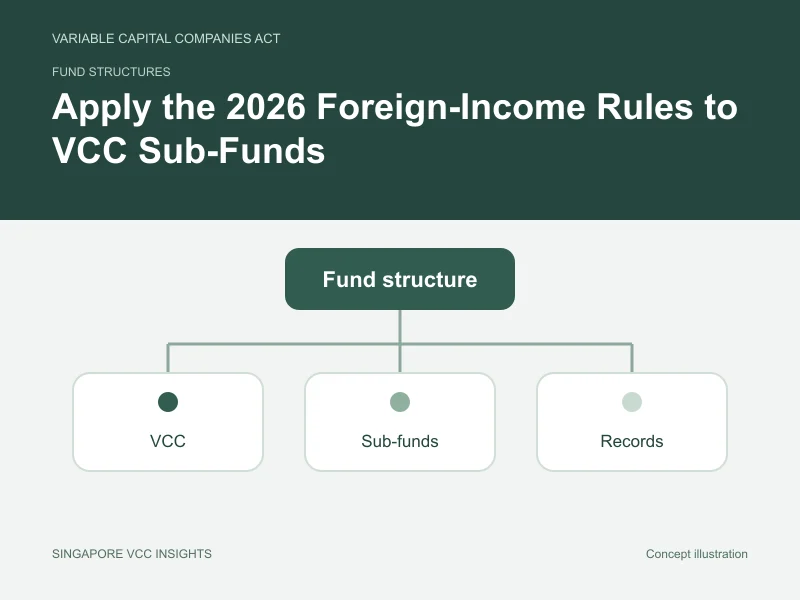
IRAS amended its Tax Framework for Variable Capital Companies on 22 April 2026. The amendment added guidance that qualifying foreign-sourced income exemptions may be applied to income derived by VCC sub-funds, subject to the conditions of the relevant exemption. The practical change for an umbrella team is clarity about where to run the analysis: at the sub-fund that earned the income, while keeping the umbrella return and supporting records internally consistent. The update is a clarification of possible treatment, not a blanket result for all foreign receipts.
Sources: Inland Revenue Authority of Singapore · Inland Revenue Authority of SingaporeRelated guidance: VCC tax incentives hub
Open one record for each receipt
| Field | Question to answer | Evidence owner |
|---|---|---|
| Income identity | What was paid and under which instrument or activity? | Fund accountant and tax adviser |
| Sub-fund attribution | Which sub-fund owned the asset or performed the service? | Administrator and legal records owner |
| Receipt event | When and how was the amount received in Singapore? | Treasury or custodian operations |
| Foreign-tax evidence | What tax was imposed or what exemption applied overseas? | Tax adviser and source-country contact |
| Singapore conclusion | Which rule applies and how will the item enter the return? | Singapore tax adviser |
Give the record a unique identifier that follows the transaction from source document to ledger and tax workpaper. An umbrella name alone is insufficient because IRAS applies income and foreign-tax-credit computations at sub-fund level. Reconcile the record to the custody statement, cash ledger and income schedule. If the remittance contains several dividends, fees or proceeds, split the analysis into traceable components rather than accepting a single narrative for a mixed amount.
Sources: Inland Revenue Authority of Singapore · Inland Revenue Authority of SingaporeRun the conditions as separate tests
- Classify the incomeDetermine whether the receipt is a foreign dividend, foreign branch profit, foreign service income or another category before selecting any exemption route.
- Establish foreign tax factsCollect the assessment, withholding record, payer documents and reliable rate information needed to evaluate the applicable conditions.
- Test beneficial treatmentDocument why applying the exemption is beneficial for this receipt, including the effect on available credits or deductions.
- Confirm sub-fund ownershipTrace the asset, contract, income accrual and cash allocation to the same sub-fund and investigate any mismatch.
- Approve the filing positionHave the appropriate tax owner record the conclusion, assumptions, unresolved points and return mapping before sign-off.
Do not merge the tests into a checkbox marked “foreign income”. IRAS describes multiple conditions for specified foreign income and provides a separate avenue for exemption where the standard route is unavailable, subject to its own requirements. A complete file shows which route was considered and why. When the evidence is incomplete, use a pending status and keep the receipt out of any exempt total until the designated tax decision maker approves the treatment.
Sources: Inland Revenue Authority of Singapore · Inland Revenue Authority of SingaporeRelated guidance: VCC investment-income classification guide
Control umbrella and sub-fund attribution
- Match the income-producing asset or contract to the correct sub-fund books and mandate.
- Confirm the payer, custody account and remittance reference against the original transaction record.
- Record any umbrella-paid expense or centrally received cash allocation with a documented basis.
- Compute income and any foreign tax credit at sub-fund level before consolidation.
- Reconcile sub-fund conclusions to the umbrella tax return workpapers and audited accounts.
The control objective is continuity of identity. The same sub-fund should appear across ownership records, administrator books, cash evidence, foreign-tax documents and the Singapore conclusion. A suspense allocation can be useful while facts are being gathered, but it should have an owner and resolution date. Do not post a receipt permanently to whichever sub-fund has available cash or the simplest tax profile. That would replace evidence with convenience and can also distort investor reporting.
Sources: Inland Revenue Authority of Singapore · Accounting and Corporate Regulatory AuthorityRelated guidance: VCC tax-residence decision record
Close exceptions before filing
| Exception | Immediate response | Closeout evidence |
|---|---|---|
| Mixed capital and income remittance | Trace components before classification | Bank trail and reconciled allocation schedule |
| Foreign-tax document names another entity | Verify beneficial ownership and payment chain | Legal and tax conclusion with source documents |
| Source country or income type uncertain | Hold the item outside the exempt pool | Specialist advice and approved classification |
| Receipt belongs to a different sub-fund | Correct books and downstream reports consistently | Adjustment record and reconciliation |
| Conditions cannot be evidenced | Prepare the conservative filing alternative | Decision memo and return mapping |
A useful exception log records the amount, sub-fund, reporting period, issue, owner, next action and final resolution. It should be visible to the fund accountant, administrator and tax preparer. Closing the accounting entry without closing the tax question is not enough. Conversely, a tax memo that does not reach the ledger and return creates a second failure. Require both the factual record and the accounting or filing treatment to be reconciled before the item is marked complete.
Sources: Inland Revenue Authority of Singapore · Inland Revenue Authority of SingaporeHand the result into the annual file
- Receipt register tied to source documents, custody records and the general ledger.
- Sub-fund attribution schedule and any umbrella allocation support.
- Foreign-tax evidence and source-country analysis retained with the item.
- Approved Singapore treatment and return-workpaper reference.
- Open exception report signed off or carried forward transparently.
At year end, aggregate only records with consistent classifications and completed approvals. Compare the schedule with the financial statements, foreign-tax-credit computation and the umbrella return. Preserve the evidence in readable form for the record-retention period that applies to company records. The strongest annual file is not a new narrative written after year end; it is a controlled index of receipt-level conclusions that were made while documents and transaction context were still available.
Sources: Inland Revenue Authority of Singapore · Inland Revenue Authority of SingaporeRelated guidance: VCC tax treatment overview
Frequently asked questions
Did the April 2026 update make all foreign income of a VCC exempt?
No. IRAS clarified that qualifying foreign-income exemptions may apply to income derived by sub-funds, subject to the relevant conditions. Each receipt still needs classification, evidence and an approved filing conclusion.
Should the analysis be done at umbrella or sub-fund level?
Build the receipt analysis at the sub-fund that earned the income, then reconcile the result into the umbrella records and return. IRAS explains that income and foreign tax credits are computed at sub-fund level.
Is a foreign withholding-tax certificate enough evidence?
It is useful but not complete by itself. The file should also identify the income type, beneficial recipient, source, receipt event, sub-fund ownership and the Singapore rule relied upon.
What should happen when a remittance mixes income and capital?
Place it in a controlled pending status, trace the components to source records and approve the split before claiming any exemption. A bank description alone should not determine tax character.
Can last year’s conclusion simply be reused?
Use it as background, not as the answer. The payer, income type, foreign tax, ownership, receipt route or applicable rule may have changed, so the current receipt still needs evidence.
Official sources and further reading
- Latest Updates: Tax Framework for Variable Capital Companies (Inland Revenue Authority of Singapore)
- Tax Framework for Variable Capital Companies (Inland Revenue Authority of Singapore)
- Companies Receiving Foreign Income (Inland Revenue Authority of Singapore)
- Record Keeping Requirements (Inland Revenue Authority of Singapore)
- Understanding VCC Features, Eligibility and Requirements (Accounting and Corporate Regulatory Authority)
Discuss a Singapore VCC structure
For help coordinating a Singapore VCC setup or corporate administration, contact Raffles Corporate Services.
General information only. This article is not legal, tax, regulatory or investment advice and does not imply affiliation with or endorsement by ACRA, MAS or IRAS.