Independent Singapore VCC guidance
Direct answer
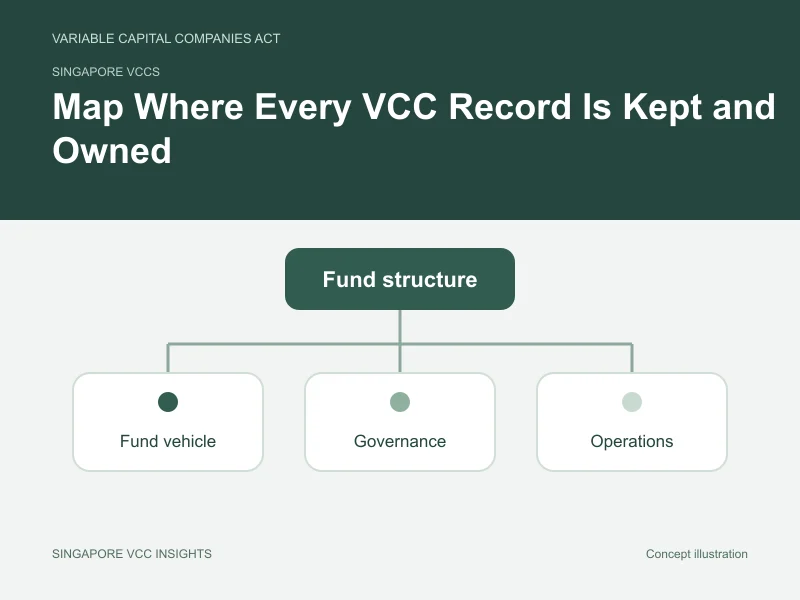
Create one controlled index for every corporate, investor, accounting, tax, manager and sub-fund record. For each item, name the authoritative copy, physical or digital location, VCC or sub-fund scope, record owner, system administrator, authorised users, update trigger, retention basis, backup and production method. Test the map by asking an independent person to retrieve a complete record set without relying on the usual operator’s memory or private inbox.
At a glance
- Distinguish the authoritative record from convenience copies and email attachments.
- Map ownership, system administration, access and production as separate responsibilities.
- Use sub-fund identifiers so umbrella records can be retrieved without mixing compartments.
- Test retrieval after personnel, provider, office or system changes.
Who this is for
- New and operating VCCs that need reliable access to corporate, investor, accounting and sub-fund evidence across providers.
Important exclusions
- A universal retention schedule; record-specific legal, tax, privacy and contractual advice may still be needed.
Define the record universe
Start with records that establish the VCC and its current filed facts, then extend the map to governance, members, controllers, officers, manager, accounting, tax, investors and each sub-fund. ACRA’s post-registration guidance identifies core registers and officer records, while its management pages explain that VCC information must remain current. The location map should connect those statutory and filed records to the operating evidence maintained by the manager and providers.
Sources: ACRA · ACRA · ACRA · Singapore Statutes Online| Record family | Examples | Scope field |
|---|---|---|
| Constitution and registration | Constitution, incorporation notice, business profile and filed changes | Umbrella or standalone VCC |
| Governance | Board papers, resolutions, declarations and action logs | VCC plus affected sub-fund |
| Registers and officers | Members, controllers, directors, secretary, manager and auditor records | VCC with sub-fund attribution where relevant |
| Fund operations | Subscriptions, redemptions, valuations, holdings, cash and provider reports | Named sub-fund and share class |
| Finance and tax | Ledgers, statements, audit support, filings and workpapers | VCC and applicable sub-fund view |
| Agreements and counterparties | Manager, administrator, custody, bank and investment documents | Contracting VCC acting for identified purpose |
Related guidance: VCC compliance checklist · keep the VCC register of members decision-ready
Give every entry operational fields
- Record the formal title, record family and stable identifier.
- State whether the authoritative copy is physical, digital or both.
- Identify the VCC, sub-fund, share class, investor or transaction scope.
- Name the business owner, updater, reviewer and system administrator separately.
- Describe the approved repository path or system without exposing credentials.
- Record access groups, update triggers, backup method and production format.
- Link superseded versions to the current record instead of leaving parallel candidates.
Avoid entries such as ‘with administrator’ or ‘in shared drive’. They do not identify which system, legal entity, version or person can produce the record. Use a repository name, structured folder or system object, document owner and access route. Keep secret credentials outside the map; the map should point to the approved access mechanism and recovery owner rather than storing passwords.
Sources: ACRA · Singapore Statutes OnlineSeparate ownership from possession
| Role | Core question | Failure to prevent |
|---|---|---|
| Record owner | Who is accountable for completeness and currency? | Everyone assumes a provider owns the final answer |
| Updater | Who changes the record after an event? | Filed facts and internal records diverge |
| Reviewer | Who confirms the update is correct? | The originator clears their own error |
| System administrator | Who grants and removes access? | Departed users retain control or retrieval fails |
| Custodian or host | Where is the data physically or digitally held? | Possession is mistaken for governance responsibility |
| Production owner | Who assembles an official response or audit pack? | Records exist but cannot be delivered coherently |
Related guidance: split secretary and administrator work clearly
Build sub-fund retrieval into the index
Umbrella records often sit in shared systems, but retrieval should preserve sub-fund identity. Use consistent sub-fund codes in account names, ledger dimensions, document titles and provider reports. Map shared documents once and record their scope; map transaction and balance records to the relevant compartment. Where a report combines sub-funds, record the filter or reconciliation that produces a complete sub-fund view and the reviewer who confirms it.
Sources: ACRA · ACRA · Singapore Statutes Online- Use the same stable sub-fund code across repositories and provider systems.
- Mark documents that apply to the umbrella and all compartments.
- Identify combined reports and the approved method for extracting one sub-fund.
- Reconcile sub-fund record totals to umbrella-level outputs where both views exist.
- Prevent closed or renamed sub-fund folders from being reused for a new purpose.
Run a production test
- SelectChoose records from different owners, systems and sub-funds, including one recently updated item and one older retained item.
- RequestGive the production owner a clear scope and ask them to work from the map without informal help from the usual operator.
- RetrieveConfirm access works, the authoritative version is identifiable and the record can be exported in a usable form.
- ReconcileCompare the produced record with filed information, provider reports and related governance evidence for unexplained differences.
- RemediateAssign gaps in ownership, naming, access, backup, version control or production and repeat the failed part of the test.
Use realistic events: an auditor request, director question, provider outage, officer change or closed sub-fund review. Measure whether the right record can be located, understood and reconciled, not merely whether a file opens. A successful test should also show that unauthorised users cannot retrieve sensitive material and that the recovery path does not depend on one person’s device.
Sources: ACRA · ACRA · Singapore Statutes OnlineKeep the map current through change
- Before changeInventory affected records, users, integrations, backups, pending updates and contractual handover obligations before moving an office, system or provider.
- At cutoverFreeze or control updates, confirm the destination, transfer authorised access and preserve an immutable handover record.
- After cutoverReconcile record counts and key balances, revoke obsolete access and test production from the new location.
- At closureRetain required records, mark the authoritative archive, document destruction decisions and keep the retrieval owner current.
Related guidance: run the first 100 days after incorporation
Frequently asked questions
Is the records map itself a statutory register?
No. It is an operational index that helps the VCC identify and produce authoritative records. It does not replace any register, filing, accounting record, agreement or evidence item that the VCC must maintain under its applicable requirements.
Should repository paths appear in board papers?
Usually the detailed technical path can remain in the controlled map. Board reporting can focus on ownership, exceptions, production tests and remediation. Avoid putting credentials or unnecessary personal information into either the map or the board pack.
What if the administrator holds most operational records?
Record the administrator’s system and responsibilities, but keep the VCC’s accountable owner, access route, export format, backup and exit method visible. Provider possession does not remove the need to understand completeness, currency and retrievability.
How often should retrieval be tested?
Use a risk-based cycle and add event-driven tests after material personnel, provider, repository, office or system changes. Include older records and closed items, because recent files in active workflows are often easier to retrieve than retained evidence.
How should duplicate copies be treated?
Label convenience copies and state which version prevails. Where duplicates are necessary for continuity, control their update or archival process. A production test should reveal whether different copies produce conflicting answers and assign a resolution owner.
Official sources and further reading
- Post-registration guide for variable capital companies (ACRA)
- Overview of managing a variable capital company (ACRA)
- Updating VCC information and officers (ACRA)
- Buying and checking VCC information (ACRA)
- Legal obligations of a VCC director (ACRA)
- Understanding VCC features, eligibility and requirements (ACRA)
- Variable Capital Companies Act 2018 (Singapore Statutes Online)
Discuss a Singapore VCC structure
For help coordinating a Singapore VCC setup or corporate administration, contact Raffles Corporate Services.
General information only. This article is not legal, tax, regulatory or investment advice and does not imply affiliation with or endorsement by ACRA, MAS or IRAS.