Independent Singapore VCC guidance
Direct answer
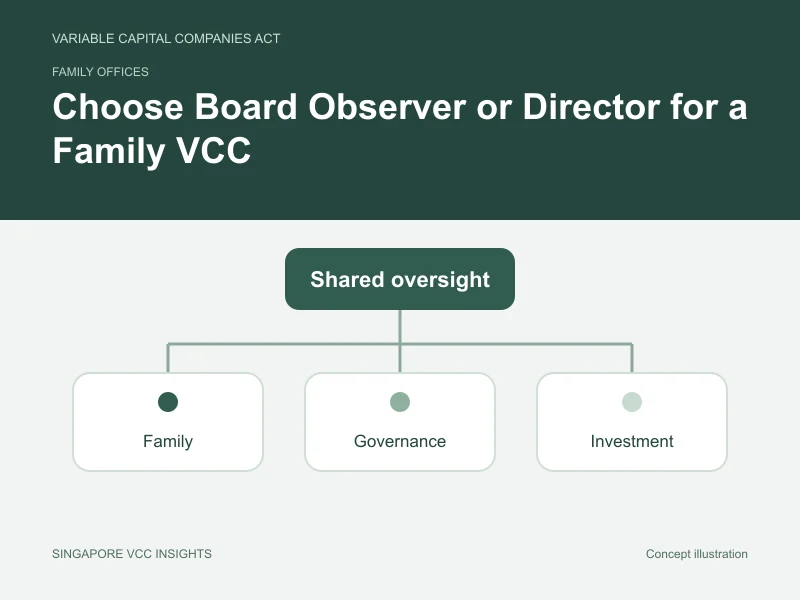
Use an observer role when the goal is learning, exposure and structured participation without director authority. Appoint a family member as a VCC director only when the board needs that person’s judgement and the candidate is ready to carry the role’s legal duties, information burden, conflicts and time commitment. Write observer rights instead of assuming them, restrict access where conflicts or investor confidentiality require it, and set a review point. Observation should be a real development role, not shadow control of the board.
At a glance
- Choose the role from the decision need, not family seniority.
- Document observer access, conduct, confidentiality and recusal expectations.
- Treat a director appointment as a duty-bearing role, not a training title.
- Use observed meetings and written exercises to test readiness before appointment.
Who this is for
- Family VCCs planning next-generation governance participation or a future board appointment
Important exclusions
- A nomination decision for an authorised retail scheme or advice on an individual candidate’s legal eligibility
Start with the role the board needs
A family succession plan often begins with a person, but the safer governance decision begins with the work. Define whether the VCC needs an additional decision maker, an informed future candidate, subject-matter advice or a channel for family perspectives. ACRA describes directors as managing the VCC’s affairs and making decisions in its best interests. An observer should therefore be designed as a non-voting participant who learns and contributes within written boundaries, not as a person who privately directs votes or providers.
Sources: Accounting and Corporate Regulatory Authority · Accounting and Corporate Regulatory Authority · Singapore Economic Development Board| Role | Primary purpose | Decision authority | Best use |
|---|---|---|---|
| Board observer | Learn the board process and contribute when invited | No vote or director authority | Development with bounded access |
| Committee member | Advise or decide within written committee terms | Only the authority validly delegated | Focused investment, risk or family input |
| VCC director | Govern the VCC and exercise board judgement | Board vote and director powers | A ready candidate needed for governance |
| Family council participant | Express family values and ownership perspectives | Family-governance authority only unless separately granted | Upstream alignment before VCC decisions |
Related guidance: VCC for family offices hub
Compare responsibility, access and consequence
The difference is not merely whether the person votes. A director receives information to make decisions, is expected to understand the VCC’s affairs and carries legal obligations associated with the office. An observer’s position comes from the invitation, protocol or contract that creates it. The observer can be excluded from sensitive agenda items, asked to preserve confidentiality and removed under the agreed process. Those limits make the role useful for development, but only if everyone respects that participation does not equal authority.
Sources: Accounting and Corporate Regulatory Authority · Accounting and Corporate Regulatory Authority| Factor | Observer | Director |
|---|---|---|
| Purpose | Learning and informed contribution | Governance and decision-making |
| Vote | None | Participates in board decisions |
| Information | Defined and potentially restricted | Information needed to discharge the role |
| Conflicts | Managed under protocol and meeting controls | Declared and handled within board governance |
| Exit | Under observer terms | Formal cessation and required records or filings |
Related guidance: family VCC ownership and authority map
Run a readiness test
- Can the candidate explain the VCC, umbrella and sub-fund structure in plain language?
- Can the candidate separate shareholder wishes, board judgement and the fund manager’s mandate?
- Can the candidate challenge a proposal using evidence without turning disagreement into family hierarchy?
- Can the candidate identify and disclose personal, family and portfolio conflicts promptly?
- Can the candidate protect investor, employee and transaction information outside the meeting?
- Can the candidate devote enough time to papers, meetings, follow-up and urgent decisions?
Score the answers with evidence rather than confidence. Use a sample board pack, a hypothetical conflict and a delayed-provider scenario. Ask the candidate to identify missing information, formulate questions and explain which body owns the decision. The test is not intended to imitate an examination or guarantee suitability. It gives the chair and candidate a common record of strengths, gaps and development actions before an appointment becomes socially difficult to reverse.
Sources: Accounting and Corporate Regulatory Authority · Singapore Economic Development BoardRelated guidance: board versus investment committee decision
Write an observer protocol
- State who appoints and removes the observer and the term of the invitation.
- Confirm that the observer has no vote and cannot bind the VCC or direct providers.
- Define paper access, meeting attendance and the grounds for excluding an agenda item.
- Apply confidentiality, document-security, conflict and conduct expectations.
- Name the chair or secretary as the channel for questions and access requests.
- Set development objectives and a date for reviewing continuation or candidacy.
Avoid giving the observer a director-like title or external signature authority. Providers, employees and family members should know that instructions remain with authorised officers and the appointed fund manager or service provider under their mandates. If the observer is also an investor, employee or family-council member, list those capacities separately. The protocol should tell the chair how to handle privilege, personal data, another family branch’s confidential information and a conflict involving the observer.
Sources: Accounting and Corporate Regulatory Authority · Accounting and Corporate Regulatory AuthorityUse a staged development path
- OrientationExplain the structure, board calendar, manager mandate, provider map, confidentiality boundaries and open governance issues.
- Observed cycleAttend a defined set of meetings, review papers and debrief with the chair without giving operational instructions.
- Applied exercisePrepare a non-binding analysis of one agenda item and work through a conflict or liquidity scenario.
- Readiness reviewCompare demonstrated behaviour with the role criteria and agree development gaps or next steps.
- Formal decisionContinue observation, move to a committee role, nominate for appointment or end the pathway with reasons recorded.
A staged path protects both the VCC and the candidate. It allows genuine participation before the family links competence with status, while leaving room for a person to contribute through investment, philanthropy or family governance instead of the board. Do not promise appointment at the start of the observer term. State that the outcome depends on the board’s needs, eligibility, demonstrated readiness and the formal appointment process at the decision date.
Sources: Accounting and Corporate Regulatory Authority · Singapore Economic Development BoardRelated guidance: VCC director induction file
Make the appointment or stop cleanly
- Board needs another director and candidate is readyComplete eligibility, consent, conflicts, induction and the formal appointment and update process.
- Candidate contributes but is not ready for board dutiesContinue a bounded observer or committee role with specific development objectives and a later review.
- Candidate has a persistent conflictRedesign access and participation or use another family-governance channel outside the board.
- Board does not need the roleEnd the pathway respectfully and record that governance need, not family rank, drove the decision.
Related guidance: family consent and VCC approval boundary
Frequently asked questions
Does a board observer have a vote?
The intended observer role described here is non-voting and has no director authority. Put that boundary in writing and ensure providers and employees do not treat the observer as an authorised decision maker.
Can an observer see every board paper?
Not automatically. The protocol can define access and permit exclusion for conflicts, privilege, personal data or particularly sensitive investor and transaction matters. Access should match the development purpose.
Is observation a required step before becoming a director?
No. It is a practical development option, not a legal prerequisite. A ready candidate may be appointed through the proper process, while another person may remain an adviser or observer.
Can the family principal instruct the observer how to influence the board?
That undermines the role. Family perspectives can be communicated through the documented governance path, but the observer should not become a shadow channel for directing directors or service providers.
What should end an observer arrangement early?
Repeated confidentiality breaches, shadow instructions, unmanaged conflicts, disruptive conduct or loss of the development purpose are sensible triggers. The written protocol should identify the decision maker and removal process.
Official sources and further reading
- Choosing Directors and Key Officers for a VCC (Accounting and Corporate Regulatory Authority)
- Legal Obligations of a VCC Director (Accounting and Corporate Regulatory Authority)
- Updating VCC Information and Officers (Accounting and Corporate Regulatory Authority)
- Understanding VCC Features, Eligibility and Requirements (Accounting and Corporate Regulatory Authority)
- Family Offices in Singapore Report (Singapore Economic Development Board)
Discuss a Singapore VCC structure
For help coordinating a Singapore VCC setup or corporate administration, contact Raffles Corporate Services.
General information only. This article is not legal, tax, regulatory or investment advice and does not imply affiliation with or endorsement by ACRA, MAS or IRAS.