Independent Singapore VCC guidance
Direct answer
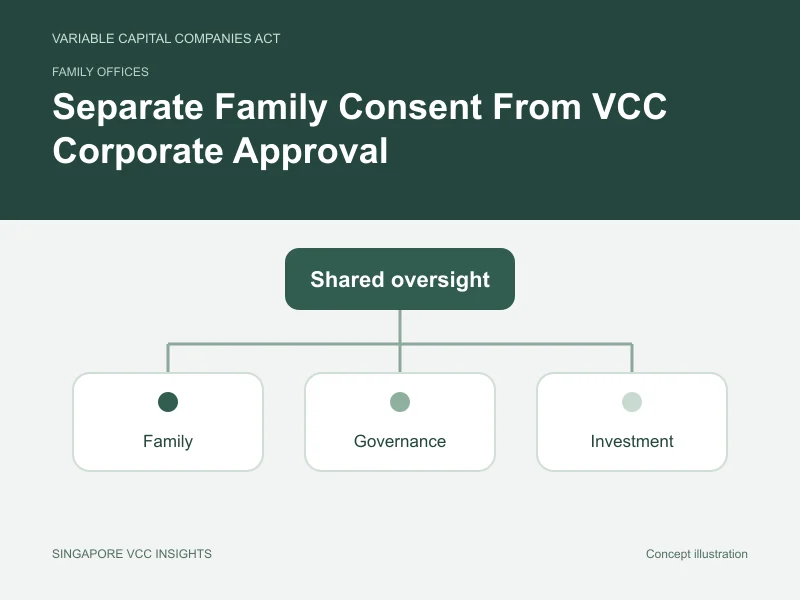
Treat family consent and VCC approval as connected but different decisions. A family council or principal can express ownership preferences, values and reserved expectations; the VCC board, shareholders, fund manager or investment committee must still act through the authority given by the constitution, fund documents, mandates and delegated arrangements. Map each decision before the meeting, identify conflicts and disagreement paths, and preserve a linked evidence chain rather than using one family email as every approval.
At a glance
- Name the decision first, then identify which body has authority to make it.
- Use family governance to guide expectations without erasing directors’ and managers’ responsibilities.
- Document information flow, conflicts and escalation when the same people sit in several bodies.
- Link related decisions while keeping each body’s record and reasoning distinct.
Who this is for
- Single-family and closely held family investment structures using a VCC alongside family governance arrangements.
Important exclusions
- A conclusion that a family constitution, letter of wishes or informal consensus overrides the VCC’s governing documents or applicable duties.
Start with an authority map
Write down the bodies in the structure and the documents that give each body its role. Typical layers may include a family assembly or council, family-office executive team, VCC shareholders, VCC board, fund manager, investment committee and service providers. The same individual may appear in several layers, but the capacity in which that person acts changes the decision, information available, conflicts analysis and record that should be created.
Sources: Singapore EDB · Singapore EDB · ACRA · Singapore Statutes Online| Body | Typical contribution | Do not assume |
|---|---|---|
| Family council or principals | Values, risk appetite, succession expectations and owner preferences | That informal consensus is automatically a VCC decision |
| VCC shareholders | Decisions reserved to members under the governing framework | That every investment or operating matter belongs to shareholders |
| VCC board | Corporate governance, oversight and decisions assigned to directors | That family preference removes independent judgement |
| Fund manager or investment committee | Investment decisions and delegated portfolio authority | That a family veto can be inserted without mandate analysis |
| Administrator, bank or custodian | Execution and recordkeeping under instructions and agreements | That a provider can decide disputed authority |
Related guidance: VCC for family offices
Classify the proposed action
- State the action in one sentence and identify the affected VCC, sub-fund and portfolio.
- Separate ownership preference, corporate approval, investment discretion and provider execution.
- Locate the constitution, mandate, agreement, policy or reserved-matters schedule that assigns authority.
- Identify people serving in more than one capacity and assess conflicts or information boundaries.
- Define which approvals are sequential, which are independent and which are merely consultative.
- Create an escalation route for disagreement before the decision reaches a provider.
Labels such as ‘strategic’, ‘family’ or ‘investment’ are not enough. A property sale might express a family liquidity preference, require a valid corporate process, sit within or outside the manager’s mandate and trigger provider instructions. Classifying the action prevents one discussion from silently substituting for all of those decisions. It also reveals where advice or amendments are needed before anyone promises an outcome.
Sources: Singapore EDB · ACRA · Singapore Statutes OnlineRelated guidance: turn family investment policy into a VCC mandate
Worked scenario: selling a legacy holding
Assume a family council wants one sub-fund to sell a long-held private investment so cash can support a succession plan. A family member is both a VCC director and a director of the portfolio company. The fund manager believes an immediate sale may harm value, while the administrator needs a clear instruction before changing records. The right response is a linked sequence, not a single family resolution forwarded to every party.
Sources: Singapore EDB · Singapore EDB · ACRA · Singapore Statutes Online- Record the family objectiveCapture the desired liquidity outcome, timing sensitivity and values without presenting the preference as a completed portfolio instruction.
- Map formal authorityReview the VCC and fund documents to identify board, shareholder, manager and committee decisions relevant to the proposed sale.
- Control the conflictDisclose the overlapping portfolio-company role and decide information access, participation, independent evidence and approval safeguards before deliberation.
- Test alternativesCompare an immediate sale with staged liquidity, financing, distributions from other assets or a revised family timetable using decision-relevant evidence.
- Create valid recordsKeep the family record, board or shareholder record, manager decision and provider instruction distinct, with links showing their sequence and conditions.
- Monitor executionTrack conditions, valuation updates, cash use and any trigger that returns the matter to the family or formal decision-maker.
Related guidance: separate family liquidity from VCC portfolio cash
Design reserved matters carefully
| Design question | Weak formulation | Stronger control |
|---|---|---|
| Scope | All important decisions need family approval | List defined matters, entities, thresholds and exclusions |
| Capacity | The principal decides | Identify whether the principal acts as shareholder, council member or office-holder |
| Timing | Consult the family before action | Set information, response and emergency procedures |
| Conflict | Interested family members may explain | Define disclosure, access, participation and independent review |
| Deadlock | No action without unanimity | Create escalation, interim controls and a final decision route |
| Evidence | Email consent is sufficient | Specify the formal record required for each decision body |
A reserved-matters schedule should protect legitimate owner expectations without turning every operational decision into a family plebiscite. Overbroad vetoes can create delay, unclear capacity and conflict with delegated responsibilities. Draft the schedule alongside the constitution, mandate, committee terms and provider agreements so the documents describe the same path. Revisit it when family roles, generations, shareholdings or investment strategies change.
Sources: Singapore EDB · Singapore EDB · Singapore Statutes OnlineRelated guidance: choose between a family-office board and investment committee
Create a disagreement protocol
- Is the family view consultative or reserved?If consultative, record it and let the authorised body decide. If reserved, verify the defined scope and capacity before proceeding.
- Is the formal decision-maker able to act?Check conflicts, information, composition and delegated authority; defer where the body cannot make a valid and informed decision.
- Can the issue be reframed?Separate the family objective from the proposed transaction and test alternative ways to reach the objective within valid authority.
- Is interim protection needed?Preserve assets, evidence and operating continuity without implying that the disputed final decision has already been made.
- Who makes the final call?Use the documented escalation route, obtain advice where needed and record why the resulting authority and process are appropriate.
Audit the evidence chain
- Confirm each record identifies the capacity in which participants acted.
- Link the family objective to the formal decision without merging the two records.
- Verify conflicts and information restrictions were applied consistently across meetings.
- Check the final provider instruction matches the conditions of the authorised decision.
- Track follow-up reporting back to the appropriate family and corporate bodies.
- Review whether the authority map still matches current people, documents and strategies.
Frequently asked questions
Can a family council direct the VCC board?
A family council may express owner expectations and may hold defined rights through the structure, but the formal effect depends on the governing documents and the capacity in which members act. The board should identify its own authority and responsibilities rather than treating informal direction as self-executing.
What if the family principal is also the only shareholder?
The roles still matter. A person may speak as principal, shareholder, director or committee member at different moments. Use the correct process and record for the decision so later reviewers and providers can see which authority was exercised.
Should every investment decision be reserved to the family?
Usually that would undermine clear delegation and make execution difficult. Define the family’s objectives and genuinely reserved matters, then allow the authorised investment process to work within the mandate. Escalate exceptions instead of reapproving routine decisions informally.
How should disagreements be handled in an urgent market event?
Pre-agree emergency authority, information, interim protections and later ratification or review. An urgent protocol should preserve valid decision-making and evidence, not give whoever responds first unlimited power. Test the protocol before a live event exposes ambiguity.
Can the same minutes cover the family council and VCC board?
Separate records are normally clearer because the bodies, capacities, information and decisions differ. Cross-reference the related records and conditions, but avoid wording that makes one meeting appear to exercise every authority in the structure.
When should the authority map be refreshed?
Refresh it after changes to family roles, ownership, directors, committees, manager arrangements, strategy, constitution, mandates or provider instructions. A periodic review is also useful to identify informal practices that have drifted away from the documented governance path.
Official sources and further reading
- Single family office setup guide (Singapore EDB)
- Primer on corporate governance for companies in Singapore (Singapore EDB)
- Legal obligations of a VCC director (ACRA)
- Understanding VCC features, eligibility and requirements (ACRA)
- Variable Capital Companies Act 2018 (Singapore Statutes Online)
Discuss a Singapore VCC structure
For help coordinating a Singapore VCC setup or corporate administration, contact Raffles Corporate Services.
General information only. This article is not legal, tax, regulatory or investment advice and does not imply affiliation with or endorsement by ACRA, MAS or IRAS.