Singapore VCC insights
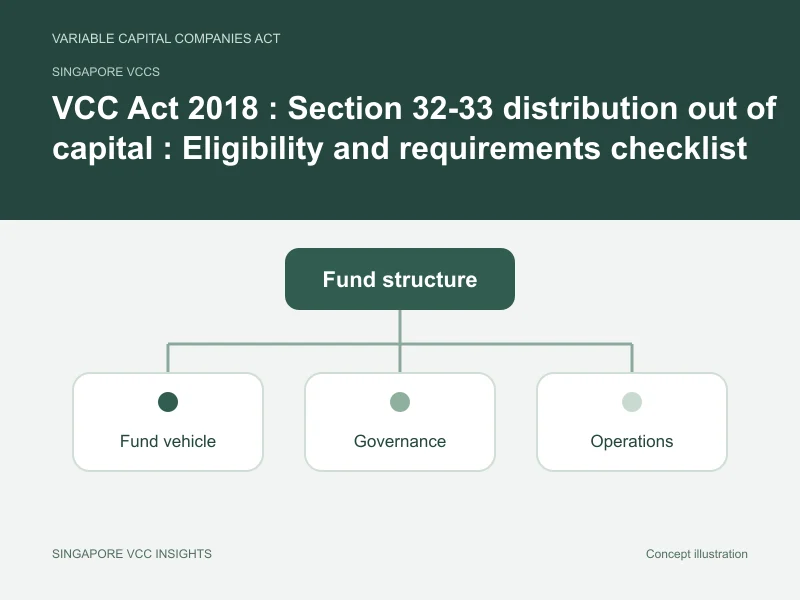
VCC Act 2018 — Section 32-33 distribution out of capital — Eligibility and requirements checklist
Raffles Corporate Services works with a panel of corporate and employment law firms; this article is general information, not legal advice.
VCC Act 2018 distribution out of capital is the statutory feature allowing a Variable Capital Company to pay dividends out of capital, not only profits, subject to solvency. Directors and counsel should hold a solvency assessment, board resolutions and the fund’s valuation policy before authorising any distribution from a VCC.
What VCC Act 2018 distribution out of capital allows
Unlike an ordinary company, which must generally pay dividends only out of profits, a Variable Capital Company may pay dividends out of its capital. This flexibility reflects the open-ended fund model in which investors expect distributions tied to net asset value rather than accounting profit. Sections 32 and 33 of the Variable Capital Companies Act 2018 provide the framework for distributions and the payment of dividends out of capital, and the directors’ authority to distribute is exercised against the fund’s constitution and valuation policy. See the Variable Capital Companies Act 2018 for the provisions.
Who this is for
This matters to fund managers designing distribution policies, directors authorising payments, and administrators calculating amounts by net asset value. It is central to income-oriented strategies where capital returns are part of the investor proposition. Where the underlying strategy relies on a tax incentive, our group guide to Section 13D offshore fund scheme , Documents required and templates on the Section 13D offshore fund scheme sets out the exemption backdrop.
Documents and records you should hold
Keep the fund constitution’s distribution provisions, the valuation and net-asset-value policy, the board resolution authorising each distribution, a solvency assessment supporting the payment, and the administrator’s calculation. Because capital can be returned, the audit trail on why the fund remained able to meet its liabilities is important. For the corporate governance standard applied to fundraising-linked resolutions, our group note on The Corporate Secretarys Role When a Singapore Company Raises Venture Capital is a useful reference.
Cost and timeline benchmarks
Distribution mechanics are usually handled within existing fund administration and audit fees rather than as a separate cost, though bespoke legal advice on a capital distribution policy may run S$3,000 to S$8,000. Distributions are typically calculated on the fund’s valuation cycle, monthly or quarterly for many strategies, and paid within the settlement window set in the constitution, commonly a few business days after the dealing date.
Step-by-step: authorising a distribution
Confirm the constitution permits distribution out of capital and sets the policy. Obtain the net-asset-value calculation from the administrator. Assess solvency, that the VCC can meet its liabilities as they fall due. Pass the board resolution authorising the distribution. Pay within the constitutional settlement window and record the audit trail. Reconcile against the register. Our own VCC Act 2018 , Section 32-33 distribution out of capital , Timeline and processing benchmarks timeline guide on Section 32-33 distributions gives the processing benchmarks.
Common mistakes
Common failures include distributing without a documented solvency assessment, paying amounts inconsistent with the valuation policy, and neglecting to record the board’s authorisation. Because a VCC can erode capital through distributions, weak record-keeping here is a live audit and investor-relations risk.
The solvency judgement behind a capital distribution
Because a VCC can return capital, the protection for creditors and remaining investors is the directors’ judgement that the fund can still meet its liabilities as they fall due after the payment. That judgement should be evidenced, not assumed: a contemporaneous note of the liabilities considered, the liquidity available and the NAV struck for the dealing date gives the audit trail its backbone. Where a distribution is large relative to the fund’s size, the directors’ file should show why solvency was not in doubt.
In an umbrella VCC, the analysis is done at sub-fund level, because each sub-fund’s assets and liabilities are segregated, so a distribution from one sub-fund is tested against that sub-fund’s position, not the umbrella as a whole.
Distribution policy and investor expectations
Income-oriented strategies often market a target distribution, and the constitution and offering documents should make clear whether distributions may include a return of capital, so investors understand that a headline yield is not the same as income earned. Clear disclosure protects the manager as much as the investor, since a distribution funded from capital that is presented as income invites complaint. The administrator’s calculation should reconcile the declared amount to the components of NAV that funded it.
Fees, timelines and thresholds at a glance
- Capital distributions: permitted for a VCC, subject to solvency
- Legal basis: Sections 32 and 33 of the Variable Capital Companies Act 2018
- Bespoke distribution-policy advice: about S$3,000 to S$8,000
- Settlement: usually a few business days after the dealing date
FAQs
Can a VCC pay dividends out of capital?
Yes. Unlike an ordinary company, a VCC may pay dividends out of capital under the framework in Sections 32 and 33 of the Variable Capital Companies Act 2018, subject to solvency.
Why is this different from a normal company?
Ordinary companies generally distribute only out of profits, whereas the open-ended fund model of a VCC ties distributions to net asset value, so capital returns are contemplated.
What protects investors if capital is returned?
The solvency requirement and the directors' duty to ensure the VCC can meet its liabilities, supported by a documented assessment and valuation policy.
How are distribution amounts calculated?
On the fund's net asset value per the valuation policy, then paid within the settlement window set in the constitution.
Related guides across the Raffles group
- Section 13D offshore fund scheme , Documents required and templates
- The Corporate Secretarys Role When a Singapore Company Raises Venture Capital
- VCC Act 2018 , Section 32-33 distribution out of capital , Timeline and processing benchmarks
Authoritative sources: the Variable Capital Companies Act 2018; the Accounting and Corporate Regulatory Authority; the MAS explainer on the VCC.
Need help with this? Call, SMS or WhatsApp +65 8501 7133, or email hello@rafflescorporateservices.com. Raffles Corporate Services works with a panel of corporate and employment law firms; this article is general information, not legal advice.