Singapore VCC insights
VCC Director Appointments and Qualifications: Eligibility and Requirements Checklist
Raffles Corporate Services works with a panel of corporate and employment law firms; this article is general information, not legal advice.
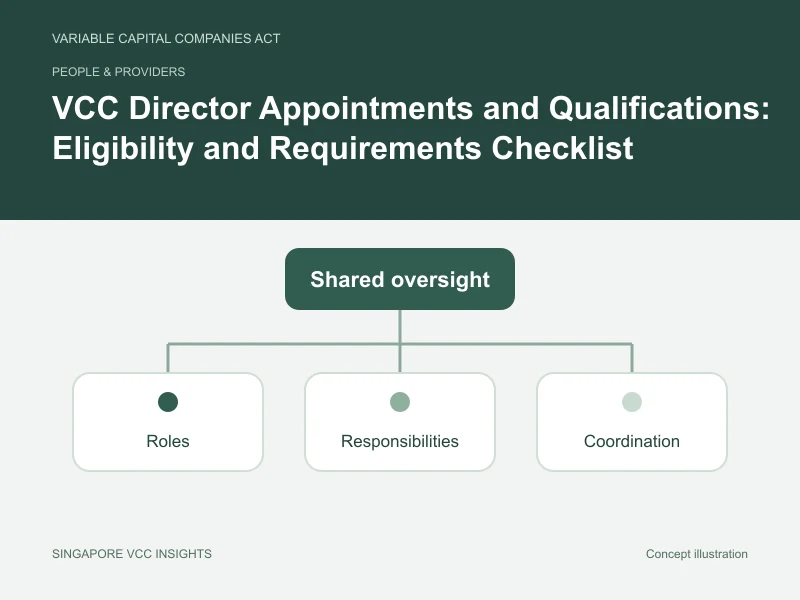
VCC director appointments and qualifications are governed by the Variable Capital Companies Act 2018. Every Variable Capital Company must have at least one director who is ordinarily resident in Singapore, and at least one director who is also a director or a qualified representative of the VCC’s regulated fund manager. Directors must be at least 18 and fit to act.
What the requirement covers
A VCC is a corporate fund vehicle, and like any company it acts through its board. The rules on VCC director appointments and qualifications in the Variable Capital Companies Act 2018 are stricter than for an ordinary private company because a VCC must be tied to a regulated fund manager. Section 46 of the Variable Capital Companies Act 2018 requires that a VCC have at least one director ordinarily resident in Singapore and at least one director who is a director or qualified representative of the VCC’s permissible fund manager. These two roles can be filled by the same person if that person meets both tests. For how directorship sits within the wider governance framework, see VCC for family office investment vehicles: Eligibility and requirements checklist.
VCC director appointments and qualifications: who can be appointed
A director must be a natural person, at least 18 years old and of full legal capacity. The same disqualification grounds that apply under Singapore company law carry across to VCC directors: an undischarged bankrupt cannot act without leave of the court, and a person disqualified for past misconduct, fraud or breach of directors’ duties is barred for the disqualification period. Because a VCC must connect to a regulated manager, at least one director must be a director or qualified representative of that fund manager, which links the board to a person accountable under the Monetary Authority of Singapore’s regime. General guidance on director appointment and duties for Singapore entities is covered in Single-Member Companies in Singapore (2026): One Shareholder, One Director.
Residency and the fund manager link
The resident-director requirement mirrors the ordinary Singapore rule and is satisfied by a Singapore citizen, permanent resident, or an EntrePass or equivalent pass holder who is ordinarily resident here. The fund manager link is the distinctive VCC feature: the qualified representative is an individual whom the manager has appointed and MAS recognises to conduct the regulated fund management activity. This ensures the board has a direct line to the regulated manager rather than being a purely nominee arrangement.
Retail versus non-retail boards
Board composition scales with investor exposure. A non-retail VCC (offered to accredited and institutional investors) can operate with the minimum board described above. A VCC that is an authorised scheme offered to retail investors is held to a higher standard: it must have at least three directors, of whom at least one is independent. Directors of a retail VCC are also expected to meet the governance expectations MAS applies to authorised collective investment schemes.
Numbers, timeline and cost
Key figures to plan around: at least one resident director and at least one director who is a director or qualified representative of the fund manager for a non-retail VCC; at least three directors with one independent for a retail VCC. Appointments are lodged with ACRA through the VCC register, and a change of director must generally be notified within 14 days of the change. There is no government fee to consent to act, though ACRA charges standard lodgement fees for changes. Appointing directors at incorporation adds no separate cost beyond the incorporation filing; later changes are lodged as they occur.
Documents required and a checklist
- Signed consent to act as director for each appointee.
- Personal particulars and identification for each director (NRIC or passport, residential address, contact details).
- Evidence of Singapore residency for the resident director.
- Written confirmation from the fund manager that the nominated director is a director or qualified representative of the manager.
- For a retail VCC, documentation supporting the independence of the independent director.
- Board resolution recording the appointments and the effective dates, for lodgement with ACRA.
Authoritative sources are the Accounting and Corporate Regulatory Authority (ACRA), which operates the VCC register, the Monetary Authority of Singapore (MAS) for fund manager and qualified representative recognition, and the Variable Capital Companies Act 2018 (Singapore Statutes Online). For the officer records that support these appointments across the group, see How to Allot New Shares in a Singapore Company: A Director's Guide (2026).
Directors’ duties and replacing a director
Once appointed, VCC directors owe the familiar fiduciary and statutory duties: to act honestly and use reasonable diligence, to avoid conflicts of interest, and to act in the interests of the VCC and, where the VCC is a fund, with proper regard to the interests of its members. Directors of a VCC that is an authorised scheme carry the heightened governance expectations MAS applies to collective investment schemes, including oversight of the fund manager and of valuation and conflicts. A director who wishes to resign, or who is removed, must ensure the VCC continues to meet the minimum board composition at all times, so a replacement should be lined up before a resident director or the fund-manager-linked director steps down. Leaving the board below the statutory minimum, even briefly, is a breach. Removal follows the VCC’s constitution and the applicable provisions carried over from company law, and every appointment, resignation and removal is lodged with ACRA within the notification window. Keeping a short bench of eligible directors, and confirming the fund manager can supply a qualified representative on short notice, avoids a scramble when someone leaves.
Common mistakes and gotchas
The most common error is appointing a resident director but overlooking the separate requirement for a director tied to the fund manager, or assuming one nominee can satisfy both without actually being a qualified representative. Retail VCCs sometimes launch with two directors and no independent director, which does not meet the authorised-scheme standard. Late notification of director changes to ACRA and stale residency evidence are frequent housekeeping failures. Confirm current thresholds before you rely on them, because MAS expectations for authorised schemes are updated from time to time.
FAQs
How many directors must a VCC have? A non-retail VCC needs at least one director, subject to the residency and fund-manager-link rules. A retail (authorised) VCC needs at least three, including one independent director.
Can one person be both the resident director and the fund manager’s representative? Yes, if that individual is ordinarily resident in Singapore and is a director or qualified representative of the VCC’s fund manager.
Can a corporate entity be a VCC director? No. A director must be a natural person aged at least 18 with full legal capacity.
How quickly must a director change be reported? A change of director is generally notified to ACRA within 14 days of the change.
Need help with this? Call, SMS or WhatsApp +65 8501 7133, or email hello@rafflescorporateservices.com. Raffles Corporate Services works with a panel of corporate and employment law firms; this article is general information, not legal advice.