Singapore VCC insights
VCC parallel funds for institutional LPs: Documents required and templates
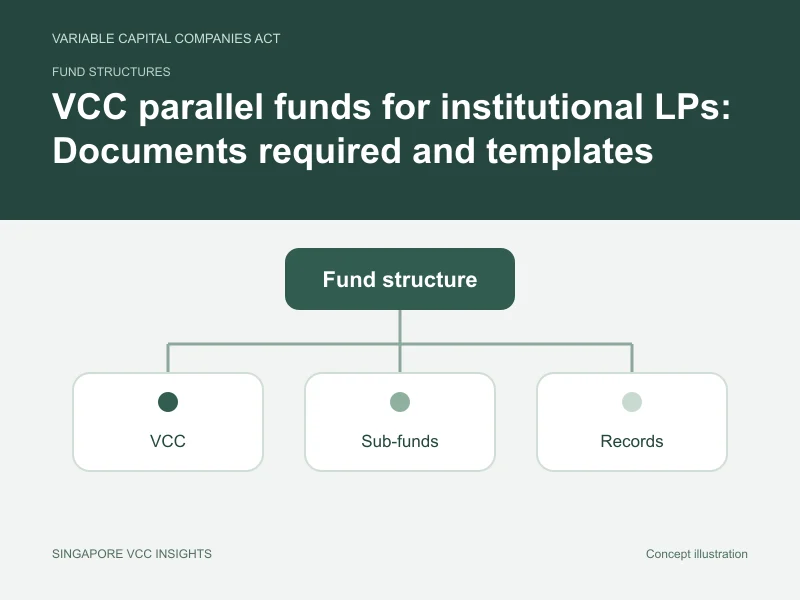
A VCC parallel fund structure lets a manager run two or more sub-funds under one umbrella Variable Capital Company, each holding legally segregated assets and liabilities under Section 29 of the Variable Capital Companies Act 2018, so institutional LPs with different regulatory, tax or currency needs can invest side by side without co-mingling exposure.
Raffles Corporate Services works with a panel of corporate and employment law firms; this article is general information, not legal advice.
What a VCC parallel fund structure actually is
An umbrella VCC can register multiple sub-funds under Section 27 of the Act, each pursuing a related but distinct investment strategy, commonly used to run parallel vehicles for different investor types, a US-taxable-investor sub-fund alongside a non-US sub-fund, for example, while sharing the same manager, custodian relationships and back-office infrastructure. Section 29 legally segregates each sub-fund’s assets and liabilities from every other sub-fund in the umbrella, meaning a claim against one sub-fund cannot be satisfied out of another’s assets.
Who this is for
This structure suits managers raising capital from institutional LPs with different regulatory classifications, tax residencies or currency mandates, where running entirely separate legal entities for each investor group would be costly, but a single co-mingled fund would create tax or regulatory complications for at least one investor group. It is common in private equity and credit strategies where sovereign wealth funds, pension funds and insurance company LPs each have distinct side-letter and reporting requirements.
Documents required and templates
Core documents include the umbrella VCC’s constitution under Section 19, the sub-fund registration filings required under Section 27 for each parallel vehicle, a cross sub-fund investment policy addressing Section 31 (which governs how one sub-fund may invest in another within the same umbrella), and side letters documenting any LP-specific terms. Institutional LPs typically also require the manager’s Form ADV or equivalent disclosure, the umbrella VCC’s audited financial statements prepared under Section 100, and confirmation of the sub-fund’s segregated bank and custody arrangements evidencing Section 29 in practice, not just on paper.
Cost and timeline in numbers
Setting up an additional sub-fund within an existing umbrella VCC is materially faster and cheaper than incorporating a standalone fund vehicle, since the umbrella’s constitution, manager appointment and much of its compliance infrastructure are already in place; a new sub-fund registration under Section 27 is a comparatively contained filing rather than a full incorporation. Ongoing audit costs under Section 107 are typically shared or allocated across sub-funds within the same umbrella, reducing the per-vehicle audit cost relative to entirely separate fund entities.
Step-by-step: setting up parallel sub-funds
A manager first confirms the umbrella VCC’s constitution under Section 19 permits the intended parallel structure and investor segregation. It then files the sub-fund registration under Section 27 for each parallel vehicle, documenting the distinct investment strategy and investor base for each. The manager confirms segregated banking and custody arrangements are genuinely in place per Section 29, not merely described in the constitution, and puts in place a cross sub-fund investment policy addressing Section 31 where any inter-sub-fund investment is contemplated. Institutional LP onboarding then proceeds sub-fund by sub-fund, with side letters and disclosure documents tailored to each investor group.
Common mistakes and gotchas
A frequent error is treating segregation under Section 29 as automatic once sub-funds are registered, without confirming banking, custody and accounting systems actually keep each sub-fund’s assets operationally separate; a manager that co-mingles cash accounts undermines the statutory protection in practice even where the paperwork is correct. Another is under-documenting cross sub-fund investment under Section 31, which requires its own governance where one sub-fund invests in another rather than assuming general umbrella-level approval covers it. A third is failing to update institutional LP disclosure and audit documentation separately for each sub-fund, since LPs in different sub-funds often have materially different reporting expectations even within the same umbrella.
FAQs
Does Singapore law actually segregate assets between sub-funds? Yes. Section 29 of the Variable Capital Companies Act 2018 provides that assets and liabilities of each sub-fund are legally segregated from other sub-funds in the same umbrella.
Is setting up a new sub-fund faster than a new standalone fund? Generally yes, since the umbrella VCC’s constitution and manager infrastructure already exist; only the sub-fund registration under Section 27 is required.
Can one sub-fund invest in another within the same umbrella? Yes, subject to the cross sub-fund investment provisions in Section 31, which require their own governance and disclosure.
Do institutional LPs in different sub-funds get separate audited accounts? Financial statements are prepared under Section 100 of the Act, and institutional LPs typically expect reporting granular enough to reflect their specific sub-fund’s position.
Why do institutional LPs prefer parallel sub-funds over co-mingled funds? Parallel sub-funds let LPs with different regulatory, tax or currency needs invest without exposure to another investor group’s specific structuring requirements.
Related guides
For how Singapore’s hedge fund investment ecosystem is evolving for managers using structures like this, see MAS’s new hedge fund investment programme and what it means for fund managers relocating to Singapore. Managers comparing a VCC against a Cayman SPC for institutional distribution should see VCC vs Cayman SPC: why Singapore is the new fund domicile. For how this structure compares to a single private equity VCC, see our companion piece, VCC for private equity funds: eligibility and requirements checklist.
Authoritative background: the Monetary Authority of Singapore’s capital markets regulation pages cover VCC oversight, ACRA administers VCC and sub-fund registration, and the full statutory text is available at Singapore Statutes Online’s Variable Capital Companies Act 2018.
Need help with this? Call, SMS or WhatsApp +65 8501 7133, or email hello@rafflescorporateservices.com. Raffles Corporate Services works with a panel of corporate and employment law firms; this article is general information, not legal advice.