Independent Singapore VCC guidance
Direct answer
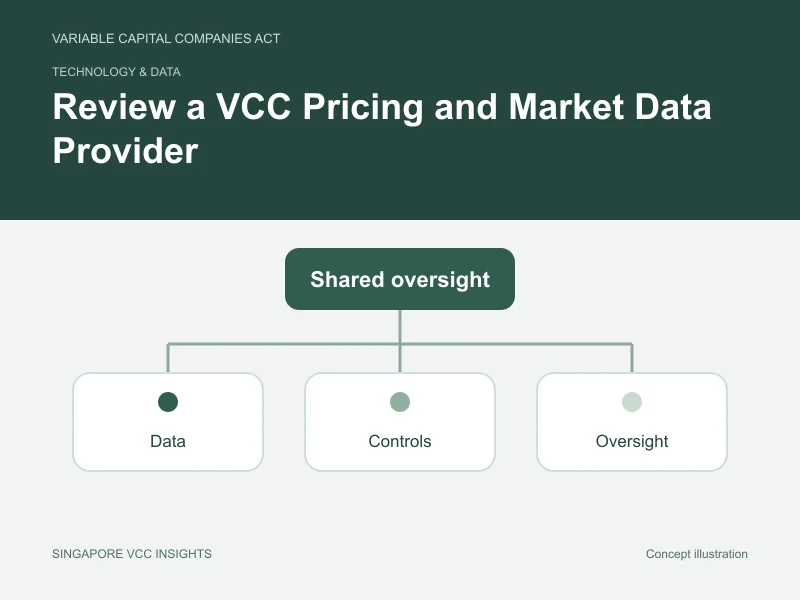
Approve a VCC pricing or market data provider only for clearly defined instruments and uses after testing coverage, lineage, timeliness, methodology, identifiers, corrections, licensing rights and fallback. Run the feed in parallel against current sources and downstream systems, investigate every material difference, and set ownership for stale, missing or overridden values. Provider reputation is not sufficient evidence. The VCC and manager should know where each important value came from and when reliance should stop.
At a glance
- Map every feed to instruments, sub-funds, systems and decisions before contracting.
- Test raw values, transformations, identifiers and downstream outputs during a parallel run.
- Keep fallback and manual override controls ready before the primary feed fails.
- Review corrections, coverage drift, service failures and user access throughout the relationship.
Who this is for
- VCCs and managers selecting or reviewing external prices, curves, benchmarks, reference data or market data used in operations
Important exclusions
- Selecting an investment benchmark, approving a valuation methodology or replacing independent valuation expertise for complex assets
Map the data uses and decision consequences
Inventory the requested data by instrument, market, currency, time, source type and intended use. Trace it through portfolio management, pre-trade controls, risk measures, collateral, fund accounting, NAV review, financial statements and investor reporting. Identify the VCC and sub-funds affected, the consuming systems, transformations and control owners. The same closing price may be acceptable for a risk estimate but inappropriate for a dealing NAV or illiquid-asset valuation. Current fund-management duties require an appropriate risk framework and independent valuation arrangements. MAS valuation material also focuses on governance, policies, independence, methodologies, inputs and review. The provider decision should therefore be made use by use, rather than through one blanket approval.
Sources: Singapore Statutes Online · Monetary Authority of Singapore · Monetary Authority of Singapore| Use | Key acceptance question | Failure consequence |
|---|---|---|
| Trading and limits | Is the value timely, correctly identified and available before the decision? | Incorrect order size, limit result or blocked trade |
| Risk monitoring | Does coverage match the exposure and measure being reported? | Hidden concentration, sensitivity or counterparty risk |
| NAV and valuation | Is the source and hierarchy consistent with the approved valuation approach? | Incorrect investor dealing value or financial record |
| Collateral and financing | Do timestamp, source and dispute terms align with agreements? | Wrong call, dispute or liquidity demand |
| Investor reporting | Can the reported value be traced to the approved source and period? | Inconsistent or misleading investor information |
Related guidance: VCC valuation governance review
Complete provider and data-lineage due diligence
Request the provider's service description, instrument coverage, source hierarchy, calculation methods, timestamp conventions, corporate-action handling, quality controls, correction policy, service levels, continuity arrangements, information security evidence, subcontractors, data locations, audit rights, incident route and termination support. Confirm that contractual rights cover every internal system, provider, report and investor use planned by the VCC. Obtain sample records showing source, observation time, publication time, identifier, currency, adjustment, quality flag and later correction. For evaluated or model-derived values, understand which inputs and judgement belong to the provider and which remain with the manager or valuation function. Unsupported black-box reliance should be treated as a gap, not convenience.
Sources: Monetary Authority of Singapore · Monetary Authority of Singapore- Confirm coverage for the actual securities, loans, derivatives, currencies and corporate actions in scope.
- Trace sample values from original contributor or market through provider transformation to the VCC system.
- Review identifiers, timestamps, time zones, currencies, accrued amounts and adjustment conventions.
- Test correction notices, historical restatements and the ability to reproduce a prior reporting date.
- Verify data-use rights for administrators, auditors, risk systems, reports and investor communications.
- Assess outages, cyber events, subcontractor changes, termination assistance and secure data return.
Related guidance: VCC administrator controls-report review
Run a controlled parallel test before reliance
Build a test population that includes liquid instruments, illiquid holdings, recent issues, corporate actions, multiple currencies, thin markets, stale candidates and known difficult identifiers. Run the proposed feed beside the current approved source or independently obtained evidence across representative dates. Compare values, timestamps, identifiers, missing records, methodology flags, revisions and downstream calculations. Set investigation thresholds based on the decision impact rather than one percentage applied to every asset. Reperform selected transformations and deliberately simulate a missing value, delayed file, duplicate record, identifier change and correction. Approval should state the instruments and uses that passed. Any excluded population should remain on a controlled alternative source, with a named owner and review date.
Sources: Monetary Authority of Singapore · Monetary Authority of Singapore · Singapore Statutes Online- Build the test setInclude ordinary positions and deliberately difficult instruments, events, identifiers, currencies and dates.
- Compare independentlyMeasure values, coverage, timestamps, flags, corrections and downstream outputs against approved evidence.
- Investigate differencesClassify source, method, mapping, timing, transformation and system causes before deciding materiality.
- Simulate failureTest missing files, stale records, duplicate messages, corrected history and use of the fallback source.
- Approve by scopeRecord accepted instruments and uses, excluded populations, conditions, owners and a future review trigger.
Operate exceptions, fallback and ongoing oversight
Create daily or periodic controls appropriate to each use: delivery completeness, expected instrument count, stale values, zero or extreme moves, currency mismatches, duplicate identifiers, corporate-action breaks, late corrections and unexplained overrides. Route exceptions to an owner independent of the person benefiting from the output. Preserve the original value, replacement, rationale, approver and affected calculations. Maintain a fallback hierarchy with access, tested connectivity and clear authority to switch. Trend coverage gaps, correction volumes, unresolved differences, outages, service breaches, user access and complaints. Suspend a feed for an affected use when its reliability cannot be demonstrated, then control every downstream report or decision that used disputed data.
Sources: Monetary Authority of Singapore · Monetary Authority of Singapore · Singapore Statutes Online- Complete and consistent deliveryProcess through normal controls, retain lineage and review the provider within the agreed oversight cycle.
- Isolated explainable exceptionHold the affected value, investigate independently, approve the correction and retain both original and final records.
- Wider coverage or integrity concernSwitch the affected population to the tested fallback and assess every downstream calculation and report.
- Unresolved provider reliability failureSuspend reliance for the affected use, escalate governance and activate remediation or orderly replacement.
Related guidance: unresolved VCC valuation inputs log · VCC provider service-level escalation
Frequently asked questions
Is a well-known pricing vendor automatically acceptable?
No. Reputation can support due diligence but does not prove coverage, lineage, contractual rights or fitness for a specific VCC use. Test the provider against the actual instruments, systems, valuation approach and reporting decisions in scope.
How long should a parallel run last?
Use enough representative dates and events to observe normal processing and difficult cases. The correct period depends on valuation frequency, asset liquidity, corporate actions and risk. Include deliberately simulated failures rather than waiting for every problem to happen naturally.
Can the administrator approve pricing exceptions alone?
The administrator may investigate or propose a value under assigned procedures, but the VCC and manager should retain clear oversight, conflict controls and authority for material exceptions. Responsibilities should match the valuation policy and service agreement.
What should be recorded for a manual price override?
Keep the original value, affected instrument and sub-fund, reason, independent evidence, replacement value, preparer, approver, time, downstream impact and later review. Trend repeated overrides because they may indicate a broader coverage or methodology problem.
When should the fallback source be used?
Use it under predefined conditions such as missing, stale, corrupted or disputed primary data. The fallback should be approved for the same instrument and purpose, technically available, periodically tested and subject to its own exception and lineage controls.
Official sources and further reading
- Valuation Practices for Fund Management Companies (Monetary Authority of Singapore)
- Risk Management Practices for Fund Management Companies (Monetary Authority of Singapore)
- Securities and Futures (Licensing and Conduct of Business) Regulations (Singapore Statutes Online)
- Legal Obligations of a VCC Director (Accounting and Corporate Regulatory Authority)
Discuss a Singapore VCC structure
For help coordinating a Singapore VCC setup or corporate administration, contact Raffles Corporate Services.
General information only. This article is not legal, tax, regulatory or investment advice and does not imply affiliation with or endorsement by ACRA, MAS or IRAS.