Singapore VCC insights
VCC for accredited-investor-only feeder funds — Complete 2026 guide
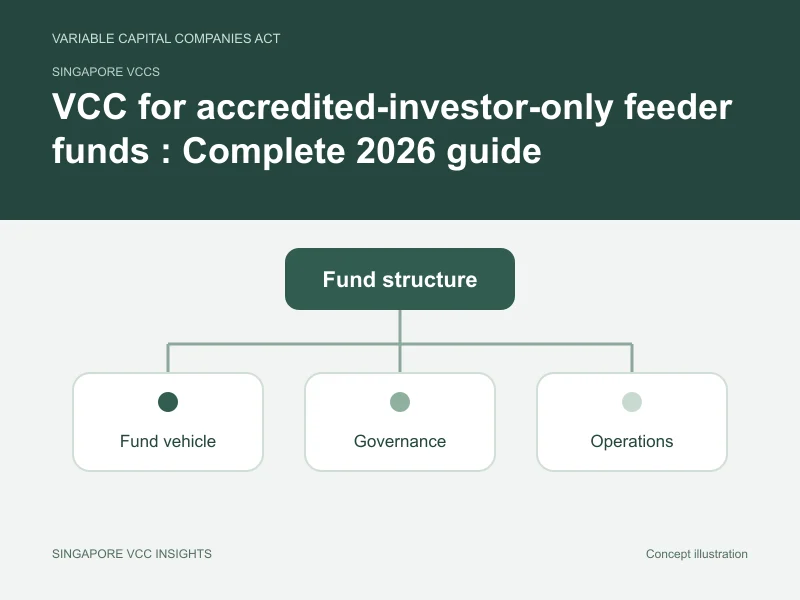
A VCC for accredited-investor-only feeder funds uses the Variable Capital Company to channel capital from accredited investors into a master fund. This 2026 guide explains how a VCC for accredited-investor-only feeder funds is structured, the investor-eligibility rules, the licensing position, and the tax incentives available.
Raffles Corporate Services works with a panel of corporate and employment law firms; this article is general information, not legal advice.
What an accredited-investor-only feeder VCC is
A feeder fund pools investor capital and invests substantially all of it into a single master fund, which carries out the actual investment strategy. Restricting the feeder to accredited investors keeps the offer within the exemptions from prospectus and retail-distribution requirements. Implementing the feeder as a VCC gives a corporate fund vehicle with variable capital, so subscriptions and redemptions can be met by issuing and redeeming shares at net asset value.
Who this structure suits
Managers raising capital from a defined pool of sophisticated investors for a single strategy favour the master-feeder design. The feeder VCC can sit alongside other feeders (for example an offshore feeder) all investing into the same master, allowing investors in different jurisdictions or tax positions to access one strategy through the most suitable entry point.
Accredited investor eligibility
The accredited investor concept is defined under the Securities and Futures Act 2001. An individual generally qualifies through net personal assets or income thresholds, and an entity through net asset thresholds. Restricting the feeder to accredited investors allows reliance on the exemptions in the SFA from the full prospectus and licensing requirements that apply to retail offers, though the fund manager must still be appropriately licensed or registered with MAS.
Tax incentives and the numbers that matter
- Section 13O scheme: exemption for qualifying income of a fund administered in Singapore, with economic conditions on expenditure and professionals.
- Section 13U scheme: exemption for larger funds, typically with a minimum fund size of S$50,000,000 and higher substance requirements.
- Section 13H: a venture-capital focused incentive; see our guide to the section 13H venture capital fund tax incentive.
- VCC directors: at least one Singapore-resident director and one director connected to the fund manager.
For how these schemes compare, see our explainer on Singapore fund tax incentives (13O, 13U) explained.
Step-by-step: building a feeder VCC
- Confirm the master fund and the proposed feeder-into-master flow of capital.
- Restrict the offer to accredited investors and document eligibility for each subscriber.
- Appoint a MAS-regulated fund manager and qualifying VCC directors.
- Register the VCC with ACRA and prepare subscription documents relying on the SFA exemptions.
- Apply for the appropriate fund tax incentive and open banking; see our guide to opening a Singapore bank account for your fund.
- Operate subscriptions and redemptions at net asset value.
Common mistakes and gotchas
Frequent errors include failing to verify and document accredited investor status for every subscriber, assuming the accredited-investor exemption removes the need for a licensed fund manager, and mismatching the feeder and master fiscal calendars. Where the master is a foreign fund, the tax characterisation of distributions back to the feeder requires careful review.
Authoritative sources
See the Monetary Authority of Singapore on accredited investors and fund incentives, ACRA for VCC registration, and IRAS for fund taxation.
Frequently asked questions
What is a feeder fund?
A feeder fund pools investor money and invests substantially all of it into a master fund, which executes the strategy. The VCC can serve as the feeder vehicle.
Who is an accredited investor?
An investor meeting the net asset or income thresholds defined under the Securities and Futures Act 2001. Restricting a fund to accredited investors permits reliance on offer exemptions.
Does the manager still need a licence?
Yes. Restricting investors to accredited investors does not remove the requirement for the fund manager to be appropriately licensed or registered with MAS.
Which tax incentive fits a feeder VCC?
Commonly the section 13O or section 13U scheme, depending on fund size and substance; venture strategies may consider section 13H.
Related guides
For wider context, see our the section 13H venture capital fund tax incentive, our opening a Singapore bank account for your fund, and Singapore fund tax incentives (13O, 13U) explained.
Need help with this? Call, SMS or WhatsApp +65 8501 7133, or email hello@rafflescorporateservices.com. Raffles Corporate Services works with a panel of corporate and employment law firms; this article is general information, not legal advice.