Singapore VCC insights
VCC parallel funds for institutional LPs — Step-by-step walkthrough
Raffles Corporate Services works with a panel of corporate and employment law firms; this article is general information, not legal advice.
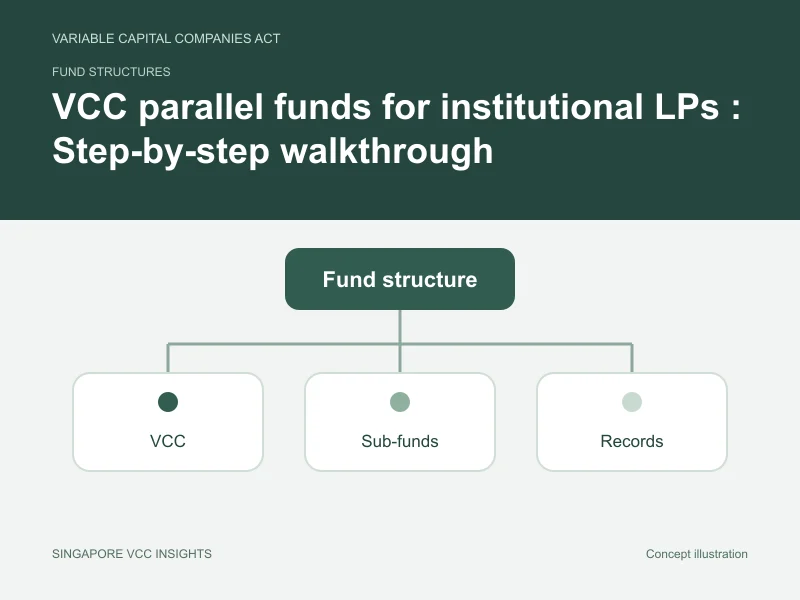
VCC parallel funds for institutional LPs let a manager run side-by-side vehicles that invest together on a pro-rata basis, accommodating institutional limited partners with distinct tax, regulatory or reporting needs. Using the Variable Capital Company framework, parallel funds can be ring-fenced sub-funds. This step-by-step walkthrough explains the mechanics.
What VCC parallel funds for institutional LPs are
Parallel funds are two or more vehicles that invest alongside each other in the same deals, in agreed proportions, but are kept legally separate to suit different limited partners (LPs). Institutional LPs, such as pension funds, sovereign investors and insurers, often cannot invest through the same vehicle because of tax, regulatory or internal-policy constraints. Parallel funds let them share the same investment programme while each sits in a vehicle that fits its requirements. A Variable Capital Company (VCC) umbrella can host these as ring-fenced sub-funds.
The framework is the Variable Capital Companies Act 2018. For the tax-incentive planning that usually accompanies institutional structures, see Singapore trust structures for HNW families , Step-by-step walkthrough; for incorporation context, Ordinary vs Special Resolutions in Singapore Companies: A Practical Guide is a useful companion.
This article is general information, not legal or tax advice; Raffles Corporate Services works with a panel of corporate and employment law firms.
Parallel funds versus master-feeder
In a master-feeder structure, feeders invest into a single master that holds the portfolio. In a parallel structure, each fund holds its own pro-rata slice of every investment directly, with no master. Parallel funds suit institutional LPs that want direct exposure and to avoid an intermediate master for tax or regulatory reasons. The trade-off is more operational coordination, because each parallel vehicle must execute and settle its proportion of every deal.
How the VCC framework supports parallel funds
An umbrella VCC can establish each parallel fund as a separate sub-fund, with Section 29 of the Variable Capital Companies Act 2018 segregating each sub-fund’s assets and liabilities. A co-investment or allocation agreement governs how deals are split pro-rata across the parallel sub-funds. Because each sub-fund has its own NAV and investor register, institutional LPs receive clean, vehicle-specific reporting while the manager runs a single allocation policy across the umbrella.
Allocation, conflicts and governance
Pro-rata allocation must be documented and applied consistently to manage conflicts of interest, because LPs in one parallel fund must not be advantaged over another. The VCC’s directors and the MAS-regulated manager are responsible for a fair allocation policy, capacity rules for oversubscribed deals, and disclosure of any deviations. Strong governance is what makes institutional LPs comfortable, and it should be evidenced in board minutes and allocation records.
Cost, timeline and step-by-step set-up
Indicative anchors and sequence:
- Umbrella VCC incorporation: from S$8,000 to S$15,000 plus ACRA fees.
- Each parallel sub-fund: from S$400 ACRA registration plus servicing.
- Timeline: 8 to 14 weeks including manager appointment, LP negotiation and incentive application.
- Annual running cost: from S$30,000 across parallel vehicles, scaling with LP reporting demands.
Steps: (1) map LP requirements and decide how many parallel sub-funds are needed; (2) incorporate the umbrella VCC and register each sub-fund; (3) appoint the manager and adopt an allocation policy; (4) negotiate side letters with institutional LPs; (5) apply for fund tax incentives under sections 13O or 13U of the Income Tax Act 1947; (6) operate with segregated records and pro-rata allocation. Our companion explainer at Standalone VCC vs umbrella VCC , decision framework , Complete 2026 guide details the allocation policy.
Common mistakes and gotchas
Frequent errors include an undocumented or inconsistently applied allocation policy, failing to ring-fence each parallel sub-fund in practice, neglecting substance conditions for the tax incentive, and underestimating the reporting burden institutional LPs impose. Side-letter terms can also conflict across vehicles. Registry steps run through ACRA and the statutory framework is on Variable Capital Companies Act 2018; the regulatory overview is the MAS VCC framework.
When parallel funds beat master-feeder for institutional LPs
Institutional limited partners often arrive with non-negotiable constraints: a pension fund may be barred from investing through certain intermediate vehicles, an insurer may face capital charges that depend on how exposure is held, and a sovereign investor may require direct ownership for transparency. A parallel structure, in which each fund holds its own pro-rata slice of every investment directly, can satisfy these constraints where a master-feeder cannot, because there is no intermediate master between the LP’s vehicle and the assets. The cost is more operational coordination, since each parallel vehicle must execute and settle its share of every deal.
The choice between parallel and master-feeder therefore comes down to the LPs you are courting. If your target investors can accept a master, the operational simplicity of master-feeder usually wins. If they cannot, parallel funds are the price of access to that capital, and the VCC umbrella makes them more efficient to run than a set of unrelated standalones.
The allocation policy is the heart of the structure
Where multiple parallel funds invest together, a documented allocation policy governs how each deal is split, and it is the single most important governance document. It must set out the default pro-rata basis, how capacity-constrained deals are shared, how follow-on investments are handled, and what disclosure applies if the manager deviates. Consistency is everything: LPs in one parallel fund must not be systematically advantaged over another. The VCC’s directors and the MAS-regulated manager are accountable for applying the policy and evidencing it in board minutes and allocation records, which is what gives institutional LPs the comfort they require.
Side letters, reporting and conflicts
Institutional LPs typically negotiate side letters covering fee terms, reporting, co-investment rights and regulatory representations. Across parallel funds these can conflict, so the manager must track each side letter and ensure that a most-favoured-nation clause in one does not inadvertently bind another vehicle in a way that breaches a different LP’s terms. Reporting demands are also heavier: institutions often require bespoke transparency, capital-account statements and regulatory data, which multiplies across parallel vehicles. Building a reporting process that can serve each vehicle consistently is part of the set-up, not an afterthought.
Worked example: three parallel sub-funds
Imagine a manager raising from a pension fund, an insurer and a sovereign investor, each requiring its own vehicle. The manager establishes an umbrella VCC with three parallel sub-funds, each ring-fenced under Section 29 of the Variable Capital Companies Act 2018, and adopts an allocation policy that splits every deal pro-rata to committed capital. When a S$30 million investment arises and the three funds have committed capital in a 2:2:1 ratio, the policy allocates S$12 million, S$12 million and S$6 million respectively. Each sub-fund settles its own share, reports to its own LP, and applies for the relevant fund tax incentive. The structure delivers direct ownership for each institution while the manager runs one coherent programme.
Related guides and where to go next
Parallel-fund structuring connects to fund tax incentives and to incorporation choices. For the incentive context, Singapore trust structures for HNW families , Step-by-step walkthrough is a useful companion, and for incorporation, Ordinary vs Special Resolutions in Singapore Companies: A Practical Guide is relevant. Our deeper explainer at Standalone VCC vs umbrella VCC , decision framework , Complete 2026 guide sets out a model allocation policy.
FAQs
What are parallel funds? Side-by-side vehicles that invest pro-rata in the same deals but are kept legally separate to suit different LPs.
How do they differ from master-feeder? Parallel funds each hold their own slice of every investment directly; master-feeder routes capital through a single master.
Why do institutional LPs need them? Tax, regulatory and internal-policy constraints often prevent different institutions investing through one vehicle.
How are deals allocated? Pro-rata under a documented allocation policy that the manager applies consistently to manage conflicts.
Can VCC sub-funds be parallel funds? Yes. Each can be a ring-fenced sub-fund under Section 29; see MAS VCC framework for the regulatory overview.
Need help with this? Call, SMS or WhatsApp +65 8501 7133, or email hello@rafflescorporateservices.com. Raffles Corporate Services works with a panel of corporate and employment law firms; this article is general information, not legal advice.