Singapore VCC insights
Multi-class share VCC for performance allocation — Step-by-step walkthrough
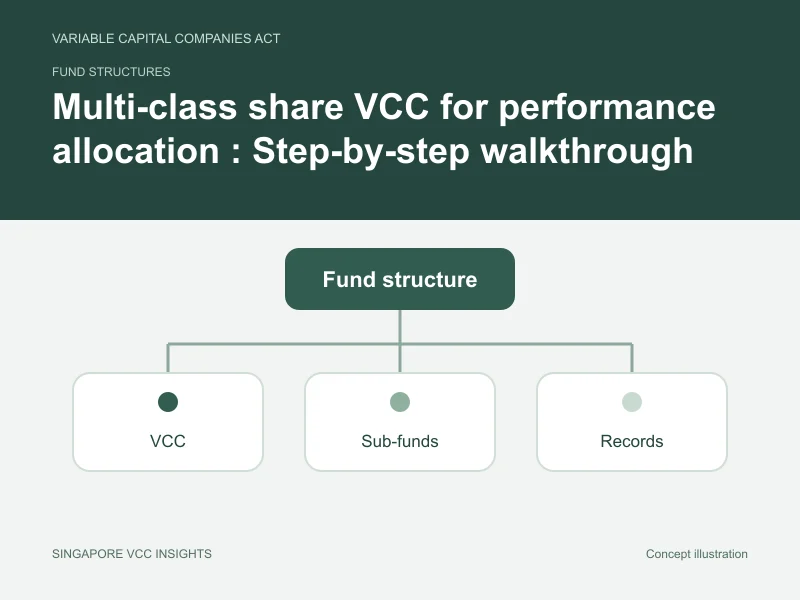
A multi-class share VCC for performance allocation uses Singapore’s Variable Capital Company framework to give different investor groups distinct economic rights, including how carried interest and performance fees are allocated. By issuing multiple share classes within a VCC or its sub-funds, managers can tailor fee structures cleanly. This walkthrough explains the structure, the legal basis, costs and the step-by-step setup in 2026.
Raffles Corporate Services works with a panel of corporate and employment law firms; this article is general information, not legal advice.
What a multi-class share VCC is
The Variable Capital Company (VCC) is a corporate fund vehicle designed for Singapore-domiciled investment funds. A single VCC can issue multiple classes of shares, each with different rights to fees, distributions and performance allocation, and can hold several ring-fenced sub-funds under one umbrella. Section 17 of the Variable Capital Companies Act 2018 provides for the incorporation of a VCC, and the Act allows its share capital to vary as shares are issued and redeemed at net asset value.
How performance allocation works across classes
Performance allocation, often called carried interest or a performance fee, rewards the manager for returns above a hurdle. In a multi-class VCC, founder or management classes can carry the performance entitlement while investor classes bear the fee, and different investor classes can have different hurdles, high-water marks or fee rates. Equalisation mechanics ensure investors who enter at different times are treated fairly.
The legal and regulatory framework
A VCC must be managed by a permissible fund manager that is regulated by the Monetary Authority of Singapore, such as a licensed or registered fund management company. The Variable Capital Companies Act 2018 governs incorporation, sub-funds and the segregation of assets and liabilities between sub-funds, so the assets of one sub-fund are not available to meet the liabilities of another.
Cost and timeline for a multi-class share VCC for performance allocation
ACRA’s incorporation fee for a VCC is S$8,000, considerably higher than an ordinary company, reflecting its fund nature. Professional set-up fees for legal documentation, the fund manager arrangement and the constitution are additional and depend on the number of classes and sub-funds. Incorporation itself is typically processed within around 14 to 60 days, since the application is reviewed by both ACRA and MAS.
Step-by-step setup
1. Appoint an MAS-regulated fund manager. 2. Design the class and sub-fund structure, mapping each investor group to a share class and defining the performance allocation, hurdle and high-water mark. 3. Draft the VCC constitution reflecting the variable capital and class rights. 4. Appoint directors (at least one resident and one who is a director or qualified representative of the fund manager), a company secretary and an auditor. 5. Incorporate via BizFile+ with the MAS notification. 6. Open bank and custody accounts and issue shares by class at NAV.
When a multi-class structure is worth it
Multiple classes add documentation and administration cost, so they pay off when there are genuinely different investor economics, such as seed investors with reduced fees, founders carrying performance allocation, or hedged and unhedged currency classes. For a single homogeneous investor base, a simpler single-class structure may suffice.
Official sources
Always confirm current rules and fees against the primary sources: www.mas.gov.sg, www.acra.gov.sg, sso.agc.gov.sg.
Related guides
- Single vs Multi-Family Office in Singapore (2026): Costs, Pros and Cons
- Ordinary vs Special Resolutions in Singapore Companies: A Practical Guide
- Singapore VCC vs Cayman SPC , Complete 2026 guide
FAQs
Can one VCC have different fee structures for different investors?
Yes. A VCC can issue multiple share classes, each with distinct fee, distribution and performance-allocation rights.
How is carried interest handled?
Performance allocation is typically attached to a management or founder class, with hurdles and high-water marks defined per class, supported by equalisation mechanics.
What does a VCC cost to incorporate?
ACRA’s incorporation fee is S$8,000, plus professional fees that vary with the number of classes and sub-funds.
Does a VCC need a regulated manager?
Yes. A VCC must be managed by a permissible, MAS-regulated fund management company.
Need help with this? Call, SMS or WhatsApp +65 8501 7133, or email hello@rafflescorporateservices.com. Raffles Corporate Services works with a panel of corporate and employment law firms; this article is general information, not legal advice.