Singapore VCC insights
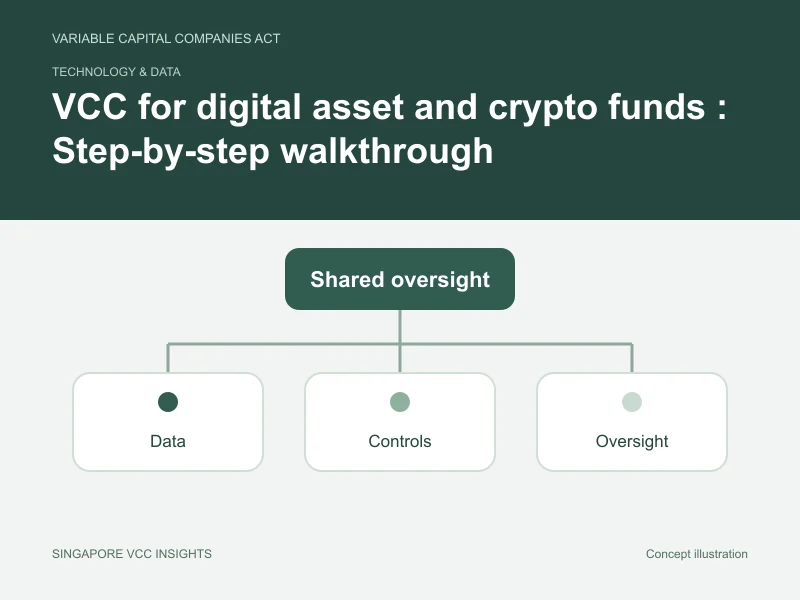
VCC for digital asset and crypto funds — Step-by-step walkthrough
A VCC for digital asset and crypto funds is a Variable Capital Company used to hold tokens, digital assets and crypto strategies under a regulated Singapore fund vehicle. The structure works for crypto because it pairs corporate fund flexibility with a MAS-regulated manager and sub-fund segregation, but it adds custody, valuation and licensing layers specific to digital assets. This walkthrough explains how a crypto VCC works, who should use it, and the set-up steps, costs and timeline in 2026.
Raffles Corporate Services works with a panel of corporate and employment law firms; this article is general information, not legal advice.
What a VCC is and why crypto managers use it
The Variable Capital Company, introduced under the Variable Capital Companies Act 2018, is a corporate fund vehicle that can be standalone or an umbrella with segregated sub-funds. Section 17 of the Variable Capital Companies Act 2018 establishes the VCC as a body corporate constituted for collective investment, and the framework allows shares to be issued and redeemed at net asset value. For digital-asset managers, the VCC offers a recognised, onshore fund wrapper that institutional investors and banking counterparties are more comfortable with than an offshore unregulated entity. The umbrella design lets a manager run distinct strategies , for example a liquid-token sub-fund and an early-stage token sub-fund , under one roof with legal segregation between them.
Who should use a crypto VCC
The structure suits digital-asset managers raising third-party capital who want a credible, MAS-anchored Singapore vehicle, and who can meet the custody and valuation demands of crypto. It suits managers running multiple strategies that benefit from sub-fund segregation. It is less suited to an individual trading personal crypto, for whom the regulatory and operational overhead is excessive. Because crypto sits within an evolving regulatory perimeter, managers should scope the licensing position carefully before committing, and compare the VCC against alternative structures.
Eligibility and the crypto-specific requirements
A crypto VCC carries the standard VCC requirements , a permissible fund manager regulated by the Monetary Authority of Singapore, a Singapore-resident director and a director common with the manager, a corporate secretary and an auditor. On top of these, digital-asset activity engages additional regulation: dealing in or providing services around digital payment tokens can require licensing under the Payment Services Act 2019, and where the tokens are capital-markets products the Securities and Futures Act 2001 applies to the offer and the manager’s activity. Custody is the defining operational challenge , institutional-grade qualified custody for digital assets is expected, not self-custody. Valuation policies must address thin or volatile markets. These layers are what distinguish a crypto VCC from a conventional fund.
Cost, timeline and the numbers
VCC incorporation involves ACRA name-application and incorporation fees, and professional set-up commonly runs from around S$8,000 to S$15,000 or more. Crypto funds typically sit at the higher end and beyond, because of the additional legal work on licensing analysis, custody arrangements and valuation policy. Ongoing annual costs , manager oversight, secretarial, audit, custody and valuation , frequently start in the mid tens of thousands of Singapore dollars and rise with strategy complexity. The VCC shell is often incorporated within one to three weeks once documents are ready, but the licensing assessment and custody onboarding are the real gating items and can take considerably longer. Our companion VCC for digital asset and crypto funds complete 2026 guide works through the licensing and custody analysis in detail.
Step-by-step process
First, scope the regulatory position , determine whether the strategy engages the Payment Services Act 2019, the Securities and Futures Act 2001, or both, and confirm the manager’s licensing. Second, confirm the MAS-regulated fund manager. Third, design the structure, using sub-funds to separate distinct strategies under Section 17 of the Variable Capital Companies Act 2018. Fourth, arrange qualified custody and a robust valuation policy before incorporation, not after. Fifth, incorporate the VCC with ACRA and appoint directors, secretary and auditor. Sixth, prepare offering documents fitting the relevant exemptions, admit investors, and apply for any fund tax incentive while maintaining substance. Where the holding structure interacts with company relief such as loss carry-back relief under Section 37E of the Income Tax Act, model it with advisers, and refresh the resolution mechanics with our primer on ordinary versus special resolutions in Singapore companies.
Common mistakes and gotchas
The first and most serious mistake is launching without a clear licensing analysis , crypto activity can fall under the Payment Services Act 2019 or the Securities and Futures Act 2001, and getting this wrong is a regulatory risk, not just a cost. The second is relying on self-custody rather than institutional qualified custody, which fails investor and counterparty due diligence. The third is a weak valuation policy for thin or volatile tokens, which undermines NAV and audit. The fourth is mixing unrelated strategies in one sub-fund, defeating segregation. The fifth is underestimating banking friction , opening accounts for a crypto fund takes longer than for a conventional one. Resolve each before incorporation.
Worked example , a manager running two digital-asset strategies
Consider a digital-asset manager running two distinct strategies: a liquid-token strategy trading established cryptocurrencies, and an early-stage strategy investing in tokens before they list. It establishes an umbrella VCC with a sub-fund for each, segregating the higher-risk early-stage positions from the liquid book under Section 17 of the Variable Capital Companies Act 2018. Before incorporation, the manager scopes the licensing position , confirming whether the activity engages the Payment Services Act 2019, the Securities and Futures Act 2001, or both , and confirms that the fund manager holds the appropriate MAS authorisation. It arranges institutional qualified custody with a recognised digital-asset custodian, and sets a valuation policy that addresses thin and volatile markets. Set-up costs sit above the typical VCC range because of this licensing and custody work, and banking onboarding takes longer than for a conventional fund. The result is a credible, onshore, regulated wrapper that institutional investors and counterparties can underwrite, which is the principal reason a serious digital-asset manager chooses a VCC over an unregulated offshore vehicle.
The regulatory perimeter and why it must be scoped first
Digital-asset regulation in Singapore is more involved than for a conventional fund, and getting the analysis right is the precondition for everything else. Whether a token is a digital payment token, a capital-markets product or something else determines which regime applies , the Payment Services Act 2019 for payment-token services, the Securities and Futures Act 2001 for capital-markets products and the manager’s regulated activity. The manager’s own licensing must match the strategy, and the custody arrangements must meet institutional standards rather than relying on self-custody, which fails investor and counterparty due diligence. Because the regulatory perimeter continues to evolve, a manager should obtain current advice rather than relying on yesterday’s position, and should build the licensing analysis, the custody solution and the valuation policy before incorporating the VCC. Treating these as afterthoughts to be solved post-launch is the most serious mistake in the crypto-fund space, because it converts a cost problem into a regulatory one.
Authoritative sources
Confirm the framework with the regulators: the Monetary Authority of Singapore regulates fund managers, digital-payment-token services and the VCC framework; ACRA administers VCC incorporation and the VCC register; and the Inland Revenue Authority of Singapore sets the tax treatment, including the fund incentives.
FAQs
Can a VCC hold crypto and digital assets? Yes , a VCC can hold digital assets, subject to the manager’s licensing, qualified custody and a robust valuation policy.
Do crypto VCCs need extra licensing? Possibly , dealing in digital payment tokens can require licensing under the Payment Services Act 2019, and capital-markets tokens engage the Securities and Futures Act 2001.
Is self-custody acceptable? Generally no , institutional-grade qualified custody is expected for investor and counterparty due diligence.
What does set-up cost? Professional set-up commonly starts from around S$8,000 to S$15,000 and is often higher for crypto, given the licensing and custody work.
How long does it take? The VCC shell is often incorporated within one to three weeks, but licensing assessment and custody onboarding are the real gating items and take longer.
Need help with this? Call, SMS or WhatsApp +65 8501 7133, or email hello@rafflescorporateservices.com. Raffles Corporate Services works with a panel of corporate and employment law firms; this article is general information, not legal advice.