Singapore VCC insights
Singapore VCC vs Irish ICAV — Step-by-step walkthrough
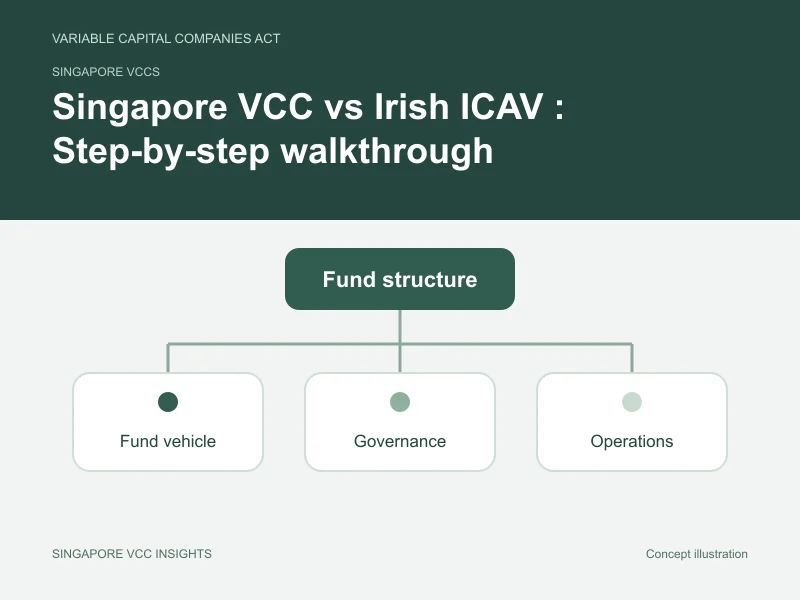
Singapore VCC vs Irish ICAV compares the Singapore Variable Capital Company with the Irish Collective Asset-management Vehicle – two corporate fund structures used to access Asian and European investors respectively. This step-by-step walkthrough covers structure, regulation, tax and the indicative 2026 costs and timelines.
Raffles Corporate Services works with a panel of corporate and employment law firms; this article is general information, not legal advice.
What each vehicle is
The Singapore VCC and the Irish ICAV are both purpose-built corporate fund vehicles with variable capital and umbrella capability. Singapore VCC vs Irish ICAV is the comparison managers make when deciding whether to anchor a platform in Asia or in the EU/UCITS ecosystem. The ICAV is an EU-domiciled vehicle widely used for UCITS and AIFs and able to elect its US tax classification, while the VCC is Singapore’s flagship Asian fund structure.
For a related perspective across the Raffles group, see our guide on Single family office sfo singapore setup costs and fees.
Who chooses which
Managers raising primarily European institutional capital, or wanting a UCITS-eligible wrapper and EU passporting, gravitate to the ICAV. Managers focused on Asian investors, family offices and regional strategies, or who value Singapore’s tax-incentive schemes and treaty network, favour the VCC.
You may also find our note on Ordinary vs special resolutions in singapore companies a practical useful for the wider context.
Regulation, tax and the statutory basis
The Variable Capital Companies Act 2018 governs the VCC, with section 29 of the Variable Capital Companies Act 2018 addressing the segregation of assets and liabilities of sub-funds within an umbrella VCC. The Irish ICAV is established under the Irish Collective Asset-management Vehicles Act 2015 and is regulated by the Central Bank of Ireland. A notable ICAV feature is its ability to elect US check-the-box classification, useful for US-taxable investors; the VCC’s edge is Singapore’s 13O/13U fund tax incentives and extensive Asian tax treaties.
Refer to the primary sources for the current position: Monetary Authority of Singapore; Accounting and Corporate Regulatory Authority.
Cost and timeline breakdown
Irish structures often carry higher ongoing regulatory and depositary costs, while the VCC can be leaner for an Asian-focused platform. Indicative 2026 figures are below.
| Item | Singapore VCC (S$) | Irish ICAV |
|---|---|---|
| Incorporation / setup | S$8,000 – S$20,000 | typically higher |
| Annual admin, audit, depositary | S$30,000 – S$80,000+ | generally higher (depositary) |
| Regulator | ACRA / MAS | Central Bank of Ireland |
| Tax feature | 13O / 13U incentives | US check-the-box election |
Step-by-step set-up (VCC route)
Sequence: appoint a Singapore-regulated manager; select standalone or umbrella form; appoint directors, administrator, custodian and auditor; incorporate with ACRA under the VCC Act; apply for the 13O or 13U tax incentive with MAS; and launch sub-funds. The ICAV route instead runs through Central Bank of Ireland authorisation and a depositary appointment.
For the procedural walkthrough, read our companion article on Singapore vcc vs irish icav complete 2026 guide.
Refer to the primary sources for the current position: Monetary Authority of Singapore; Accounting and Corporate Regulatory Authority.
Common mistakes and gotchas
Common pitfalls include choosing a domicile based on prestige rather than investor base, overlooking the ICAV’s depositary and reporting cost, and not modelling the VCC tax incentive conditions (minimum assets under management and local business spending) before committing.
Investor base drives the decision
The ICAV’s defining advantage is access to the EU market: as a UCITS or AIF wrapper it can be passported across the EU and is familiar to European institutional allocators. The VCC’s advantage is proximity to Asian capital and Singapore’s tax-incentive regime. A manager raising predominantly European institutional money will usually favour the ICAV; a manager raising Asian, Middle Eastern or family-office capital, or running Asian strategies, will usually favour the VCC. Some large platforms run both in parallel to serve different investor pools.
Regulatory and operating cost profile
The ICAV must appoint a depositary and comply with Central Bank of Ireland rules and, for UCITS, detailed eligible-asset and liquidity requirements, which adds to running cost and operational complexity. The VCC’s regime is corporate and comparatively streamlined for private funds, though it still requires a regulated manager, custodian, administrator and auditor. Sponsors should build a multi-year total-cost model rather than comparing only set-up fees, because the depositary and ongoing regulatory cost differential compounds over the fund’s life.
US-taxable investors and structuring
The ICAV’s ability to elect its US tax classification (the check-the-box election) can make it efficient for US-taxable investors, a feature the VCC does not replicate. Where a fund expects meaningful US-taxable participation, this can tilt the decision toward the ICAV; where the investor base is Asian and treaty-driven, the VCC’s incentives and treaty access dominate. Cross-border tax advice should precede the domicile decision.
Total-cost modelling over the fund’s life
Because the headline set-up fees of the VCC and ICAV can look similar, the meaningful comparison is the multi-year total cost. The ICAV’s mandatory depositary, UCITS compliance where relevant, and Central Bank of Ireland obligations add recurring cost that compounds over the fund’s life, while the VCC’s corporate regime can be leaner for a private fund. Sponsors should build a five-year model that captures administration, audit, custody or depositary, regulatory and directorship costs for each option before deciding.
Re-domiciliation and platform strategy
Managers are not locked in: a foreign corporate fund can re-domicile into a VCC, and large platforms sometimes maintain both an ICAV for European investors and a VCC for Asian investors, running parallel feeders into a common strategy. The right answer depends on where the next dollar of capital will come from. Mapping the fundraising roadmap to investor domiciles is the most reliable way to choose, because the structure should follow the capital rather than the other way round.
Singapore VCC vs Irish ICAV: key considerations
In summary, Singapore VCC vs Irish ICAV compares the Singapore Variable Capital Company with the Irish Collective Asset-management Vehicle – two corporate fund structures used to access Asian and European investors respectively. The figures above are indicative for 2026 and should be confirmed against your specific circumstances and the latest official guidance before you commit.
FAQs
Can an ICAV be marketed in Asia?
An ICAV can be offered to Asian investors on a private-placement basis subject to local rules, but it does not access Singapore’s domestic fund tax incentives the way a VCC does.
Why elect US tax classification?
The ICAV’s ability to check-the-box can make it more efficient for US-taxable investors; the VCC is generally chosen for Asian and treaty-driven strategies instead.
Which is cheaper to run?
For an Asia-focused platform the VCC is often leaner; an EU/UCITS ICAV typically carries higher depositary and regulatory costs, so the answer depends on the investor base.
Is the VCC recognised in the EU?
The VCC is not an EU-domiciled vehicle and cannot be passported under UCITS or AIFMD; it can be marketed into the EU only on a private-placement basis subject to local rules.
Why do some managers run both an ICAV and a VCC?
To serve distinct investor pools – European institutions via the ICAV and Asian or family-office capital via the VCC – while running similar strategies.
Need help with this? Call, SMS or WhatsApp +65 8501 7133, or email hello@rafflescorporateservices.com. Raffles Corporate Services works with a panel of corporate and employment law firms; this article is general information, not legal advice.