Independent Singapore VCC guidance
Direct answer
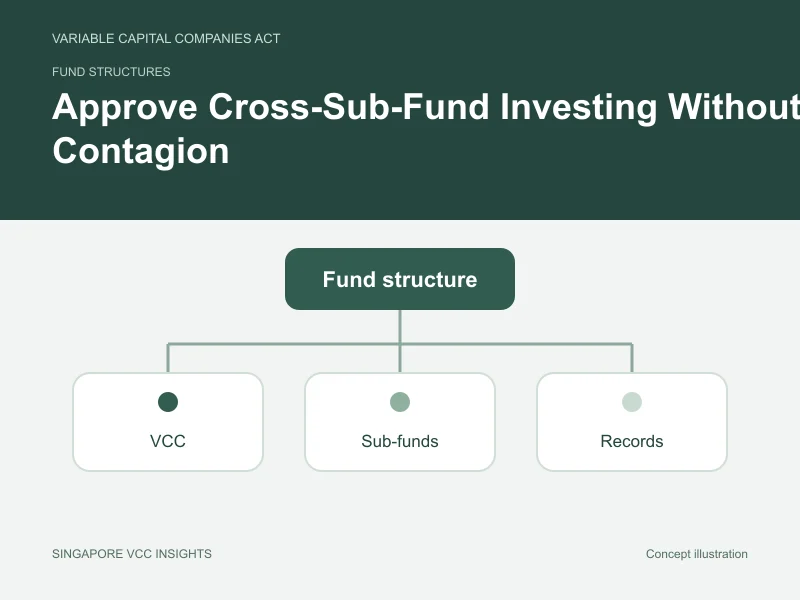
Section 31 permits an umbrella VCC, for one sub-fund’s account, to acquire shares issued for another sub-fund of the same umbrella in accordance with the applicable regulations. Permission is only the first gate. The board and manager should also confirm both mandates, investor disclosures, conflicts, valuation, liquidity, fee treatment, voting, accounting and exit mechanics. Approve the transaction only when each sub-fund can record and defend its own decision, assets, liabilities and investor outcome.
At a glance
- Treat the investing and underlying sub-funds as two decision records, not one internal journal.
- Test both mandates and disclosures before considering operational convenience.
- Neutralise avoidable fee, voting, valuation and liquidity conflicts in writing.
- Keep two-sided records that preserve the segregation of each protected pool.
- Pre-agree an exit and distress response before the first investment.
Who this is for
- An umbrella VCC considering an investment by one registered sub-fund in shares attributable to another sub-fund of that same umbrella.
Important exclusions
- A conclusion on a specific offer, tax incentive, investor restriction, accounting standard, related-party rule or foreign-law treatment.
Start with permission, then test purpose
Section 31 of the Variable Capital Companies Act is headed “Cross sub-fund investment”. It permits the umbrella VCC, for the account of one sub-fund, to acquire by subscription or transfer for consideration shares issued for another sub-fund, subject to the applicable regulations. That does not make every internal investment suitable. Write the commercial purpose in one sentence: portfolio exposure, treasury allocation, seed capital or another defined objective. If the purpose is merely to move a loss, support liquidity cosmetically or simplify an unreconciled balance, stop and redesign.
Sources: Singapore Statutes Online · ACRA- Is the transaction within section 31?Confirm that the same umbrella VCC acts for an investing sub-fund and acquires shares issued in respect of another sub-fund.
- Do both mandates allow the result?Test the investing fund’s eligible assets and concentration terms, then test the underlying fund’s investor and issuance terms.
- Can conflicts be controlled?Identify common decision-makers, fee beneficiaries, valuation dependencies, voting rights and information advantages before approval.
- Can both sides exit cleanly?Model dealing, suspension, gating, illiquidity and underlying-fund closure before the investment is accepted.
- Is a material gate unresolved?Do not approve. Obtain document-specific legal, regulatory, tax or accounting advice and record the hold reason.
Related guidance: VCC sub-funds guide
Test the two mandates independently
The investing sub-fund needs authority to hold the exposure, and the underlying sub-fund needs authority to issue or transfer the relevant shares to that investor. Compare investment objective, eligible assets, concentration limits, borrowing or leverage terms, investor eligibility, dealing frequency, valuation point, base currency, distribution policy, redemption terms and side-letter rights. A shared board or manager does not collapse those tests. Record each conclusion against the controlling clause and identify any investor notice, consent or disclosure dependency before money or shares move.
Sources: Singapore Statutes Online · ACRA · IRAS| Question | Investing sub-fund | Underlying sub-fund |
|---|---|---|
| Purpose | Why this exposure serves its portfolio objective | Why accepting the investor fits its capital plan |
| Authority | Eligible asset and concentration terms | Issue, transfer and investor-eligibility terms |
| Liquidity | Ability to fund and exit the position | Ability to meet a redemption or transfer request |
| Valuation | Price and look-through treatment | NAV, dealing price and error process |
| Disclosure | Investor understanding of indirect exposure | Investor understanding of a related internal holder |
| Failure state | Response to suspension or impairment | Treatment of a large related investor exit |
Separate conflicts from convenience
A cross-sub-fund position creates two constituencies inside one corporate umbrella. The manager may recommend the investment, value both sides, earn fees at both levels and influence dealing or voting. The administrator may calculate both NAVs from overlapping data. Build a conflict register that names the conflict, affected investors, control owner, information barrier or independent check, approval body and recurring review trigger. Recusal alone is not a complete control if the remaining decision-makers still rely on the same unchallenged valuation or recommendation.
Sources: Singapore Statutes Online · ACRA · IRAS- Identify management, performance, administration and transaction fees at both levels and remove unintended duplication where appropriate.
- Define whether the investing sub-fund may vote the underlying shares and who decides when interests diverge.
- Use an independently checked dealing price and document any valuation input shared across both NAVs.
- Set information-access rules so one investor group does not receive selective underlying-fund information.
- Record recusals, independent challenge and the basis on which the transaction remains fair to each affected pool.
Related guidance: allocate shared costs across VCC sub-funds
Preserve segregation in contracts and books
Section 29 is headed “Segregated assets and liabilities of sub-funds”. Cross-investment does not erase that architecture. Every instruction, confirmation, register entry, bank or custody movement and accounting record should name the umbrella VCC acting in respect of the correct sub-fund. The investing pool records an asset; the underlying pool records the corresponding issuance and investor position. Do not eliminate the position from operational records simply because financial reporting may later require a different presentation. Legal, investor, dealing and audit trails still need two-sided detail.
Sources: Singapore Statutes Online · Singapore Statutes Online · ACRA| Event | Investing sub-fund record | Underlying sub-fund record |
|---|---|---|
| Approval | Portfolio decision and conflict clearance | Acceptance, issue or transfer approval |
| Cash | Subscription or purchase payment | Receipt attributed to the correct protected pool |
| Shares | Investment position and cost | Member register, class and shares issued or transferred |
| Valuation | Fair value and exposure monitoring | NAV and dealing-price support |
| Income or fees | Distribution and fee recognition | Payment and expense attribution |
| Exit | Sale, transfer or redemption proceeds | Register change and liquidity event |
Related guidance: build a counterparty pack for every sub-fund
Approve a complete board paper
The board paper should identify the statutory route, commercial purpose, mandate analysis, investor impact, conflicts, price, size rationale, fee treatment, voting position, liquidity source, accounting treatment, tax questions, operational owners and stop conditions. Attach the relevant constitutional and offering clauses rather than summarising them from memory. Require the manager and administrator to confirm how the transaction will appear on both sides. If one approval body acts for both sub-funds, use separate resolutions or clearly separated findings so each protected pool’s reasoning remains visible.
Sources: Singapore Statutes Online · Singapore Statutes Online · ACRA- Prepare dual analysesWrite separate investing-fund and underlying-fund assessments, each tied to its mandate, investors, economics and risks.
- Challenge conflictsTest fees, price, voting, information and liquidity with an independent reviewer or control owner.
- Approve conditionsState the maximum exposure, price basis, permitted dealing route, monitoring triggers and conditions that automatically pause further investment.
- Release both recordsIssue coordinated instructions that name the correct sub-fund on every cash, share, register, custody and accounting entry.
- Verify first cycleReconcile the first NAV, investor ledger, fee calculation and board-condition report before treating the model as routine.
Monitor exits, distress and concentration
Monitoring should cover exposure size, underlying liquidity, valuation uncertainty, fee leakage, voting events, mandate changes, investor redemptions, suspension risk and dependency on the internal position. Predefine who acts if the underlying sub-fund gates or suspends dealing, becomes illiquid, changes strategy, accumulates a pricing error or prepares to close. The investing sub-fund must not assume the umbrella can simply move assets across pools to solve the problem. Escalate any proposed support transaction as a new decision with its own legal and fairness analysis.
Sources: Singapore Statutes Online · Singapore Statutes Online · IRASRelated guidance: close one VCC sub-fund while keeping the umbrella
Frequently asked questions
Can one VCC sub-fund invest in another sub-fund?
Section 31 provides a statutory route for an umbrella VCC, acting for one sub-fund, to acquire shares issued for another sub-fund of the same umbrella, subject to the applicable regulations. The mandates, disclosures, conflicts and operational conditions still need separate analysis.
Does statutory segregation remove investment risk?
No. Segregation allocates assets and liabilities between protected pools; it does not remove market, liquidity, valuation, concentration, operational or conflict risk in an investment. The investing sub-fund can still lose value or face a delayed exit from the underlying sub-fund.
Can the same board approve both sides?
The umbrella VCC has one board, but the paper should preserve separate findings for the investing and underlying pools. Identify conflicts, recusals and independent challenge. Obtain legal advice where investor rights, voting or the board’s decision process is uncertain.
How should management fees be handled?
Map every fee at both levels, identify the economic burden on investors and apply the governing documents. Where a waiver, rebate or offset is used, document its legal and accounting treatment and test it through the first calculation rather than relying on a commercial summary.
What happens if the underlying sub-fund suspends redemptions?
Use the pre-agreed distress plan. Reassess valuation, liquidity, disclosure, concentration and the investing fund’s own dealing position. Do not move assets or preferences across sub-funds informally. Escalate support, transfer or restructuring proposals as fresh related decisions.
Official sources and further reading
- Variable Capital Companies Act 2018 , section 31 (Singapore Statutes Online)
- Variable Capital Companies Act 2018 , section 29 (Singapore Statutes Online)
- VCC features, eligibility and requirements (ACRA)
- Post-registration guide for variable capital companies (ACRA)
- Tax Framework for Variable Capital Companies (IRAS)
- Choosing directors and key officers for a VCC (ACRA)
Discuss a Singapore VCC structure
For help coordinating a Singapore VCC setup or corporate administration, contact Raffles Corporate Services.
General information only. This article is not legal, tax, regulatory or investment advice and does not imply affiliation with or endorsement by ACRA, MAS or IRAS.