Independent Singapore VCC guidance
Direct answer
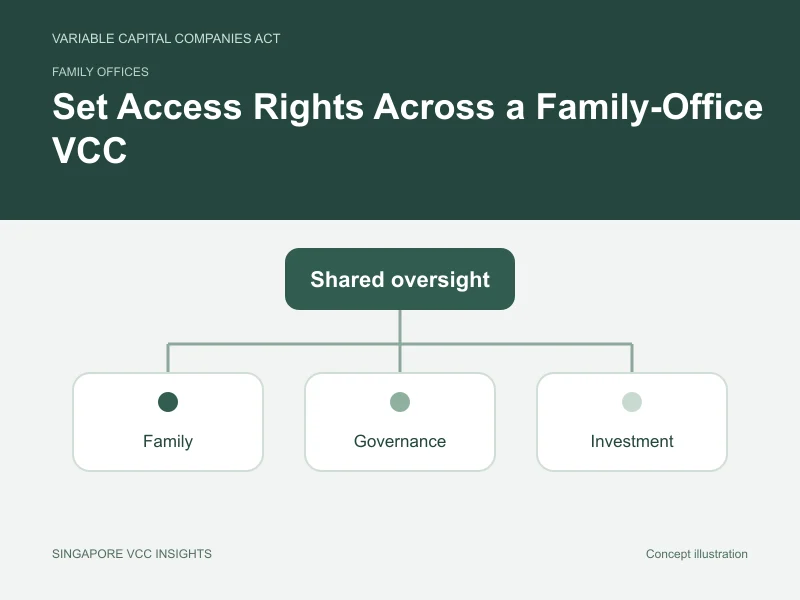
Give access according to legal role, decision purpose and protected pool, not family seniority alone. Separate family-governance records, VCC corporate records, manager investment records, administrator books, investor files and provider data. For each repository, name the owner, approved users, permitted purpose and emergency route. A family principal may influence family objectives without automatically becoming the operator of every VCC record.
At a glance
- Separate family ownership from fund decision and record rights.
- Give dual-role staff a documented capacity for each access event.
- Restrict umbrella data by sub-fund as well as by function.
- Review access when people, mandates or providers change.
Who this is for
- Family principals, family-office executives, VCC directors, managers and administrators designing a practical information-control model.
Important exclusions
- Personal privacy advice, employment monitoring, litigation disclosure, regulatory production decisions or a substitute for document-specific legal privilege analysis.
Separate the six record domains
ACRA describes a VCC as a fund structure with its own officers and explains that its member list is not public, although public authorities can request access when needed. A family office may support the structure, but it is not a reason to collapse the VCC, manager, administrator and family repositories into one shared drive. Start with the legal owner and purpose of each record.
Sources: ACRA · ACRA| Domain | Typical records | Primary access question |
|---|---|---|
| Family governance | Family constitution, succession wishes, family council papers | Who acts for the family and for what family purpose? |
| VCC corporate | Constitution, board papers, officer records, registers | Who needs the record to discharge a VCC role? |
| Fund manager | Research, orders, conflicts, mandate and risk records | Who performs or oversees the management function? |
| Fund administration | NAV, investor, dealing, ledger and reporting files | Who prepares, checks or approves fund books? |
| Investor and onboarding | Applications, identity evidence, beneficial ownership and communications | Who needs the data for a defined investor process? |
| Provider operations | Bank, custody, audit, tax and legal workspaces | What minimum information is needed for the contracted service? |
Related guidance: VCC guide for family offices
Assign access by capacity and purpose
ACRA’s officer guide distinguishes the director, company secretary, fund manager and auditor functions. Use those capacities in the access design. A person who is both a family executive and VCC director should choose and record the capacity in which a paper is received, a decision is made or an instruction is issued. Dual roles are manageable only when the authority trail remains legible.
Sources: ACRA- Is the user acting for the VCC?Provide the corporate or board material needed for that role and record any conflict restrictions.
- Is the user acting for the manager?Provide mandate, portfolio and risk information through the manager’s controlled systems.
- Is the user acting for the family?Provide the relevant family-governance information without opening unrelated investor, portfolio or provider files.
- Is the user a service provider?Provide the minimum fund, sub-fund and personal data needed for the contracted task.
- Is the purpose unclear?Pause access and ask the record owner to classify the request before release.
Related guidance: VCC board and investment committee decision rights
Apply sub-fund and investor boundaries
An umbrella VCC contains separate sub-funds, and ACRA describes each protected pool as separate from the others. The access model should therefore prevent a user working on one sub-fund from browsing another pool merely because both sit under the same umbrella. Investor files deserve a second boundary: portfolio visibility does not automatically justify access to identity, wealth-source or communication records.
Sources: ACRA · Singapore Statutes Online- Tag every repository and report with the VCC, sub-fund and record owner.
- Separate portfolio, accounting, investor and corporate permissions.
- Restrict downloads and local copies where the task can be completed in the source system.
- Use named groups rather than inherited access from a broad family-office folder.
- Test whether a user can search across unauthorised sub-funds or investor populations.
- Keep a controlled route for board-wide reporting without exposing unnecessary personal data.
Related guidance: VCC sub-funds and protected pools
Control providers and urgent exceptions
Provider access should be derived from the service agreement, data flow and actual task. Give the auditor, administrator, bank, custodian, tax adviser and counsel distinct workspaces where practical. When an urgent event requires broader access, record the reason, approving person, exact repository, time limit and post-event review. Emergency access should leave a better audit trail, not a permanent privilege.
Sources: EDB · ACRA- RequestState the user, capacity, record set, protected pool, purpose and expected duration.
- ApproveRoute the request to the legal or operational owner and record any conflict or confidentiality condition.
- ProvisionUse the narrowest group, folder, report or system role that completes the task.
- MonitorReview downloads, exports, failed searches and unusual access during the exception window.
- Revoke and reviewRemove the temporary right, confirm copied data handling and document whether the standing model needs repair.
Run a quarterly access certification
Build a certification report by person rather than by folder. It should show each user’s family-office role, VCC capacity, manager or provider role, authorised sub-funds, investor-data access, approval owner and last use. Ask owners to remove obsolete or inherited privileges after a role change, provider transition, new sub-fund, conflict event or family-governance change.
Sources: EDB · ACRARelated guidance: family VCC related-party investment controls
Frequently asked questions
Should a family principal have access to every VCC record?
Not automatically. Define whether the principal is acting as shareholder, director, committee member or family-governance participant. Provide the records needed for that capacity and route broader requests to the appropriate owner, especially where other investors, personal data or conflicts are involved.
Can the same person work for the family office and sit on the VCC board?
Dual roles can exist, but each decision and access event should show the capacity being used. Separate email groups, repositories, meeting sessions and approval records where that helps prevent a family instruction from being mistaken for a VCC or manager decision.
Does an umbrella VCC need separate permissions for each sub-fund?
Use sub-fund permissions when the task, mandate or provider scope is pool-specific. A consolidated board report may span the umbrella, but underlying investor, trading and accounting records should not become universally searchable just because the board receives a summary.
How should emergency access work?
Use a named approver, precise repository, stated purpose, short validity window and enhanced logging. After the event, revoke the right, review any exports and decide whether the ordinary process was deficient. Do not convert urgency into permanent broad access.
What is the simplest access review?
Review by person and capacity. Ask what role authorises each permission, which VCC or sub-fund it covers, what the user did with it and whether the task still exists. Folder-by-folder reviews often miss inherited and cross-system privileges.
Official sources and further reading
- Understanding VCC features, eligibility and requirements (ACRA)
- Choosing directors and key officers for a VCC (ACRA)
- Variable Capital Companies Act 2018 (Singapore Statutes Online)
- Family Offices in Singapore (EDB)
Discuss a Singapore VCC structure
For help coordinating a Singapore VCC setup or corporate administration, contact Raffles Corporate Services.
General information only. This article is not legal, tax, regulatory or investment advice and does not imply affiliation with or endorsement by ACRA, MAS or IRAS.