Independent Singapore VCC guidance
Direct answer
Choose the operating model by deciding four things separately: who employs the family’s team, who makes or implements investment decisions, who holds the assets, and who coordinates tax, succession, governance and reporting. A single-family office maximises dedicated control but creates an operating organisation; an MFO, external asset manager or private bank outsources different combinations of those responsibilities.
At a glance
- The provider label matters less than the actual allocation of employment, management, custody and oversight.
- A family can combine models, but every interface needs one accountable owner.
- Do not use an unsupported asset threshold as the deciding rule.
- A VCC is an investment vehicle beneath the operating model, not a substitute for the operating model.
Who this is for
- Families deciding whether to build a dedicated office or use a multi-family office, external asset manager, private bank or hybrid arrangement in Singapore.
Important exclusions
- Provider recommendations, fee quotations, tax-incentive eligibility or a conclusion that a particular family-office activity is exempt from licensing.
Separate the four operating layers
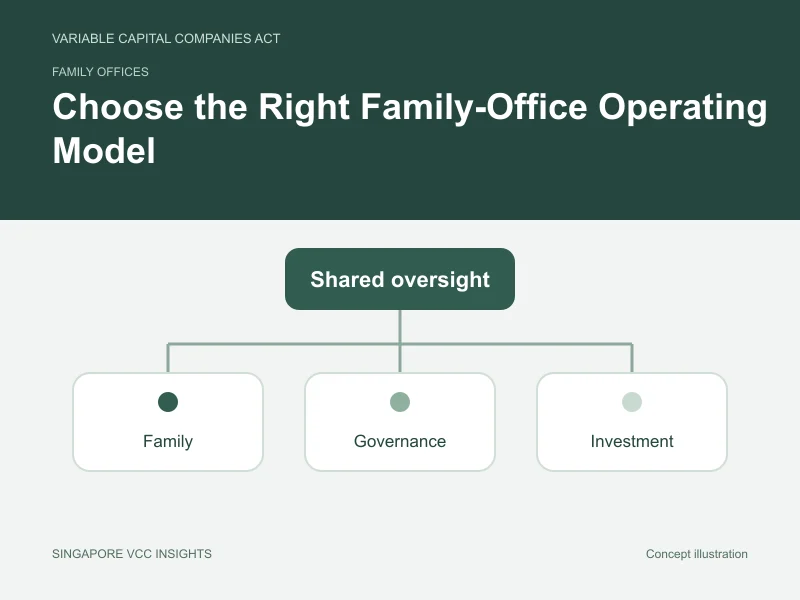
The first layer is family governance: purpose, decision rights, succession and information boundaries. The second is investment management: portfolio recommendations, discretion, execution and monitoring. The third is custody and banking: where assets and cash are held and who can instruct them. The fourth is family-office operations: consolidated reporting, administration, tax coordination, philanthropy and household or business interfaces. EDB materials describe the breadth of Singapore’s family-office ecosystem, while MAS maintains the directory used to verify regulated financial institutions. Map each layer before comparing providers.
Sources: EDB · MAS| Layer | Core question | Evidence to request |
|---|---|---|
| Family governance | Who defines purpose, reserved decisions and conflict rules? | Charter, decision matrix and reporting calendar |
| Investment management | Who has discretion, who advises and who executes? | Mandates, regulatory status and investment process |
| Custody and banking | Which institution holds assets and who can instruct accounts? | Account structure, authority matrix and statements |
| Family-office operations | Who integrates reporting, tax, succession and administration? | Service catalogue, responsibility map and escalation route |
Related guidance: family-office VCC board and investment committee roles
Understand what each model actually changes
An SFO creates a dedicated organisation for one family and may employ its own investment and non-investment professionals. An MFO shares people and systems across several families. An external asset manager focuses on investment management while assets are normally held with separate financial institutions. A private bank combines custody, execution, financing and advisory or discretionary services within a bank relationship. These descriptions are starting points, not conclusions: actual scopes differ, and regulatory status should be checked for the exact entity and activity.
Sources: EDB · EDB · MAS| Model | Typical strength | Operating burden to test | Control question |
|---|---|---|---|
| Single-family office | Dedicated people, process and family context | Employment, systems, governance and provider oversight | Does the family want to run an enduring organisation? |
| Multi-family office | Broad shared capability and integrated coordination | Provider dependency and clarity across service lines | Which responsibilities remain with the family? |
| External asset manager | Independent investment management across custody relationships | Interfaces with banks and non-investment advisers | Who integrates reporting and wider family work? |
| Private bank | Custody, execution, financing and relationship coverage | Concentration, product governance and cross-bank visibility | Is one institution’s platform enough for the mandate? |
Use a decision tree based on control and breadth
Operating-model decision tree
- Dedicated organisation?If the family wants to employ and govern a permanent multidisciplinary team, test an SFO before outsourcing the core office.
- Broad outsourced office?If integrated reporting, governance and administration matter more than building staff, test an MFO and define retained family decisions.
- Investment specialist?If the need is independent portfolio management across one or more custodians, test an external asset manager and its bank interfaces.
- Bank-led relationship?If custody, financing, execution and investment access should sit together, test a private-bank-led model and concentration safeguards.
- Hybrid needed?If no single answer covers all layers, combine models only after assigning one owner to every interface and report.
A hybrid often emerges naturally: an SFO may use external managers and private banks; an MFO may coordinate several custodians; an external manager may work alongside family governance advisers. The design succeeds when overlaps are deliberate and gaps are visible. Create a responsibility map for manager selection, trading, custody, cash, consolidated performance, legal and tax coordination, succession projects, cyber controls and incident response. Ask which party produces evidence and which party challenges it.
Sources: EDB · EDBRelated guidance: family-office VCC access-rights matrix
Place the VCC beneath the operating model
A VCC can hold a single fund or operate as an umbrella with separate sub-funds, but it does not decide who should run the wider family office. ACRA identifies a company secretary, fund manager and auditor among the VCC roles and describes the VCC as a structure mainly for investment funds rather than operating businesses. The family should first choose its operating model and regulatory perimeter, then decide whether a VCC’s fund architecture supports the investment pools, governance and reporting required.
Sources: ACRA · ACRA| Question | Why it matters | Do not assume |
|---|---|---|
| Is there a defined investment fund purpose? | The vehicle should support an investment mandate rather than general family activity. | That every family-office function belongs inside the fund. |
| Who will be the fund manager? | The appointment and operating scope need to fit the selected model. | That a family-office label resolves the manager question. |
| Are separate strategy pools needed? | An umbrella may support distinct sub-funds and records. | That sub-funds replace governance or service-provider controls. |
| Who consolidates family-wide reporting? | The VCC record covers the fund, not every family asset or obligation. | That fund administration equals full family-office reporting. |
Related guidance: VCC for family offices
Test providers with the same evidence request
Send each candidate the same mandate and responsibility schedule. Ask for the exact contracting entity, current regulatory status, service scope, custody model, key people, delegation map, conflicts, data ownership, reporting sample, incident route, termination assistance and all compensation channels. Verify status in the MAS directory where applicable. Then score candidates against the family’s required control and service breadth rather than allowing each provider to redefine the problem around its own product set.
Sources: MAS · EDBRelated guidance: VCC private-wealth governance guide
Frequently asked questions
Is an SFO always more independent than an external manager?
Not automatically. An SFO provides dedicated organisational control, but it may still depend on banks, external managers, administrators and advisers. Independence should be tested at each layer: decision rights, product selection, custody, reporting and compensation. A small internal team with concentrated provider dependence can be less independent than a well-designed outsourced model.
Can an MFO and a private bank both be used?
Yes. An MFO may coordinate family-wide work while one or more banks provide custody, financing and execution. The responsibility map should identify who selects banks, approves mandates, reconciles cross-bank data, reviews conflicts and responds to incidents. Without that map, a hybrid can create duplicated advice and unowned exceptions.
Does an EAM hold the family’s assets?
The usual distinction is that an external asset manager manages or advises while custody remains with a financial institution, but the actual contract and account structure control. Confirm the exact entity, authority, custody arrangement and instruction limits. Do not rely on the EAM label or assume that every provider uses the same model.
Where does a VCC fit in this choice?
The VCC is a fund vehicle that may sit beneath an SFO, MFO or another manager arrangement. It can organise investment pools, but it does not employ the entire family-office team or resolve family governance, succession and household administration. Design the operating model first, then assess the fund vehicle and manager appointments.
How often should the operating model be reviewed?
Review it when the family mandate, leadership, jurisdictions, asset mix, liquidity needs, provider concentration or desired service breadth changes. A useful review repeats the four-layer map, verifies current provider status, tests reporting and incident performance, and identifies whether the family has taken on work that no party is resourced to perform.
Official sources and further reading
Discuss a Singapore VCC structure
For help coordinating a Singapore VCC setup or corporate administration, contact Raffles Corporate Services.
General information only. This article is not legal, tax, regulatory or investment advice and does not imply affiliation with or endorsement by ACRA, MAS or IRAS.