Independent Singapore VCC guidance
Direct answer
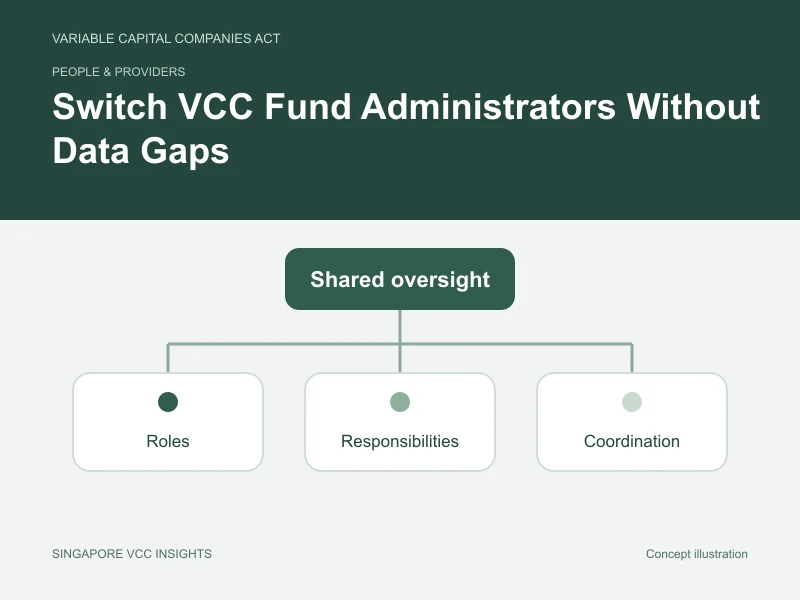
Run the administrator change as a controlled migration of records, calculations, authority and evidence. Freeze the transition perimeter, inventory every source and output, agree data definitions, reconcile opening positions, test dealing and valuation in parallel, and assign every open exception before cutover. The outgoing provider should remain accountable for its period, while the incoming provider accepts only reconciled records under a documented readiness decision.
At a glance
- Map records and decisions before negotiating the cutover date.
- Reconcile source data, not only headline balances.
- Keep period ownership and exception ownership explicit.
- Test normal and failed workflows in parallel.
- Remove access only after evidence and recovery copies are secure.
Who this is for
- VCCs changing an administrator, transfer agent or a combined provider responsible for fund records and recurring outputs.
Important exclusions
- A contract-termination opinion, data-protection assessment or assurance that a live migration is complete.
Define the migration perimeter
List every fund and sub-fund, share class, investor population, asset type, currency, dealing cycle, fee, report, interface and retained record touched by the outgoing administrator. Add services supplied through affiliates or subcontractors. MAS governance material emphasises effective oversight of VCC operations, while directors retain responsibility for informed governance of the vehicle. A transition perimeter should therefore describe both production work and the evidence needed to oversee it. If an output has no named source, owner or receiving system, it is not ready to migrate.
Sources: MAS · ACRA · Singapore Statutes OnlinePerimeter inventory
- Legal entities, umbrella, sub-funds and share classes are listed with exact identifiers.
- Investor, portfolio, cash, fee, expense, tax and reporting records have named sources.
- Manual files, email approvals and provider-hosted evidence stores are included.
- Interfaces to banks, custodians, managers, distributors and auditors are mapped.
- Historic periods, open corrections and pending transactions have responsible owners.
- Data retention, retrieval and access constraints are recorded before notice is served.
Related guidance: secretary and administrator responsibility map
Create the data contract
For each extract, define the field, format, population, valuation or effective time, control total, owner and acceptance rule. A file delivery is not acceptance. The incoming administrator should be able to explain how source records become its opening ledger, investor register, fee state and reporting history. Preserve original identifiers so later queries can trace back to the outgoing system. Where transformation is unavoidable, retain the mapping, rejected records and approval. Sensitive data should move only through authorised channels under the agreed security and privacy controls.
Sources: MAS · Singapore Statutes Online| Element | Question | Acceptance proof |
|---|---|---|
| Population | Which funds, classes, investors and periods are included? | Count and identifier reconciliation |
| Values | At what effective time and basis were amounts produced? | Control totals tied to source reports |
| History | How much transaction and change history moves? | Sample trace from origin to current state |
| Exceptions | Which records are incomplete, disputed or pending? | Named owner and resolution treatment |
| Security | Who can send, receive, decrypt and retain the extract? | Authorised transfer and access log |
Reconcile opening records
Reconcile cash, holdings, investor capital, shares, fees, expenses, receivables, payables and pending activity at the same effective point. Do not treat agreement at net asset value as proof that components match; offsetting errors can leave the headline unchanged. For umbrella VCCs, perform the reconciliation by sub-fund and class as well as in aggregate. Investigate every difference, retain both provider views and decide whether it is a correction, timing item, mapping issue or unresolved dispute. The incoming administrator should not silently load a balancing entry to force agreement.
Sources: Singapore Statutes Online · MAS · ACRAOpening-balance acceptance
- ExtractObtain locked outgoing records at the agreed effective point with control totals and source identifiers.
- LoadImport through the documented mapping and retain rejected, transformed and manually entered records.
- CompareReconcile component balances, units, transactions and investor attributes across every affected fund layer.
- ResolveClassify differences and assign corrections, timing treatment or escalation without unsupported plugs.
- ApproveRecord the accepted opening state, residual exceptions and authority for operational use.
Run parallel operating tests
Use representative normal and exception scenarios before the incoming provider becomes the sole producer. Test a subscription or commitment, redemption or distribution where relevant, investment booking, cash reconciliation, valuation input, fee calculation, investor report and board output. Add a late file, failed payment, pricing exception or corrected investor instruction. Compare not only the final number but also timestamps, approvals, exception routing and retained evidence. Parallel production should have a defined purpose and end; indefinite dual books create uncertainty about the authoritative record.
Sources: MAS · ACRA| Workflow | Normal test | Exception test |
|---|---|---|
| Investor activity | Complete instruction through register and cash | Rejected or changed instruction with approval trail |
| Portfolio and cash | Book and reconcile an ordinary event | Late or mismatched source with escalation |
| Valuation | Produce and approve a recurring cycle | Unavailable input or override with evidence |
| Fees and expenses | Calculate and allocate approved charges | Correction that affects fund or class outputs |
| Reporting | Issue a controlled draft to reviewers | Revised output after a source-data error |
Related guidance: VCC NAV error correction workflow
Make a bounded cutover decision
The cutover pack should state which records have been accepted, which tests passed, which issues remain open, who owns each issue, what work remains with the outgoing provider and what would trigger rollback or escalation. Give the decision-makers a clear go, conditional go or no-go choice. A contractual termination date should not force operational acceptance of unreconciled data. Likewise, a technically successful migration should not erase the outgoing provider’s responsibility for corrections, audit queries or reports relating to its service period.
Sources: MAS · ACRA · Singapore Statutes OnlineRelated guidance: evidence-based VCC provider review
Close access and preserve exit evidence
After cutover, secure final extracts, report archives, procedures, approvals, exception logs, correspondence and evidence needed for audit or later reconstruction. Verify that the VCC and manager can retrieve the records without relying on an outgoing employee. Remove outgoing access from bank, custody, file-transfer, reporting and collaboration systems through a controlled access review. Keep a short stabilisation period with heightened reconciliations and incident reporting. Close the transition only after the first recurring cycles pass and every residual issue has a responsible owner and due process.
Sources: MAS · ACRA · Singapore Statutes OnlineExit closure
- Final source extracts and readable archives are stored under controlled retention.
- Open audit, investor, tax and correction queries have period owners.
- Outgoing user, service and integration access is revoked and evidenced.
- Incoming access follows approved roles and maker-checker boundaries.
- The first recurring cycles are reconciled against the accepted opening state.
- Transition incidents and lessons are reported to the appropriate governance body.
Related guidance: VCC bank mandate change controls
Frequently asked questions
How long should parallel administration run?
Use enough cycles to test the material workflows and exception types for the particular fund, then end parallel production under a documented decision. A fixed generic duration can be misleading. The asset mix, dealing frequency, valuation complexity, reporting calendar and unresolved data quality issues should determine the test plan.
Can the incoming administrator rely on outgoing NAV reports?
NAV reports are useful control points but do not prove that underlying cash, holdings, investor capital, fees, expenses and pending transactions migrated correctly. The incoming provider should reconcile source components and preserve mappings. Otherwise, a headline balance may hide offsetting differences or incomplete history.
Who owns an error found after cutover?
Ownership depends on when and how the error arose, the relevant agreements, control responsibilities and correction process. Record the outgoing production period, incoming transformation, review evidence and impact before allocating work. Commercial responsibility and immediate investor-protection actions may need to be handled on separate tracks.
Should outgoing access be removed on cutover day?
Access removal should follow the approved security plan, but do not destroy the ability to retrieve records or answer valid historical queries. Secure complete archives and define any bounded residual access first. Then revoke or reduce access, review integrations and preserve evidence of who can still reach each system.
What should directors see about the transition?
Provide the perimeter, material reconciliations, test outcomes, unresolved exceptions, access status, period ownership and cutover recommendation. Directors need decision-useful evidence, not every technical file. Significant failures or uncertainty should be visible with the proposed containment, owner and next review point.
Official sources and further reading
- Governance and management of variable capital companies (MAS)
- Legal obligations of a VCC director (ACRA)
- Overview of managing a variable capital company (ACRA)
- Variable Capital Companies Act 2018 (Singapore Statutes Online)
Discuss a Singapore VCC structure
For help coordinating a Singapore VCC setup or corporate administration, contact Raffles Corporate Services.
General information only. This article is not legal, tax, regulatory or investment advice and does not imply affiliation with or endorsement by ACRA, MAS or IRAS.