Independent Singapore VCC guidance
Direct answer
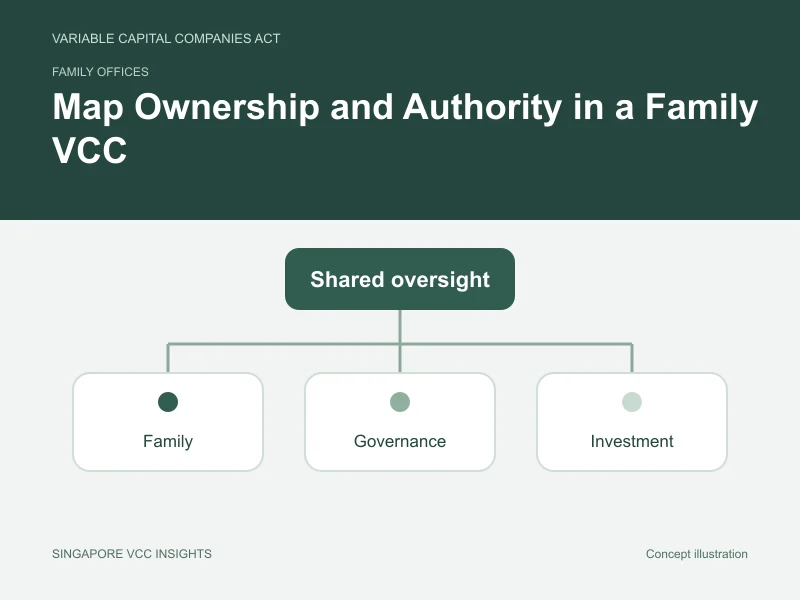
A family VCC structure map should use different lines for ownership, appointment, decision, advice and execution. Shareholders hold the VCC shares; the VCC is the asset-owning legal entity; directors govern its affairs; the appointed fund manager manages investments within its mandate; and administrators, banks, custodians and advisers perform defined services. A trust, holding company or family principal may sit above the shareholder layer, but that does not automatically give day-to-day authority inside the VCC.
At a glance
- Label every relationship by the authority it actually carries.
- Separate economic ownership from board and manager decision rights.
- Tie each line in the map to a constitution, mandate, resolution, agreement or bank authority.
- Treat family councils and advisers as advisory unless a valid document grants another role.
Who this is for
- Families documenting a VCC, umbrella or sub-fund governance structure
Important exclusions
- A substitute for trust, estate, tax, regulatory or offering-document advice
Read the map in layers
Begin at the top with the persons or entities that hold the economic interest, then move down through the VCC’s corporate layer, investment-management layer and service-provider layer. ACRA describes shareholders as owning the VCC through their shares and the VCC as a separate legal entity that can own property in its own name. Those two propositions stop a common drafting error: drawing family assets as though they remain personally owned after they have been contributed to the VCC. The map should show the legal holder of each interest and avoid using one generic arrow labelled “controls”.
Sources: Accounting and Corporate Regulatory Authority · Singapore Economic Development Board| Line type | Meaning | Typical document |
|---|---|---|
| Ownership line | Shares or another economic interest are held | Register of members, trust or holding-company record |
| Appointment line | One body appoints or removes a role holder | Constitution, resolution or service agreement |
| Decision line | The recipient has defined approval authority | Reserved-matter schedule or board delegation |
| Advice line | The recipient recommends but does not bind the VCC | Advisory agreement or committee terms |
| Execution line | The recipient implements an approved instruction | Investment mandate, bank mandate or operating procedure |
Related guidance: VCC for family offices hub
Place each participant correctly
- Who holds the shares?Place the individual, trust, holding company or other registered holder above the VCC and label only the ownership relationship actually documented.
- Who governs the VCC?Place the board inside the corporate layer and connect its authority to the constitution, resolutions and reserved-matter framework.
- Who manages investments?Place the appointed fund manager in the management layer with its mandate, limits, reporting duties and any approved delegation shown separately.
- Who gives family input?Place a family council, investment committee or principal in an advisory lane unless another valid instrument grants a defined decision right.
- Who executes and records?Place the administrator, bank, custodian, secretary and other providers under their contracts and operating authorities, not under informal family instructions.
A family office can perform several functions, but the map should not make the family office itself an all-purpose legal actor. Break it into actual entities and committees. One company may employ staff, another may be the appointed manager, and an informal family council may set non-binding preferences. If the same individual appears in several boxes, show each capacity separately. A director who is also a family member or manager representative does not stop carrying the duties and authority attached to the director role when a board decision is made.
Sources: Accounting and Corporate Regulatory Authority · Singapore Economic Development BoardRelated guidance: family-office operating model decision
Distinguish ownership from authority
Ownership answers who holds the economic interest. Authority answers who may make or implement a particular decision. A shareholder can have voting or appointment rights without being the person authorised to place trades, sign a custody instruction or approve a service-provider invoice. Conversely, a fund manager may have broad investment discretion without owning VCC shares. Write these distinctions next to the map because family teams often operate through personal trust and long relationships; the formal boundary becomes most important during disagreement, incapacity, staff turnover or an urgent transaction.
Sources: Accounting and Corporate Regulatory Authority · Accounting and Corporate Regulatory Authority · Accounting and Corporate Regulatory Authority| Decision | Primary authority question | Evidence to inspect |
|---|---|---|
| Change investment mandate | Who can approve the change and who implements it? | Constitution, offering documents, board approval and manager mandate |
| Appoint a provider | Which body contracts for the VCC or relevant sub-fund? | Board delegation, resolution and signed agreement |
| Give a bank instruction | Who is authorised for this account and purpose? | Account mandate and operating protocol |
| Admit or redeem an investor | Who decides eligibility and who processes the dealing? | Offering terms, manager or board authority and administrator procedure |
| Express family preferences | Is the input binding, advisory or an ownership vote? | Family governance document and VCC authority records |
Related guidance: family investment policy and VCC mandate
Build the document index
- Register of members and any upstream trust or holding-company ownership record.
- VCC constitution and the current board and shareholder reserved-matter schedule.
- Fund-management agreement, investment mandate and approved delegation records.
- Terms of reference for family, investment, risk or other advisory committees.
- Administrator, custody, banking, secretarial and other provider agreements and mandates.
- Umbrella and sub-fund schedule showing which contracts and accounts belong to each pool.
Give every document an owner, effective date, approval reference and replacement history. The map is unreliable if it points to an expired mandate or a committee charter that was never adopted. For an umbrella, identify whether an agreement is signed by the VCC generally or for a named sub-fund, and ensure operational teams use the same naming convention. The document index should also distinguish public registry information from private constitutional, contractual and family-governance records. That distinction helps control access without hiding the source of authority from people who need it.
Sources: Accounting and Corporate Regulatory Authority · Accounting and Corporate Regulatory AuthorityResolve overlaps before they become disputes
Overlap is not automatically a problem. A family principal may be a shareholder, director and member of an investment committee, while the family office company may employ staff and also provide services. The control is to state which capacity governs each action, how conflicts are declared and what happens when two documents appear to grant competing authority. Create a short conflict rule: pause execution, identify the affected capacity, compare the governing documents, obtain advice when needed and record the board’s resolution. Do not let a provider choose whichever instruction is easiest to follow.
Sources: Accounting and Corporate Regulatory Authority · Accounting and Corporate Regulatory Authority- Identify the actionDescribe the specific approval, instruction or execution step without relying on titles such as principal, adviser or family representative.
- Identify each capacityList every role the people involved hold and the document that grants authority in that capacity.
- Compare the instrumentsCheck the constitution, resolutions, mandate, committee terms and provider agreement for hierarchy, limits and conflicts.
- Record the resolutionDocument who resolved the overlap, any recusal, the instruction issued and the map or document updates required.
Related guidance: family consent and VCC approval boundary
Keep the map operational
Review the map whenever ownership, directors, the fund manager, committee membership, a key provider, a bank mandate or the umbrella’s sub-fund list changes. Add a light periodic confirmation even when nothing appears to have changed: each owner of a map layer confirms that the entities, people, agreements and escalation contacts remain current. Test the map with one real scenario, such as approving a mandate amendment or replacing an administrator. If the team cannot trace the decision from family input through board or manager authority to provider execution, the map is a picture rather than a control.
Sources: Accounting and Corporate Regulatory Authority · Accounting and Corporate Regulatory AuthorityFrequently asked questions
Who legally owns assets held by a VCC?
ACRA describes the VCC as a separate legal entity that can own property in its own name. Shareholders own shares in the VCC; they do not simply continue to own each underlying portfolio asset personally.
Can a family council direct the fund manager?
Only if the documented structure gives it a valid role consistent with the manager’s mandate and other governing documents. Otherwise, show the council as advisory and route binding decisions through the authorised body.
Can one person appear in several boxes?
Yes, but label each capacity separately. The authority exercised as a shareholder, director, manager representative or committee member can differ, even when the individual is the same.
Should every sub-fund have its own map?
Use one umbrella map with sub-fund overlays where participants, mandates, accounts or providers differ. The overlay should make separate assets, liabilities and operating authorities easy to trace.
What event should trigger an immediate map update?
Update it after a change in ownership, directors, fund manager, committee authority, key provider, bank mandate or sub-fund structure, and whenever a real instruction exposes an undocumented authority path.
Official sources and further reading
- Understanding VCC Features, Eligibility and Requirements (Accounting and Corporate Regulatory Authority)
- Choosing Directors and Key Officers for a VCC (Accounting and Corporate Regulatory Authority)
- Registering a Variable Capital Company (Accounting and Corporate Regulatory Authority)
- Family Offices in Singapore Report (Singapore Economic Development Board)
Discuss a Singapore VCC structure
For help coordinating a Singapore VCC setup or corporate administration, contact Raffles Corporate Services.
General information only. This article is not legal, tax, regulatory or investment advice and does not imply affiliation with or endorsement by ACRA, MAS or IRAS.