Independent Singapore VCC guidance
Direct answer
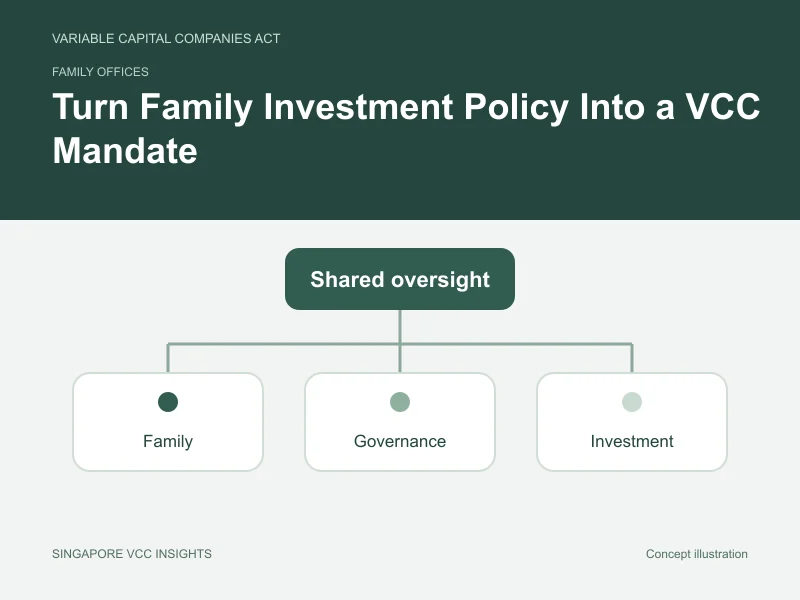
Keep the family policy and the VCC mandate separate but connected. The policy should state the family outcomes, time horizons, liquidity needs, risk boundaries and governance preferences. The mandate should convert the approved investment constraints into instructions the appointed manager can implement, measure and report. Do not turn every family preference into a trading rule or let informal requests override the mandate; define who may change policy, who may adjust implementation, and when the manager must escalate.
At a glance
- Write family outcomes before selecting asset classes or products.
- Translate only investment-relevant constraints into the manager mandate.
- Separate owner preferences, VCC governance and regulated investment decisions.
- Make liquidity, concentration and related-party boundaries measurable.
- Use a controlled change path for exceptions, new objectives and temporary instructions.
Who this is for
- Families and their governance teams aligning an investment policy with a VCC managed through an appointed fund manager.
Important exclusions
- Personal investment advice, asset-allocation recommendations or a legal conclusion on who holds authority in a particular family.
Separate policy from mandate
A family investment policy expresses durable objectives and constraints across the family wealth context. A VCC investment mandate governs how the appointed manager handles the assets within the fund structure. The two records should connect, but they do not serve the same audience or allocate the same authority. EDB family-office materials place investment strategy alongside governance and succession considerations, while ACRA describes the VCC as an investment-fund structure with its own officers and operating requirements.
Sources: Singapore EDB · ACRA| Question | Family policy | VCC mandate |
|---|---|---|
| Purpose | What outcomes and trade-offs the family accepts | What the manager may implement for the fund |
| Horizon | Family and generational time frames | Portfolio horizons and liquidity constraints |
| Authority | Who approves family-level changes | Who decides investments and handles mandate exceptions |
| Measurement | Outcome and risk indicators for the family | Portfolio, limit and performance reporting |
| Change | Family governance process | Controlled amendment, escalation and implementation path |
Related guidance: VCC for family offices guide
Start with family outcomes
Begin with outcomes rather than products: preservation of purchasing power, funding for family needs, long-term growth, support for operating businesses, intergenerational transfers or defined giving commitments. State the time horizon and what can change it. Separate recurring household or family-office cash needs from capital that genuinely belongs in the investment pool. A clear outcome statement helps the manager understand why a constraint exists without inviting the manager to make personal, succession or ownership decisions outside the fund mandate.
Sources: Singapore EDB · Singapore EDBOutcome-definition questions
- Which family obligations are funded outside the VCC and which depend on portfolio distributions?
- What time horizons apply to operating liquidity, strategic reserves and long-term capital?
- Which losses, concentrations or illiquidity would undermine an agreed family objective?
- Are any assets retained for identity, control or legacy reasons rather than financial optimisation?
- Who may change an objective and what evidence should accompany that decision?
Related guidance: family liquidity and VCC portfolio cash boundaries
Convert constraints into investable rules
The mandate needs rules that the manager and administrator can apply consistently. Replace vague instructions such as avoid excessive risk with defined portfolio boundaries, monitoring indicators and escalation triggers suited to the strategy. Distinguish a hard prohibition from a target range, preference or review trigger. Where a family wishes to retain or avoid a particular asset, document whether that instruction applies to the VCC, another holding vehicle or the family balance sheet. Unclear entity scope is a common source of mandate drift.
Sources: MAS · ACRA| Family statement | Mandate question | Evidence of control |
|---|---|---|
| Keep adequate liquidity | What obligations, horizon and portfolio sources are in scope? | Forecast, buffer logic and escalation indicator |
| Avoid over-concentration | What exposure measure and aggregation rule apply? | Limit report and look-through method |
| Invest responsibly | Which exclusions, selection criteria or stewardship expectations are intended? | Defined method and exception record |
| Protect strategic holdings | Which entity owns them and may the manager trade or hedge them? | Asset schedule and explicit authority |
| Limit related-party exposure | What relationships and approval route are captured? | Conflict record, diligence and decision evidence |
Allocate decisions to the right body
Map each decision to the capacity in which a person acts. A family principal may approve family policy, a family council may discuss shared objectives, a VCC board may oversee the company and its providers, and the appointed manager may hold investment discretion. An investment committee can advise or decide only within its documented authority. Avoid a design in which the manager appears to have discretion but waits for informal approval from the principal, or in which family preference is treated as authority to direct a live fund transaction.
Sources: MAS · ACRA · Singapore EDBDecision allocation test
- Family outcomeIf the decision changes family objectives, liquidity commitments or enduring constraints, route it through the approved family governance process.
- Fund governanceIf the decision concerns the VCC, provider oversight or a reserved corporate matter, use the documented board or member route.
- Investment implementationIf the decision selects or manages investments within the mandate, follow the appointed manager’s authorised process.
- Conflict or uncertaintyIf roles overlap or authority is unclear, pause the action, record the ambiguity and obtain appropriate advice before proceeding.
Related guidance: family-office VCC board and investment committee decision
Design monitoring that answers family questions
Monitoring should connect portfolio data to the family outcome without turning the family forum into a shadow trading desk. Use a small set of indicators: progress toward the outcome, liquidity coverage, material concentrations, risk relative to approved boundaries, mandate exceptions and unresolved decisions. The manager can explain portfolio implementation and risks; the family governance body can decide whether objectives have changed. Record questions and conclusions so repeated concern becomes a policy review rather than a stream of informal instructions.
Sources: Singapore EDB · MASA useful policy-to-mandate dashboard
- Outcome indicator with a clear explanation of what the portfolio can and cannot control.
- Liquidity view that distinguishes known family needs from fund-level portfolio cash.
- Concentration and risk measures using the aggregation method stated in the mandate.
- Mandate exceptions, temporary approvals and remediation status.
- Decisions required from the family governance body, board or manager, kept in separate lanes.
Control changes and exceptional requests
Define a change taxonomy before pressure arrives. A policy change alters an enduring family objective or constraint. A mandate amendment changes the manager’s instructions. A temporary exception permits a bounded departure with an expiry, monitoring and closure test. An emergency response uses the authority already granted for a disruption. Each route needs a proposer, evidence, decision-maker, effective date and communication path. Do not backdate a mandate change to legitimise a transaction or leave an exception open without an expiry and review.
Sources: MAS · ACRA| Change type | Decision owner | Minimum record |
|---|---|---|
| Family policy change | Approved family governance body | Reason, affected outcome, effective date and mandate impact assessment |
| Mandate amendment | Body authorised under the fund documents | Revised instruction, approvals and implementation confirmation |
| Temporary exception | Named exception authority | Scope, rationale, limit, expiry, monitoring and closure |
| Operational emergency | Existing contingency authority | Event facts, actions, communications and restoration evidence |
Related guidance: VCC mandate-breach response plan
Test the design with worked scenarios
Before approval, test the policy and mandate against plausible situations. Ask whether the family needs a large distribution, a strategic holding breaches a concentration boundary, an attractive investment conflicts with a stated exclusion, a principal asks the manager to trade immediately, or market stress changes liquidity assumptions. For each scenario, identify who decides, which record governs, what the manager may do without further approval, what is reported and whether an exception expires. Ambiguous answers reveal drafting or authority gaps before a live decision.
Sources: Singapore EDB · MASRelated guidance: family-office VCC continuity drill
Frequently asked questions
Is a family investment policy legally binding on the VCC manager?
That depends on how the approved policy is translated into the VCC’s governing and contractual documents. Treat the family policy as the source of objectives and constraints, then have advisers determine which terms belong in the investment-management agreement, offering documents, constitution, committee terms or internal procedures. Do not assume an informal family paper changes the manager’s authority.
Should the family principal approve every investment?
Not if the documented model gives the appointed manager investment discretion. The family can approve outcomes, enduring constraints and governance boundaries, while the manager decides within the mandate. If the desired model is advisory or approval-based, it should be designed, documented and assessed for regulatory implications rather than operating through informal calls.
How much detail belongs in the mandate?
Enough detail for the manager to implement the strategy, the administrator and control functions to measure applicable limits, and the governance bodies to identify exceptions. Avoid product-level micromanagement that becomes stale quickly. Put enduring constraints in the mandate and more changeable implementation detail in controlled schedules or procedures where the documents permit.
How should family liquidity needs be reflected?
Translate known needs into horizons, amounts or planning ranges, notice expectations and portfolio implications, while keeping household reserves and fund cash conceptually separate. The manager should understand expected outflows and applicable fund terms. The family governance body should revisit policy when needs change rather than treating every request as an emergency instruction.
What happens when a family preference conflicts with the mandate?
Pause the proposed action and classify the request. It may require a family policy decision, a formal mandate amendment, a bounded exception or no action because the request falls outside the decision-maker’s authority. Record the analysis and approvals. Do not let status within the family substitute for documented authority over the VCC or manager.
How often should the policy and mandate be reviewed?
Use both a scheduled review and event triggers. Relevant events can include a material family objective change, liquidity commitment, strategic asset change, governance transition, sustained limit pressure or operating-model change. A review should test whether the two documents still align; it need not rewrite them when objectives and implementation remain suitable.
Official sources and further reading
Discuss a Singapore VCC structure
For help coordinating a Singapore VCC setup or corporate administration, contact Raffles Corporate Services.
General information only. This article is not legal, tax, regulatory or investment advice and does not imply affiliation with or endorsement by ACRA, MAS or IRAS.