Independent Singapore VCC guidance
Direct answer
Treat a related-party provider proposal as a conflicted procurement decision, not as an automatic rejection or a convenient internal appointment. Identify every connection and benefit, freeze a common service scope, obtain evidence of capability and price on a comparable basis, separate interested input from approval, and document alternatives. Approve only when unconflicted decision-makers can explain why the appointment serves the VCC, how weaknesses are controlled, and which performance evidence will trigger remediation or exit.
At a glance
- Map relationships before evaluating the proposal.
- Use one scope and evidence standard for all options.
- Separate recommendation, approval, contracting and monitoring.
- Record why the chosen provider serves the VCC.
- Build exit triggers into the appointment record.
Who this is for
- VCC boards and sponsors considering an administrator, secretary, adviser, technology provider or other supplier connected to a stakeholder.
Important exclusions
- A legal, tax or transfer-pricing opinion on a specific arrangement, or a substitute for checking the governing documents and conflicts policy.
Map the relationship before comparing providers
Begin with ownership, control, employment, family, fee-sharing, referral and recurring commercial relationships around the proposed provider. Ask who recommended the firm, who negotiated the scope, who receives any direct or indirect benefit, and which decision-maker has worked with it elsewhere. Record facts rather than labels. A provider can create a material conflict even when it is not legally controlled by the sponsor, while common ownership alone does not prove that the appointment is unsuitable. The purpose of the map is to show where independent challenge is needed and who should not define the evidence or approval route.
Sources: Monetary Authority of Singapore · Accounting and Corporate Regulatory Authority| Question | Evidence | Decision response |
|---|---|---|
| Who benefits from the appointment? | Ownership, referral, remuneration and side-arrangement declarations | Identify interested participants and independent approvers |
| Who set the scope? | Drafts, instructions and change history | Rebuild a neutral scope if one bidder shaped it |
| Who controls information? | Data ownership and access map | Give unconflicted reviewers direct access to evidence |
| What other roles exist? | Group, employment and family relationship chart | Test capacity, influence and recurring conflicts |
| What happens on exit? | Termination, data return and transition terms | Prevent the relationship from creating operational lock-in |
Circulate the relationship statement before commercial evaluation starts. Interested people may supply facts and explain operational history, but they should not be the only reviewers of their own proposal. Minutes should identify who declared an interest, what information that person received, whether the person joined discussion, and who reached the conclusion. If the actual documents allocate authority differently from the assumed process, stop and obtain advice before a meeting is used to legitimise a decision that the participants could not make.
Sources: Accounting and Corporate Regulatory Authority · Monetary Authority of SingaporeRelated guidance: VCC directors and service-provider roles
Make capability and price comparable
Freeze the service perimeter before comparing options. State the exact VCC, sub-funds, investor profile, strategy, currencies, transaction volumes, systems, reports, filing support, dependencies and exclusions. Require the connected provider and any external benchmark option to respond to the same scope. A cheap headline can conceal missing work, while an expensive bundled proposal may include tasks already performed by another operator. Comparison should expose assumptions, duplications, one-off implementation effort, recurring work and change charges without pretending that unlike proposals are equivalent.
Sources: Monetary Authority of Singapore · Inland Revenue Authority of Singapore- Verify the proposing entity, responsible team, authorisations where relevant and actual subcontractors.
- Request service descriptions, control evidence, incident history, references and sample reporting suited to the proposed work.
- Separate one-off implementation, recurring service, pass-through expense and optional work in the commercial schedule.
- Record data sources, system interfaces, review points and responsibilities retained by the VCC or manager.
- Test capacity under launch peaks, audit requests, incidents, provider absence and an orderly exit.
- Require every reviewer to state gaps and assumptions instead of silently normalising them.
Independent evidence does not always require a full tender. A narrow appointment may be tested using a market quote, prior comparable contract, documented rate card, capability interview and reference checks. A complex or central role normally needs deeper diligence. Whatever method is proportionate, preserve the basis. The file should let a later director distinguish commercial preference from a reasoned conclusion about scope, capability, resilience and value. IRAS material on companies serving related parties also reinforces the need to understand and document the actual service arrangement before drawing a tax conclusion.
Sources: Inland Revenue Authority of Singapore · Accounting and Corporate Regulatory AuthorityRelated guidance: VCC provider directory and selection questions
Separate the four decision capacities
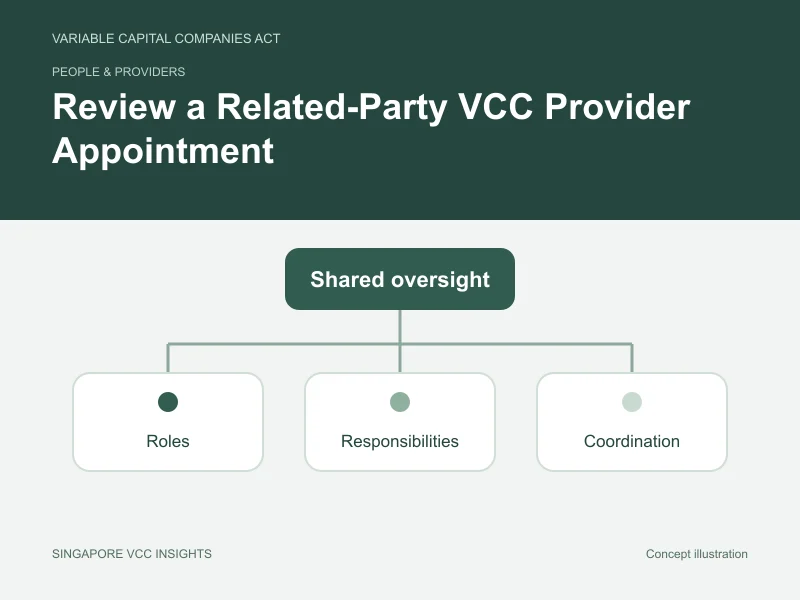
Write a short responsibility map for recommendation, challenge, approval and execution. The sponsor may describe the commercial need. The manager may assess operational fit within its mandate. Directors consider the VCC and reserved matters under the actual documents. Procurement or operations may negotiate and implement only after authority is clear. A person who holds several titles should label the capacity used at each stage. Combining all stages in one conversation makes it difficult to prove that conflicts were challenged or that conditions survived into the final contract.
Sources: Accounting and Corporate Regulatory Authority · Monetary Authority of Singapore- Declare and containComplete the relationship map, identify interested participants and set the independent review route before scoring begins.
- Compare on one basisIssue a common scope, collect capability and price evidence, and show unresolved assumptions beside every option.
- Decide with reasonsRecord authority, alternatives, challenge, recusals, conditions, rejected options and the evidence supporting the conclusion.
- Contract the decisionReconcile approved scope, controls, fees, ownership, service levels and exit terms to the executed agreement.
- Monitor and reopenUse performance and conflict changes to trigger remediation, reapproval, benchmarking or an orderly provider exit.
A conditional approval should name each condition, owner, due point and evidence. Do not treat signature as proof that a pre-appointment gap was closed. Reconcile the signed agreement and implementation plan to the approval record. If a material term changed during negotiation, send it back through the appropriate decision route. This discipline matters most when relationship pressure might encourage teams to accept an informal assurance that would not be accepted from an unrelated provider.
Sources: Monetary Authority of Singapore · Accounting and Corporate Regulatory AuthorityRelated guidance: VCC board effectiveness review
Use a decision rule that can produce no
Approve only if the unconflicted reviewers can answer four questions: does the provider have demonstrated capability for this exact scope; is the commercial basis understandable and supportable; can the VCC oversee the service without relying on the interested person; and can the arrangement be changed or exited without losing records, access or control? A no or deferral is appropriate when material information is missing, authority is uncertain, comparisons cannot be normalised, or the connected relationship prevents credible challenge.
Sources: Monetary Authority of Singapore · Accounting and Corporate Regulatory AuthorityAfter appointment, report performance against deliverables rather than relationship sentiment. Track incomplete work, aged issues, incidents, recurring manual intervention, change requests and unresolved conflicts. Compare actual charges with the approved scope and investigate work that migrates between providers. Periodically confirm ownership and relationship facts because a formerly unrelated supplier may become connected, or a connected supplier may add subcontractors and incentives. A material change should reopen the assessment instead of waiting for renewal.
Sources: Monetary Authority of Singapore · Inland Revenue Authority of SingaporeRelated guidance: VCC provider exit and handover plan
Keep an appointment file that supports oversight
The final file should include the relationship map, approved scope, responses, evidence index, comparison, conflict handling, advice questions, decision record, agreement reconciliation, implementation proof and monitoring plan. Keep source documents separate from the board summary so reviewers can trace conclusions without overcrowding minutes. Record known limitations honestly. A controlled statement that a reference was unavailable or a control remains under implementation is safer than converting an assumption into a fact.
Sources: Accounting and Corporate Regulatory Authority · Monetary Authority of Singapore · Inland Revenue Authority of Singapore- Relationship and benefit declarations are signed or otherwise attributable.
- Every option responded to the same current scope and data set.
- Capability, price, resilience, data ownership and exit evidence are indexed.
- Interested input and independent approval are distinguishable in the record.
- Contract terms and implementation tasks match approved conditions.
- Performance indicators, review cadence and reopening triggers have named owners.
The appointment file is not a one-time defence document. It should seed the live outsourcing inventory, invoice review, issue register and exit plan. When the service evolves, update the scope and ownership record rather than letting informal additions accumulate. This turns the initial conflict review into ongoing governance and gives the VCC a practical basis to renew, remediate, benchmark or replace the provider later.
Sources: Monetary Authority of Singapore · Inland Revenue Authority of SingaporeFrequently asked questions
Is a related-party provider automatically unsuitable for a VCC?
No. The relationship creates a need for disclosure, independent challenge and a defensible decision, but suitability depends on the actual scope, capability, commercial basis, governance and alternatives. The process should be capable of approving, conditioning, deferring or rejecting the proposal.
Does every appointment need a competitive tender?
Not necessarily. Use a proportionate evidence method. A narrow service may be benchmarked through comparable quotes and capability checks, while a central operational role may require a structured tender. The file should explain why the chosen method was sufficient.
Can an interested director provide information?
The governing documents and conflict process determine participation. Factual input may be useful, but the record should separate that input from challenge and decision-making. Identify attendance, declarations, departures, recusals and the unconflicted basis for the final conclusion.
What if the connected provider is the cheapest option?
Price is one input, not the decision. Normalise scope and assumptions, then assess capability, resilience, data control, service quality and exit risk. A low price is not comparable if important work is excluded or shifted to the VCC.
When should the appointment be reviewed again?
Reopen the assessment when ownership, incentives, scope, subcontracting, fees, performance, incidents or conflicts change materially. Regular reviews should also test whether the original conditions remain complete and whether the VCC can still oversee and exit the arrangement.
Official sources and further reading
- Governance and Management of Variable Capital Companies (Monetary Authority of Singapore)
- Legal obligations of a VCC director (Accounting and Corporate Regulatory Authority)
- Understanding VCC features, eligibility and requirements (Accounting and Corporate Regulatory Authority)
- Companies Servicing Only Related Parties (Inland Revenue Authority of Singapore)
- Record Keeping Requirements (Inland Revenue Authority of Singapore)
Discuss a Singapore VCC structure
For help coordinating a Singapore VCC setup or corporate administration, contact Raffles Corporate Services.
General information only. This article is not legal, tax, regulatory or investment advice and does not imply affiliation with or endorsement by ACRA, MAS or IRAS.