Singapore VCC insights
VCC parallel funds for institutional LPs — Eligibility and requirements checklist
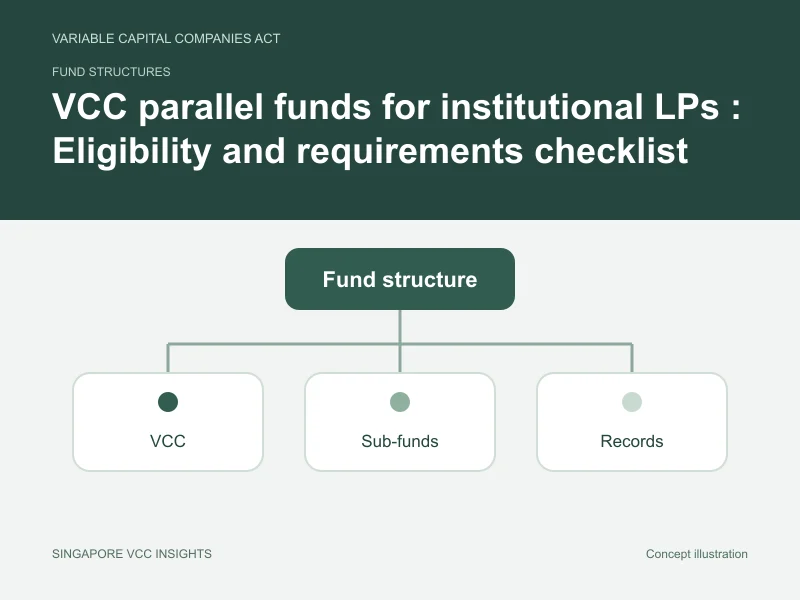
VCC parallel funds for institutional LPs run two or more Variable Capital Companies, or sub-funds, side by side that invest pro rata in the same deals, letting institutional limited partners hold through the vehicle that best fits their tax, regulatory or governance needs. This checklist explains when parallel funds fit and what is required.
Raffles Corporate Services works with a panel of corporate and employment law firms; this article is general information, not legal advice.
What parallel funds are
Parallel funds are separate but co-ordinated vehicles that invest alongside a main fund on substantially the same terms and timing. Rather than force every institutional limited partner into one structure, the manager runs parallel VCCs, or parallel sub-funds under an umbrella, so that different investor groups can each hold through a vehicle suited to them while sharing the same portfolio economics. Allocations are made pro rata across the parallel vehicles.
Why institutional LPs ask for them
Large institutions frequently have constraints a single fund cannot satisfy: a sovereign or pension investor may need a particular tax treaty position, an insurer may face regulatory capital rules, and some LPs cannot invest through vehicles holding certain assets. Parallel funds let the manager accommodate these without renegotiating the whole fund. The VCC is well suited because Section 17 of the Variable Capital Companies Act 2018 gives each vehicle legal personality, and an umbrella can keep parallel sub-funds segregated under Section 29 of the Variable Capital Companies Act 2018.
Eligibility and requirements checklist
Confirm the following: a permissible, MAS-regulated fund manager is appointed; the constitutions and side letters set out the co-investment and allocation policy clearly; expenses and deal costs are shared pro rata and documented; the tax position of each parallel vehicle, including any 13O or 13U incentive under the Income Tax Act 1947, is analysed separately; and AML and KYC are completed for the institutional LPs in each vehicle. A conflicts policy governing allocation between parallel vehicles is essential. Our note on VCC for private-equity funds covers the closely related closed-end mechanics.
Documents required
Prepare the VCC constitutions for each parallel vehicle, a co-ordinated set of offering documents, the investment management agreement, an allocation and co-investment policy, side letters for the institutional LPs, and the administration, custody and audit engagements. Where parallel sub-funds are used under one umbrella, the notification of each sub-fund to ACRA is also required.
Cost and timeline
Because parallel vehicles duplicate some documents, budget realistically: from S$15,000 to S$40,000 to establish a parallel set, depending on the number of vehicles and whether an umbrella with sub-funds is used, plus ongoing costs for each vehicle’s audit, administration and tax filing. Timelines usually run eight to fourteen weeks, driven by negotiating side letters with institutional LPs and finalising the allocation policy rather than by incorporation.
Common mistakes and gotchas
Allocation disputes are the main risk: without a clear, documented pro-rata policy, LPs in one vehicle may allege they were disadvantaged. Cost-sharing that is not genuinely pro rata is a related complaint. Managers also sometimes assume every parallel vehicle inherits the same tax incentive, when each must satisfy the conditions in its own right. Finally, side letters can conflict with the constitution if not reconciled. For the wider tax-planning context, see our guide on Estimated Chargeable Income filing, and on governance, the corporate secretary’s role in venture capital.
Official sources to check
Work from the primary materials: the Monetary Authority of Singapore explainer on the VCC and the registration and filing guidance from the Accounting and Corporate Regulatory Authority.
VCC parallel funds for institutional LPs: the takeaways
Well-run vcc parallel funds for institutional lps solve real constraints: they let sovereign, pension and insurance investors each hold through a suitable vehicle while sharing pro-rata economics. Success depends on a documented allocation policy, genuine pro-rata cost sharing, and a separate tax analysis for each vehicle.
FAQs
How do parallel funds differ from a master-feeder? Parallel funds invest directly and pro rata in each deal; feeders pool into a single master that does the investing.
Can parallel vehicles be sub-funds of one umbrella? Yes. An umbrella VCC can host parallel sub-funds, each segregated under the Act.
How are deal costs shared? Pro rata across the parallel vehicles, under a documented allocation and cost-sharing policy.
Does each parallel vehicle get the same tax treatment? Not automatically. Each must meet the conditions of any incentive it claims.
Are side letters common? Yes, especially with institutional LPs, but they must be reconciled with the constitution and offering documents.
Need help with this? Call, SMS or WhatsApp +65 8501 7133, or email hello@rafflescorporateservices.com. Raffles Corporate Services works with a panel of corporate and employment law firms; this article is general information, not legal advice.