Independent Singapore VCC guidance
Direct answer
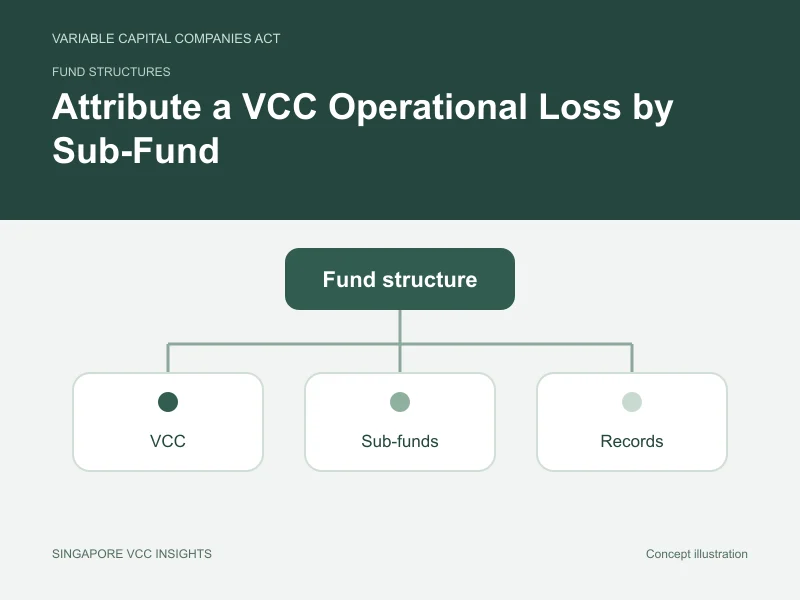
Attribute an operational loss to the VCC or sub-fund whose transaction, asset, liability or investor population was affected, then keep provider responsibility and recovery as separate questions. Freeze the event evidence, calculate the impact by date and class, decide any interim accounting treatment, assess conflicts, pursue contractual recovery and reconcile compensation to the same affected population. Do not spread a loss across an umbrella merely because service arrangements are shared.
At a glance
- Separate economic attribution from who may ultimately reimburse the fund.
- Name the affected sub-fund, class, period and investor population.
- Preserve gross loss, interim booking, recovery and residual amount as distinct fields.
- Use independent review when a related provider or manager may be responsible.
- Reconcile NAV, cash, accounting and investor outcomes before closure.
Who this is for
- Trade, cash, valuation, payment, dealing, data or provider errors that create a measurable financial effect in a VCC.
Important exclusions
- Ordinary investment losses caused by market movement or a predetermined conclusion about legal liability or insurance coverage.
Build the event record before allocating the loss
Capture the original instruction, system output, timestamps, approvals, settlement evidence, valuation files and communications before corrections begin. State what should have happened, what actually happened and when the difference became measurable. Keep the gross economic effect separate from later recoveries or accounting entries. In an umbrella VCC, label the exact sub-fund and any class or investor cohort; do not begin with an umbrella-wide allocation because the same provider served several funds.
Sources: Monetary Authority of Singapore · Accounting and Corporate Regulatory Authority · Accounting and Corporate Regulatory Authority- Preserve the original transaction, price, cash, position and investor records in read-only evidence.
- Identify the process owner, service provider, system and approval path involved in the event.
- Calculate the gross effect using controlled prices and dates, with an independent reviewer.
- Record affected sub-funds, classes and investors without netting unrelated gains or losses.
- Separate confirmed facts, assumptions, disputed responsibility and open evidence requests.
Work through a sub-fund scenario
Hypothetical scenario: an administrator applies an incorrect corporate-action election to one listed holding in Sub-Fund A. The error creates an avoidable cash shortfall and changes the NAV used for one redemption day. Sub-Fund B uses the same administrator but does not hold the security and is unaffected. The evidence therefore starts with Sub-Fund A. A later provider reimbursement may reduce the residual loss, but it does not justify charging Sub-Fund B while responsibility is being negotiated.
Sources: Monetary Authority of Singapore · Monetary Authority of Singapore · Accounting and Corporate Regulatory Authority| Field | Scenario entry | Why it matters |
|---|---|---|
| Gross economic effect | Difference between the documented correct outcome and actual cash or asset result | Shows the full event before recovery assumptions. |
| Affected population | Sub-Fund A and investors whose dealing price used the affected NAV | Prevents umbrella-wide spreading and identifies remediation scope. |
| Interim accounting | Case-specific receivable, expense or other treatment subject to advice | Keeps financial statements and NAV records aligned with the current evidence. |
| Potential recovery | Provider, insurer or other counterparty claim recorded separately | Avoids treating an uncertain recovery as completed cash. |
| Residual amount | Gross effect less realised recovery and approved compensation | Shows what remains with the affected fund after each decision. |
Decide interim treatment without prejudging liability
The investigation team should distinguish operational cause, contractual responsibility, accounting recognition, investor remediation and cash recovery. Those conclusions may mature at different times. A provider can dispute liability while the VCC still needs a reliable NAV and financial record. Use the governing documents, accounting advice and approved error policy to decide interim entries. Any receivable should reflect supportable evidence rather than a desired outcome, and the decision should be revisited when correspondence, settlement or insurance evidence changes.
Sources: Monetary Authority of Singapore · Monetary Authority of Singapore · Inland Revenue Authority of Singapore- Impact confirmed, responsibility openBook and report the effect under the approved accounting approach while maintaining a separate recovery claim and evidence schedule.
- Impact range onlyEscalate valuation uncertainty, define the range and decision owner, and avoid false precision in NAV or investor calculations.
- Provider accepts reimbursementRecord the agreed amount, payment conditions and timing, but do not mark recovery complete until cash and accounting records reconcile.
- Conflict affects the decisionUse an independent reviewer or unconflicted authority for attribution, settlement and any decision that changes investor outcomes.
Related guidance: VCC NAV oversight model comparison
Map compensation to the affected population
Compensation analysis should start from the affected economic position, not from a convenient current register. Investors may have entered or exited between the error date and discovery. Reconstruct the class NAVs, dealing transactions, distributions and account balances for the relevant period. If direct investor remediation is appropriate, define the population, calculation, materiality basis, approval and communication. If the fund receives recovery, show how it reduces the sub-fund loss and whether any amount remains attributable elsewhere.
Sources: Monetary Authority of Singapore · Monetary Authority of Singapore · Accounting and Corporate Regulatory Authority- ReconstructRebuild the correct and actual outcomes for each affected valuation or dealing point using preserved input files.
- IdentifyMap continuing, subscribing and redeeming investors to the class and transaction population affected by the difference.
- ApprovePresent calculation methods, assumptions, conflicts, alternatives and communications to the stated decision authority.
- Pay or allocateUse controlled payment and accounting instructions, then reconcile cash, units, NAV and investor statements.
- TestHave an independent reviewer reproduce the population and calculation from source evidence before final closure.
Related guidance: VCC payment approval controls
Close the case across every record
Closure requires a root-cause statement, sub-fund attribution, approved financial treatment, realised recovery record, investor-remediation decision, reconciliations and a tested control change. Link provider correspondence and insurance material without letting those documents replace the VCC decision record. Trend cases by cause and service chain so recurring issues are visible. Keep the original event data immutable, and record each later adjustment as a dated development rather than rewriting the first calculation.
Sources: Monetary Authority of Singapore · Monetary Authority of Singapore · Accounting and Corporate Regulatory AuthorityUse the sub-fund guide to maintain protected-pool attribution, the payment-control article for any reimbursement release, and the cash-exception guide to reconcile the realised recovery.
Sources: Accounting and Corporate Regulatory Authority · Monetary Authority of SingaporeRelated guidance: umbrella VCC and sub-fund guide · sub-fund cash exception reconciliation
Frequently asked questions
Is every investment loss an operational loss?
No. Market movement within the approved strategy is different from loss caused by a process, data, transaction, valuation or service failure. The case record should state the counterfactual correct outcome and supporting evidence.
Can the umbrella absorb a small sub-fund loss?
Do not assume so. Start with the affected transaction, asset, liability and investor population, then apply the governing and accounting framework. Shared providers do not by themselves justify spreading the economic effect.
Should a provider receivable be booked immediately?
That is a case-specific accounting decision. Keep the gross loss, disputed responsibility, evidence, agreed settlement and realised cash separate so an uncertain recovery is not treated as completed compensation.
How are former investors included in remediation?
Reconstruct the affected dealing and class population for the event period rather than relying only on the current register. Preserve the calculation basis, payment route and approval for every included or excluded cohort.
What proves that the case is closed?
The event, attribution, accounting, recovery, investor outcome, cash and NAV records should reconcile, and the control change should be tested. A provider payment alone does not close root-cause or investor-treatment questions.
Official sources and further reading
- Understanding VCC Features, Eligibility and Requirements (Accounting and Corporate Regulatory Authority)
- Overview of Managing a Variable Capital Company (Accounting and Corporate Regulatory Authority)
- Legal Obligations of a VCC Director (Accounting and Corporate Regulatory Authority)
- Valuation Practices for Fund Management Companies (Monetary Authority of Singapore)
- Risk Management Practices for Fund Management Companies (Monetary Authority of Singapore)
- Governance and Management of Variable Capital Companies (Monetary Authority of Singapore)
- Tax Framework for Variable Capital Companies (Inland Revenue Authority of Singapore)
Discuss a Singapore VCC structure
For help coordinating a Singapore VCC setup or corporate administration, contact Raffles Corporate Services.
General information only. This article is not legal, tax, regulatory or investment advice and does not imply affiliation with or endorsement by ACRA, MAS or IRAS.