Singapore VCC insights
VCC Act 2018: Section 86 fund administrator requirements: Documents required and templates
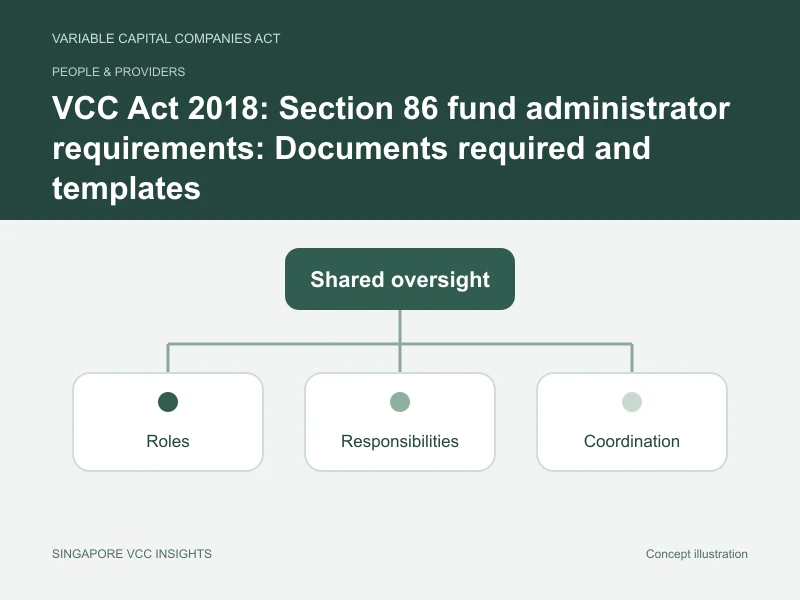
VCC Act 2018 Section 86 requires a Variable Capital Company to maintain a Singapore-based fund administrator function for its registers and accounting records, and the practical challenge is usually documenting that the administrator relationship genuinely meets the statutory test rather than finding a provider at all.
Raffles Corporate Services works with a panel of corporate and employment law firms; this article is general information, not legal advice.
What it is
Section 86 of the Variable Capital Companies Act 2018 requires a VCC to maintain its register of members and accounting records in Singapore, typically through a licensed or exempt fund administrator appointed for that purpose, alongside the corporate secretarial function every Singapore company already requires. The fund administrator handles net asset value calculation, investor register maintenance, and financial reporting support, distinct from both the fund manager’s investment role and the corporate secretary’s statutory filings.
This requirement anchors part of the VCC’s Singapore substance in its back-office function, complementing the fund manager and resident director requirements to ensure a VCC is not merely a shell with all real activity conducted offshore, but rather a vehicle with genuine operational presence spanning investment management, governance and record-keeping.
Who it’s for
Every VCC needs a fund administration arrangement in place, though the scale of the function varies significantly between a single-fund VCC with one sub-fund and a large umbrella VCC with multiple sub-funds and investor classes. It is particularly important for umbrella VCCs, where segregated sub-fund accounting and register maintenance under Section 29 depend on the administrator’s systems correctly ring-fencing each sub-fund’s assets and liabilities.
It is also directly relevant for sponsors converting an existing offshore fund into VCC form through redomiciliation, since the fund’s historical records, investor register and accounting history need to be properly migrated to a Singapore-based administration function as part of the conversion, not simply left with the original offshore administrator on an ongoing basis.
Eligibility and requirements
The fund administrator function must be based in Singapore and maintain the statutory registers and records required under the Act, with the specific licensing status depending on the scope of services provided and whether the administrator also performs regulated activities under the Securities and Futures Act. A VCC’s directors remain ultimately responsible for ensuring accurate records are kept even where day-to-day administration is outsourced, so the appointment should be governed by a clear service agreement with defined reporting obligations.
Cost and timeline
Fund administration fees vary considerably by fund size, sub-fund count and complexity, but a straightforward single-fund VCC should budget from a baseline of several thousand Singapore dollars a year, scaling materially for umbrella structures with multiple sub-funds and investor classes. Onboarding a fund administrator typically takes 4 to 8 weeks, including data migration for an existing fund converting into VCC form, and should be arranged well before the target incorporation or conversion date.
Step-by-step process
First, decide whether fund administration will be performed in-house by a licensed group entity or outsourced to an independent Singapore-based administrator. Second, negotiate a service agreement covering register maintenance, net asset value calculation frequency, and reporting timelines to the fund manager and directors. Third, ensure the administrator’s systems can segregate sub-fund records correctly if the VCC is or will become an umbrella structure. Fourth, include the administrator’s role and reporting lines in the VCC’s internal governance documentation. Fifth, review the administrator relationship periodically as the fund scales, since a provider suited to a single sub-fund may not have capacity for a growing umbrella structure.
Documents required
Prepare the fund administration service agreement, evidence of the administrator’s relevant licensing or exemption status where applicable, the register of members template maintained in the required format, and periodic net asset value and financial reporting schedules. A governance template setting out reporting frequency, escalation procedures for discrepancies, and the administrator’s business continuity arrangements helps directors demonstrate they are exercising proper oversight of the outsourced function.
Common mistakes and gotchas
The most common gotcha is assuming that outsourcing fund administration removes director responsibility for the accuracy of the VCC’s records, when in fact directors remain accountable and need genuine oversight, not just a signed contract. Umbrella VCCs sometimes appoint an administrator without confirming its systems can properly segregate sub-fund assets and liabilities, creating downstream reconciliation problems as more sub-funds are added. Some sponsors also underbudget for administration costs at the single-fund stage and are surprised by the step-up in fees once the structure expands to an umbrella VCC with several sub-funds. Finally, VCCs occasionally treat the corporate secretarial function and the fund administrator function as interchangeable, when they serve different statutory purposes and are usually provided by different specialists.
A further gotcha specific to redomiciliation cases is underestimating the effort involved in migrating historical fund records into the new administrator’s systems, particularly where the offshore fund’s prior administrator used a different accounting or reporting standard. Sponsors sometimes discover data quality or reconciliation issues only once the new Singapore-based administrator begins its own review of the migrated records, which can delay the target conversion or launch date if not identified and addressed early in the process.
Choosing between a group entity and an independent administrator
Larger fund management groups sometimes have their own affiliated fund administration entity and ask whether that affiliate can perform the Section 86 function for a new Singapore VCC. This is generally permissible provided the affiliate maintains the required Singapore-based records and the arrangement is properly governed, though sponsors should weigh the potential conflict-of-interest optics of an affiliated administrator against the cost and integration benefits of keeping the function in-house. Institutional investors conducting due diligence on a fund increasingly ask specifically whether the administrator is independent of the manager, so sponsors targeting institutional capital should factor this expectation into the choice between an affiliated and a genuinely independent administrator at the outset, rather than revisiting the decision later under investor pressure.
Related guides
For the broader tax reporting context fund administrators support, see IRAS CRS 2.0: What the Updated E-Tax Guide Means for Singapore Companies with Foreign Financial Accounts. For the corporate secretarial function that sits alongside fund administration, see Company Secretary in Singapore: Role, Duties and How to Appoint One. This is part of our statute-level series, alongside VCC Act 2018: Section 29 sub-fund segregation: documents required and templates.
FAQs
Can a VCC’s fund manager also act as its fund administrator?
It depends on the group’s structure and licensing, but many sponsors deliberately separate the two functions for governance and conflict-of-interest reasons, even where both sit within the same corporate group.
Do directors remain liable for record-keeping errors if administration is outsourced?
Yes, directors retain ultimate responsibility for the accuracy of the VCC’s registers and accounts, which is why oversight of the administrator relationship matters, not just the appointment itself.
Does an umbrella VCC need a different type of administrator to a single-fund VCC?
Not necessarily a different type, but the administrator’s systems must be capable of properly segregating each sub-fund’s assets, liabilities and investor register, which not every provider can support at scale.
How long does it take to onboard a fund administrator?
Typically 4 to 8 weeks, longer where an existing fund’s historical data needs to be migrated as part of converting into VCC form.
Numerical specifics
Typical fund administrator onboarding timeline: 4 to 8 weeks. Key statutory reference: Section 86 of the Variable Capital Companies Act 2018, read alongside Section 29 (sub-fund segregation) for umbrella structures.
Scaling administration as an umbrella VCC grows
A VCC that starts as a single-fund structure but plans to add sub-funds over time should choose an administrator with the systems capacity to scale, rather than one suited only to its initial size. Adding a new sub-fund to an existing umbrella VCC is generally a lighter exercise than the original administrator onboarding, provided the underlying systems architecture was built with multi-sub-fund segregation in mind from the start. Sponsors that select an administrator purely on initial cost, without confirming its capacity to handle additional sub-funds and more complex investor register requirements as the platform grows, sometimes face a disruptive administrator change part-way through the VCC’s life, which is materially more costly and operationally disruptive than planning for scale from the outset.
Need help with this? Call, SMS or WhatsApp +65 8501 7133, or email hello@rafflescorporateservices.com. Raffles Corporate Services works with a panel of corporate and employment law firms; this article is general information, not legal advice.
Verify the current text of the Act at Singapore Statutes Online, registration requirements at ACRA, and regulatory guidance at the Monetary Authority of Singapore.