Singapore VCC insights
Multi-class share VCC for performance allocation: Documents required and templates
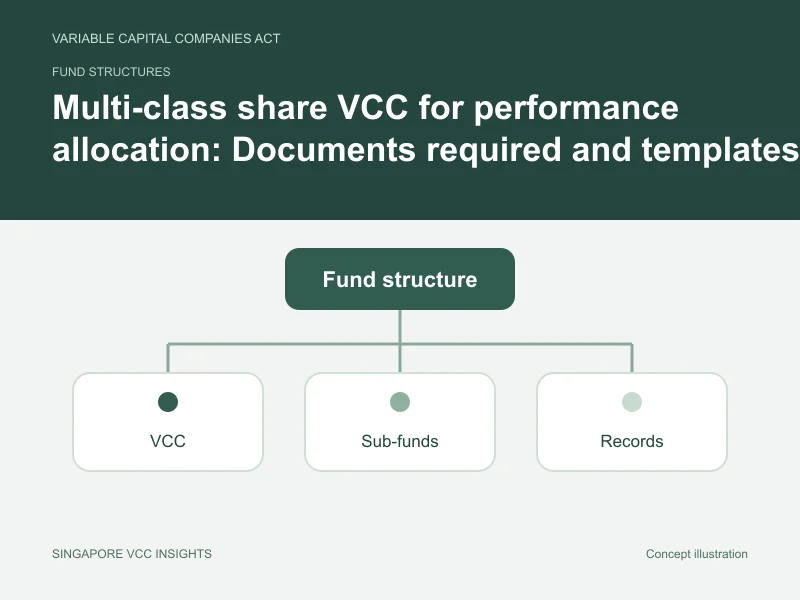
A multi-class share VCC issues distinct classes of shares under Section 34 of the Variable Capital Companies Act 2018, each carrying its own economics, so a manager can allocate performance fees, carried interest or preferred returns differently across investor classes within the same sub-fund without setting up a separate legal vehicle for each arrangement.
Raffles Corporate Services works with a panel of corporate and employment law firms; this article is general information, not legal advice.
What multi-class shares actually enable
Section 34 of the Act confirms a VCC’s shares can be issued in different classes, each with its own rights attached, letting a single sub-fund offer, for example, a founder class with reduced fees, an institutional class with a higher minimum commitment and lower management fee, and a performance-fee class structured around a specific hurdle rate or high-water mark. Because this sits within one sub-fund rather than requiring parallel legal entities, back-office administration, NAV calculation and audit can be run once across all classes, with class-level economics applied at the allocation stage.
Who this is for
This suits fund managers running strategies where different investor cohorts negotiate genuinely different fee and performance terms, early anchor investors, strategic LPs, or a manager’s own co-investment vehicle, but who want all classes to share the same underlying portfolio and NAV mechanics rather than running economically identical but legally separate sub-funds. It is also used where a manager wants a distinct class for carried interest or performance allocation entitlements tied to specific personnel or co-investment arrangements.
Documents required and templates
Core documents include the VCC’s constitution under Section 19 specifying each share class and its attached rights, a subscription agreement per class setting out the specific fee, hurdle and high-water mark terms, and board resolutions approving each new class’s issuance. Because Section 35 gives a VCC power to repurchase or redeem its own shares, redemption mechanics should be documented per class where redemption terms differ, for instance a lock-up period applying to a founder class but not an institutional class. NAV allocation methodology showing how gains, losses and fees are attributed across classes should also be documented and disclosed to investors.
Cost and timeline in numbers
Adding a new share class to an existing VCC sub-fund is typically a constitution amendment and board resolution rather than a new registration, making it considerably faster than establishing a new sub-fund or a new umbrella VCC. The main ongoing cost is the added complexity of NAV allocation across classes, which fund administrators typically price as an incremental fee on top of standard single-class NAV calculation, reflecting the extra allocation logic required each valuation cycle.
Step-by-step: setting up multi-class shares
A manager first defines the economic terms for each intended share class, fees, hurdle rates, high-water marks and any lock-up or redemption differences. It then amends the VCC’s constitution under Section 19 to authorise the new class structure and confirms this with legal counsel against Section 34’s share class provisions. The fund administrator builds the NAV allocation methodology to reflect each class’s terms before the first valuation date involving multiple classes. Subscription agreements per class are then issued to investors, with board resolutions formally approving each class’s creation retained as part of the VCC’s statutory records.
Common mistakes and gotchas
A common error is drafting class economics in side letters rather than in the constitution and subscription agreements, which can create ambiguity about which terms are actually enforceable against the VCC itself under Section 34. Another is underestimating the NAV allocation complexity multi-class structures introduce, leading to administrator errors in fee or performance allocation that surface only at audit. A third is not addressing redemption terms per class under Section 35 up front, leaving ambiguity about whether a founder class with a lock-up can be redeemed on the same terms as an institutional class without one.
FAQs
Can a single VCC sub-fund have multiple share classes? Yes, Section 34 of the Variable Capital Companies Act 2018 confirms shares can be issued in different classes with distinct rights attached.
Is adding a share class faster than creating a new sub-fund? Generally yes, since it is typically a constitution amendment rather than a new sub-fund registration under Section 27.
Do all share classes in a VCC share the same NAV? They share the same underlying portfolio, but NAV is allocated across classes according to each class’s fee, hurdle and performance terms.
Can redemption terms differ by share class? Yes, redemption is exercised under Section 35’s power to repurchase or redeem shares, and terms such as lock-ups can differ meaningfully by class.
Why use multi-class shares instead of separate sub-funds? It lets a manager offer different investor economics within one sub-fund, sharing NAV and audit infrastructure rather than duplicating it across parallel vehicles.
Related guides
For the tax treatment of carried interest that a performance-fee share class is often designed around, see MAS’s Asset Management Hub Package and the new carried interest tax exemption for Singapore fund managers. Managers comparing this structure against offshore alternatives should see VCC vs Cayman SPC: why Singapore is the new fund domicile. For a full eligibility and requirements checklist on this exact structure, see our companion piece, multi-class share VCC for performance allocation: eligibility and requirements checklist.
Authoritative background: ACRA administers VCC constitution filings, and the statutory basis for share classes and redemption is set out at Singapore Statutes Online’s Variable Capital Companies Act 2018, alongside IRAS‘s guidance on the tax treatment of fund-level performance allocations.
Need help with this? Call, SMS or WhatsApp +65 8501 7133, or email hello@rafflescorporateservices.com. Raffles Corporate Services works with a panel of corporate and employment law firms; this article is general information, not legal advice.