Singapore VCC insights
Standalone VCC vs umbrella VCC — decision framework — Step-by-step walkthrough
Raffles Corporate Services works with a panel of corporate and employment law firms; this article is general information, not legal advice.
Understanding standalone vcc vs umbrella vcc is essential for 2026. Choosing between a standalone VCC and an umbrella VCC with sub-funds is one of the first structuring decisions a Singapore fund manager makes. This walkthrough sets out a clear decision framework – covering cost, segregation, governance and scalability – so managers can pick the right variable capital company structure in 2026.
What standalone and umbrella VCCs are – standalone vcc vs umbrella vcc
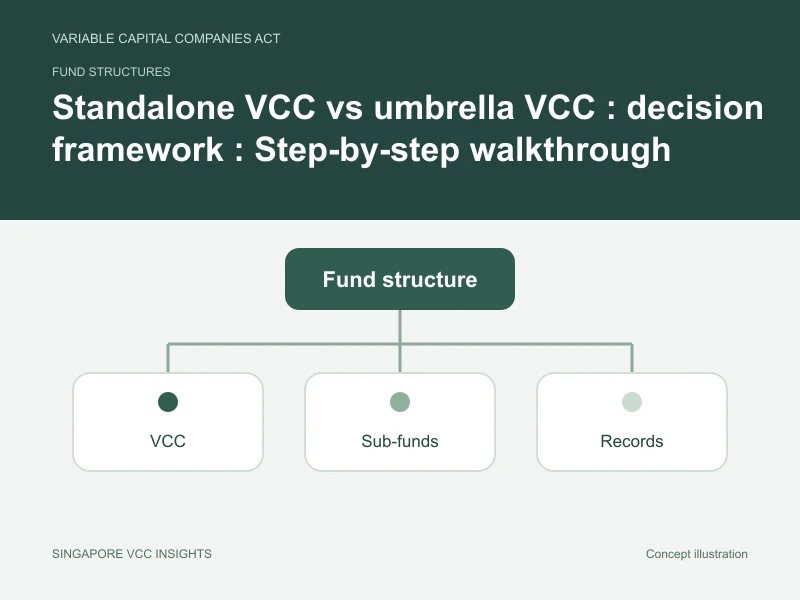
A standalone VCC is a single variable capital company holding one investment strategy or pool of capital. An umbrella VCC is a single VCC that holds two or more sub-funds, each ring-fenced from the others, under one legal entity and one board. Both are creatures of the Variable Capital Companies Act 2018.
Section 17 of the Variable Capital Companies Act 2018 establishes the VCC as a body corporate with separate legal personality, and the Act provides that the assets and liabilities of each sub-fund of an umbrella VCC are segregated, so the choice is really about how many strategies you run under one corporate roof.
For corporate-secretarial and related context, see Single vs Multi-Family Office in Singapore (2026): Costs, Pros and Cons. Our companion article Standalone VCC vs umbrella VCC , decision framework , Complete 2026 guide covers a related angle.
Who should consider each structure
A manager launching a single fund, or testing a new strategy, often starts with a standalone VCC for simplicity. A manager running multiple strategies, share classes or client mandates typically prefers an umbrella VCC, which shares one board, one auditor engagement and one set of corporate-service costs across several sub-funds.
Family offices frequently use an umbrella VCC to house distinct pools – for example, a liquid-markets sub-fund and a private-investments sub-fund – while keeping their liabilities separate.
On the immigration and employment side, see Sole proprietorship vs LLP vs Pte Ltd , Step-by-step walkthrough.
The decision framework: cost, segregation, governance, scale
On cost, the umbrella structure spreads fixed corporate and compliance costs across sub-funds, which lowers the per-strategy cost once there are two or more funds; a single strategy is usually cheaper as a standalone. On segregation, both protect investors, but an umbrella relies on statutory ring-fencing between sub-funds within one entity, whereas standalone VCCs are wholly separate companies.
On governance, the umbrella shares one board and constitution, simplifying administration but concentrating oversight; standalones give each strategy its own governance at higher aggregate cost. On scale, the umbrella is built to add sub-funds quickly, making it the default where growth into multiple strategies is expected.
Tax treatment differences
An umbrella VCC is treated as a single company for tax and files one corporate income tax return covering all its sub-funds, under the framework introduced through amendments to the Income Tax Act 1947. Two standalone VCCs file two returns. Both can apply for the fund tax exemption schemes under the Income Tax Act 1947, but the umbrella applies and tests the conditions at entity level.
This single-return efficiency is a frequent reason managers choose the umbrella once they expect more than one sub-fund.
Cost, timeline and getting it right
Incorporating either structure through ACRA generally completes within days once the Singapore fund manager and directors are in place. Setup costs commonly start from S$8,000 to S$20,000, with the umbrella's incremental cost per additional sub-fund being modest relative to launching a fresh standalone.
Model your two-to-three-year roadmap before deciding: if more than one strategy is likely, the umbrella usually wins; if not, the standalone keeps things simple.
Common mistakes and gotchas
Managers over-build with an umbrella for a single strategy, or under-build with a standalone and then face the cost of migrating to an umbrella later. Misreading the sub-fund segregation as creating separate legal entities is another common error – sub-funds are not separate companies.
Step-by-step: choosing your VCC structure
Start with the strategy count. One strategy with no near-term expansion points to a standalone VCC; two or more strategies, share classes or client mandates point to an umbrella with sub-funds. Be honest about the two-to-three-year roadmap, because migrating a standalone into an umbrella later is costly.
Weigh segregation needs. Both structures protect investors, but an umbrella relies on statutory ring-fencing of each sub-fund's assets and liabilities within one entity, while standalone VCCs are wholly separate companies. For managers who want absolute legal separation, multiple standalones may appeal despite the higher cost.
Finally, model the economics: the umbrella spreads one board, one audit engagement and one set of corporate-service costs across sub-funds, and files a single tax return, whereas standalones multiply those costs. Set the structure decision against the expected number of strategies and the cost per strategy.
Numbers that matter: cost, returns and scale
Setup costs for either structure commonly start between S$8,000 and S$20,000, but the per-strategy cost diverges as funds are added: the umbrella's incremental cost per sub-fund is modest, while each new standalone repeats the full setup. An umbrella also files one corporate income tax return for all sub-funds, against two returns for two standalones.
Incorporation through ACRA generally completes within days once the fund manager and directors are in place, so the binding constraint is the structuring decision itself rather than the filing.
Related guides and where to go next
The structure choice interacts with the tax treatment and any re-domiciliation plan, and the cross-references here point to the related tax and incorporation resources across the group. Reading this decision framework alongside the umbrella-tax and re-domiciliation guides gives the complete view.
Because the decision is hard to reverse cheaply, modelling the roadmap with a tax and corporate adviser before incorporating is the prudent step, and Raffles Corporate Services can assist.
Official sources and further reading
Always verify the current position against the primary sources: www.mas.gov.sg, www.acra.gov.sg, sso.agc.gov.sg.
FAQs
Is a sub-fund a separate legal entity?
No. Sub-funds sit within one umbrella VCC; their assets and liabilities are segregated by statute, but they are not separate companies.
Which is cheaper, standalone or umbrella?
For a single strategy, a standalone is usually cheaper; for two or more strategies, the umbrella spreads fixed costs and is generally more economical per sub-fund.
Can I start standalone and move to umbrella later?
You can, but migrating is costly, so model your roadmap before choosing.
Need help with this? Call, SMS or WhatsApp +65 8501 7133, or email hello@rafflescorporateservices.com. Raffles Corporate Services works with a panel of corporate and employment law firms; this article is general information, not legal advice.