Independent Singapore VCC guidance
Direct answer
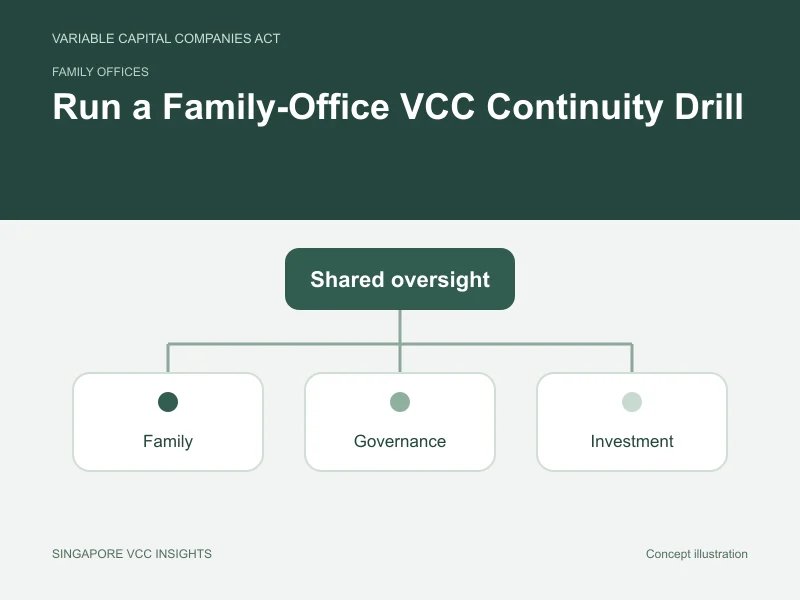
Run the drill as a controlled absence scenario: the family principal becomes unavailable, but the VCC, manager, board and providers still have to operate. Test who can verify the event, convene decisions, access records, manage portfolio and cash actions, communicate with authorised family members and restore normal governance. Record every assumption, failed handoff and remediation owner.
At a glance
- Test temporary unavailability separately from ownership succession.
- Keep family wishes, VCC governance and investment authority in distinct lanes.
- Use real records and controlled simulations rather than a discussion-only exercise.
- Test access, cash, portfolio, provider and communication workflows together.
- Turn each failed assumption into a dated remediation and retest item.
Who this is for
- Family principals, family-office executives and VCC governance teams testing operational continuity.
Important exclusions
- A live incapacity, death, family dispute or contested authority event requiring immediate legal and professional advice.
Use a bounded absence scenario
The scenario is deliberately narrow: a principal who usually gives strategic direction becomes unexpectedly unavailable, while no conclusion is assumed about legal incapacity, ownership or succession. The family office receives incomplete information and the VCC has normal portfolio, cash and provider activity approaching. This tests whether the operating model can continue without allowing a simulation to make legal findings or redistribute authority.
Sources: Singapore EDB · Singapore EDB · ACRA| Assumption | Included in drill | Excluded from drill | Professional follow-up |
|---|---|---|---|
| Principal unavailable | Communication and decision continuity | Determining legal incapacity | Review enduring authority and personal arrangements |
| VCC remains active | Board, manager and provider workflows | Changing ownership by assumption | Review governing and estate documents |
| Normal operations continue | Portfolio, cash and reporting decisions | Emergency asset transfer | Assess specific legal, investment and tax consequences |
| Family requests information | Authorised communication route | Disclosing records to any relative | Confirm confidentiality and information rights |
Related guidance: VCC for family offices guide
Separate three kinds of control
Family-office structures often combine influence in one person, but continuity improves when three questions are separated. Who owns or benefits from the family assets? Who governs the VCC and its records? Who makes investment decisions under the fund-management model? EDB materials emphasise mandate, structure, governance and succession as distinct family-office considerations, while ACRA identifies ongoing duties for the VCC and its officers.
Sources: Singapore EDB · Singapore EDB · ACRA| Lane | Question | Evidence used in drill | Failure signal |
|---|---|---|---|
| Family and ownership | Who may express family wishes or exercise ownership rights? | Governing ownership and family documents | A family title is treated as automatic legal authority |
| VCC governance | Who can convene and decide within the VCC framework? | Constitution, resolutions, role records and board procedures | No authorised route exists without the principal |
| Investment management | Who can make and supervise portfolio decisions? | Manager mandate, committee records, limits and systems | Principal habit overrides the documented manager process |
| Operations | Who can run cash, reporting and provider workflows? | Mandates, access matrix, procedures and contact tree | One unavailable person holds essential access or knowledge |
Ask participants to state the capacity in which they are acting before each decision. A family member may also be a director, committee member or employee, but those capacities have different sources and limits. The drill should expose where the operating team relies on social status or custom rather than a documented decision path.
Sources: Singapore EDB · ACRARelated guidance: family-office operating model decision
Walk through the first operating cycle
Continuity drill sequence
- Event receivedRecord what is known, what is unverified and who may receive sensitive information about the principal.
- Authority checkedLocate the current family, VCC, manager and operational authority records without assuming the conclusion.
- Governance convenedUse the documented board, committee and manager routes to classify urgent decisions and conflicts.
- Operations stabilisedTest portfolio, cash, reporting, access and provider workflows under the approved temporary operating plan.
- Communications controlledGive authorised recipients consistent factual updates while protecting confidential family and fund information.
- Normal state restoredRecord the verified return or transition trigger, remove temporary access and reconcile every action taken.
Inject realistic but non-destructive tasks: an investment proposal reaches its decision point, a cash forecast shows an upcoming obligation, an investor report needs approval and a provider asks for confirmation from the usual principal contact. Participants should work from controlled copies of current documents and systems. Observers record delays, contradictory instructions, missing access and decisions that lack a clear source.
Sources: Singapore EDB · ACRAObserver evidence
- Time taken to locate current authority and contact records.
- Decisions paused because the correct role or document could not be verified.
- Systems, files or accounts accessible only to the unavailable person.
- Conflicting messages sent or prepared for family members and providers.
- Portfolio or cash actions that depended on undocumented personal habit.
- Temporary controls created during the drill and the person who approved them.
Test portfolio and cash continuity
The drill should test whether the fund manager and approved governance bodies can operate the investment mandate without informal confirmation from the principal. Use a hypothetical proposal that is time-sensitive but not an emergency. Participants locate the mandate, limits, conflicts record, decision authority and evidence path. If the documented model says the manager decides but practice waits for the principal, record the mismatch rather than bypassing it.
Sources: ACRA · Singapore EDB| Test | Expected control | Failure to capture | Remediation owner |
|---|---|---|---|
| Time-sensitive investment proposal | Documented manager and governance decision path | Informal veto or approval outside the record | Manager and board governance owner |
| Upcoming fund expense | Approved cash forecast and payment workflow | Principal holds sole practical release knowledge | Finance and access-control owner |
| Family liquidity request | Separate ownership, redemption and fund-cash assessment | Household request treated as an automatic VCC payment | Family governance and fund counsel workstream |
| Valuation or reporting judgement | Named preparer, reviewer and approver | Approval cannot proceed without personal custom | Administrator, manager and board owner |
Related guidance: family-office VCC board versus investment committee
Control access and communications
Continuity can fail because the correct people cannot access documents, bank information, portfolio systems, secure mailboxes or provider portals. It can also fail because too many people receive sensitive information. Test the access matrix using read-only or sandbox methods where possible. Confirm that backup users can retrieve the approved records and that temporary access has a defined scope, approver and closure route.
Sources: ACRA · ACRAAccess and communication tests
- Backup decision-makers can retrieve current governing and authority records.
- Critical provider contacts are available outside one person’s private address book.
- Bank, custody, administrator and reporting access follows approved role boundaries.
- Family updates have an authorised sender, recipient group and fact-check owner.
- Sensitive medical, personal and portfolio information stays in separate controlled records.
- Temporary credentials, devices and communication groups have a documented closure step.
Prepare two short messages during the exercise: one for internal operational providers and one for authorised family recipients. Compare them for consistency, confidentiality and action requests. A provider may need to know who is acting for a defined operational purpose, while a family recipient may need a different factual update. Neither audience needs speculation about the principal’s condition or unverified future ownership.
Sources: Singapore EDB · ACRARelated guidance: family-office VCC access-rights matrix
Turn failures into a continuity backlog
End with an after-action record that distinguishes missing documents, unclear authority, inaccessible systems, provider dependencies, communication weaknesses and training gaps. Rank issues by the consequence of failure and the time needed to repair them. A high-impact issue is not closed by rewriting the plan; the team should update the source record, access, agreement or procedure and then retest it.
Sources: Singapore EDB · ACRA · ACRA| Finding | Immediate containment | Permanent fix | Retest evidence |
|---|---|---|---|
| Authority record cannot be located | Pause affected decision and identify adviser | Create controlled current authority index | Backup user retrieves and explains the record |
| Principal is sole practical approver | Use only verified existing alternatives | Align governance, mandate and systems | Sample decision completes without informal approval |
| Provider contact tree is stale | Verify contacts through trusted channels | Maintain controlled role-based directory | Simulated notification reaches every owner |
| Family communication is inconsistent | Use one approved factual update | Create recipient and approval protocol | Parallel messages pass confidentiality review |
| Temporary access has no closure | Record scope and expiry immediately | Add access lifecycle procedure | Access removal is independently verified |
Drill closure
- Every failed assumption has an accountable owner and evidence-based completion test.
- Professional review is assigned where authority, ownership or legal effect is unclear.
- Source documents and systems are updated rather than bypassed with a new summary.
- Temporary access, instructions and communication groups are removed or normalised.
- The next drill includes a different absence, provider or market-stress variation.
- The board and family-governance forum receive findings appropriate to their separate roles.
A successful drill is not one in which every simulated task finishes quickly. It is one that reveals where the family’s habits, the VCC’s formal governance and the manager’s operating model diverge while there is still time to repair them. Keep the exercise bounded, protect personal information and involve legal, tax, investment and succession advisers for findings within their scope.
Sources: Singapore EDB · Singapore EDB · ACRAFrequently asked questions
Is a continuity drill the same as succession planning?
No. Succession planning addresses longer-term ownership, governance and personal arrangements. A continuity drill tests whether current authorised people and systems can operate during a disruption. Findings may prompt succession work, but the exercise should not assume that ownership or authority has changed.
Should the principal participate in the drill?
The principal can approve the scenario and observe selected parts, but the operating test is stronger when the team must proceed without informal answers from that person. Use clear simulation boundaries so nobody mistakes the exercise for a live transfer of authority.
Can family members receive every update?
Use the information rights, confidentiality rules and communication protocol that apply to the actual structure. Family relationship alone should not determine access to personal, fund or investor information. The drill should test recipient verification and appropriate message content.
What is the safest way to test bank and trading access?
Prefer read-only inspection, sandbox tools, controlled authentication checks and test data. Stop before a live payment, trade or account change. The objective is to prove that authorised backup roles can operate and that unauthorised or obsolete access is blocked.
How often should the scenario change?
Change it after material updates and across successive exercises. Rotate the unavailable person, affected provider, market condition and decision type. Repeating one familiar scenario can confirm the script while leaving different single-person dependencies undiscovered.
Official sources and further reading
- Single family office setup guide (Singapore EDB)
- How Singapore family offices are built to last (Singapore EDB)
- Legal obligations of a VCC director (ACRA)
- Updating VCC information and officers (ACRA)
Discuss a Singapore VCC structure
For help coordinating a Singapore VCC setup or corporate administration, contact Raffles Corporate Services.
General information only. This article is not legal, tax, regulatory or investment advice and does not imply affiliation with or endorsement by ACRA, MAS or IRAS.