Independent Singapore VCC guidance
Direct answer
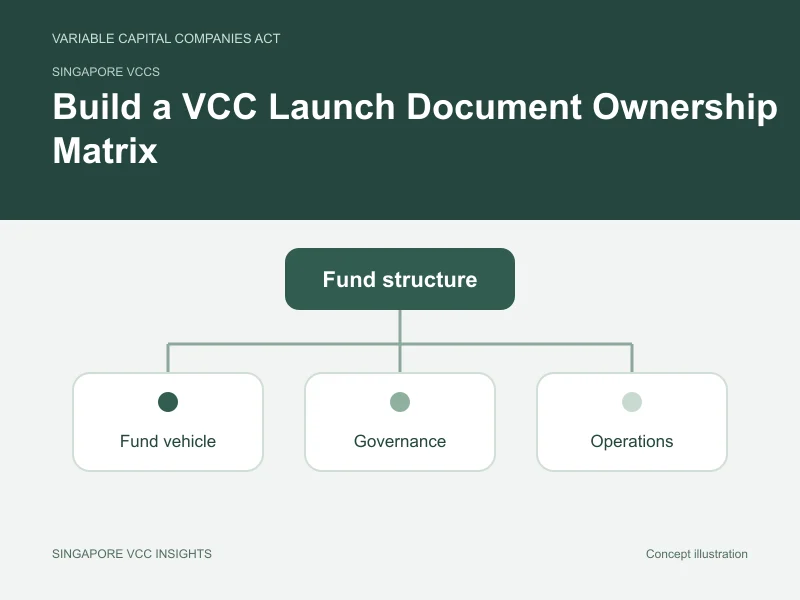
Build the launch room around document ownership, not file quantity. For every item, name the legal entity it belongs to, the preparer, the substantive approver, the final signatory, the controlled source of truth and the downstream systems that depend on it. Separate corporate records, fund terms, provider contracts, investor documents and onboarding evidence. One project owner should then block release wherever names, authorities, dates or economic terms disagree.
At a glance
- Classify every document by legal entity and business purpose.
- Separate drafting responsibility from approval and signing authority.
- Use one controlled source for names, dates, roles and economic terms.
- Close the room through dependency tests, not a count of uploaded files.
Who this is for
- New standalone or umbrella VCC launches and existing platforms adding a materially new strategy or provider stack.
Important exclusions
- A substitute for legal drafting, tax advice, licensing analysis or the onboarding requirements of a particular bank or investor.
Split the room into five document families
ACRA’s registration guide identifies the core corporate information needed for a VCC, including the approved name, VCC type, financial year end, registered office, officers, subscribers, fund manager and constitution. Those items should anchor the corporate family. Create separate families for fund and investor terms, provider contracts, operational procedures and counterparty onboarding. The separation makes conflicts visible: a constitution may define corporate authority, while an offering document describes investor economics and a service agreement allocates work to an administrator. One document should not silently override another.
Sources: ACRA · ACRA · ACRA| Family | Primary purpose | Typical source of truth |
|---|---|---|
| Corporate and registry | Establish identity, officers, authority and structure | Approved filing pack and corporate records |
| Fund and investor terms | Describe mandate, dealing, economics and investor rights | Executed offering and subscription set |
| Provider contracts | Allocate services, data, liability and exit duties | Executed agreement and schedules |
| Operational controls | Translate terms into repeatable workflows | Approved procedures and system configuration |
| Onboarding evidence | Support bank, custody, investor and counterparty acceptance | Current verified evidence repository |
Related guidance: VCC incorporation in Singapore
Assign four different kinds of owner
Avoid the single “owner” column that turns into an inbox. Use four roles: preparer, substantive approver, authorised signatory or filer, and custodian of the final record. The fund manager may own the investment mandate but not the VCC’s corporate register. Counsel may draft an offering memorandum but should not be recorded as approving the commercial economics for the sponsor. The administrator may configure dealing and accounting from the final terms but cannot cure an unresolved legal inconsistency. Name a person or role for each cell and record who resolves conflicts between families.
Sources: ACRA · ACRA · ACRA| Document or record | Preparer | Approver | Final record owner |
|---|---|---|---|
| VCC constitution and corporate resolutions | Counsel or secretary | Authorised board or members | Company secretary |
| Registry filing data and evidence | Secretary or corporate service provider | Authorised officers | Company secretary |
| Offering and subscription set | Counsel with sponsor inputs | Board and manager under the agreed route | Controlled legal or fund repository |
| Investment-management agreement | Counsel and commercial owners | VCC and manager authorities | Each contracting party |
| Administration and operating schedules | Administrator and operations leads | Contracting authorities | VCC and administrator repositories |
| Bank and custody onboarding pack | Operations with evidence owners | Authorised signatories and institutions | Controlled onboarding repository |
| Dealing, valuation and cash procedures | Manager and administrator | Named governance authority | Operations control library |
| Investor and member records | Administrator or transfer agent | Authorised acceptance owner | Controlled investor ledger |
Related guidance: VCC directors, managers, auditors and secretary guide
Create one identity and terms sheet
The most useful source-of-truth tool is a short identity and terms sheet approved before documents are finalised. It should show the legal VCC name, UEN when issued, registered office, VCC type, financial year end, officers, manager, umbrella and sub-fund relationship, share classes, base currency, key dealing definitions and authorised signatories. Each field needs a source document and status. ACRA notes that the VCC receives a UEN and business profile after successful registration; provisional drafts should be replaced from that evidence, not from memory or an email signature.
Sources: ACRA · ACRA- Give every field a controlled source document and version.
- Mark pre-registration identifiers as provisional and prevent live use.
- Use the exact registered names across contracts and onboarding packs.
- Separate umbrella, sub-fund and share-class fields visibly.
- Record which economic terms still await board or manager approval.
- Require a named reviewer to clear every mismatch before signing.
Map dependencies before parallel drafting
Parallel drafting is useful only when teams know which inputs are stable. The constitution and approved structure feed the registry submission; the registered identity feeds bank and provider records; the final offering terms feed subscription forms, administrator configuration, valuation and dealing procedures; signed provider agreements feed the responsibility map, access model and business-continuity plan. Build arrows between those items in the document index. If an upstream field changes, the index should identify every document and system that must be reopened instead of relying on participants to remember their own dependencies.
Sources: ACRA · ACRA · DBS Bank- Freeze structural inputsApprove the VCC type, umbrella architecture, proposed names, financial year end, officers and manager before finalising dependent drafts.
- Lock investor economicsConfirm mandate, dealing, fees, liquidity and class terms before configuring forms, ledgers and provider procedures.
- Execute provider responsibilitiesTranslate each signed service schedule into the operating responsibility map, access list and evidence requirements.
- Replace provisional identityUse the registration outcome and business profile to update every draft, contract, account and system field.
- Test downstream agreementTrace a sample subscription, trade, valuation and payment through the final document and provider stack.
Control versions and signatures
Use a document index that distinguishes working draft, approval draft, execution version, executed copy and superseded record. Each final item should have a unique identifier, date, parties or approving body, signatories, storage location and related dependency. Restrict edit rights to working areas and publish final copies to a read-only launch room. Never relabel an unsigned copy as final because it matches the negotiated text. Where electronic signing is used, retain the completion certificate or equivalent authentication with the executed document and ensure providers configure from the executed version.
Sources: ACRA · DBS Bank · ACRA| Status | Permitted use | Control |
|---|---|---|
| Working draft | Review and negotiation only | Editable, clearly watermarked and not distributed operationally |
| Approval draft | Formal decision against frozen text | Hash, identifier or locked PDF linked to the paper |
| Execution version | Signature only | Named parties, signing authority and final schedules confirmed |
| Executed record | Operational source of truth | Read-only copy with signature evidence and index entry |
| Superseded | Historical reference only | Removed from active folders and linked to replacement |
Related guidance: build a Singapore VCC document room for first close
Close with transaction walk-throughs
A launch room is ready when the documents work together under realistic transactions. Walk a hypothetical subscription from the offering route and investor form through acceptance, cash, allotment and the member record. Walk an investment from the mandate through approval, execution, custody, accounting and valuation. Walk a provider incident from notice through decision rights, recovery records and investor communication. Each walk-through should identify the controlling document, system owner and evidence produced. Log contradictions as launch blockers and close them through corrected final records, not explanatory side emails.
Sources: ACRA · DBS Bank · ACRARelated guidance: test Singapore VCC launch readiness
Frequently asked questions
Who owns the VCC constitution after launch?
The corporate record should sit with the VCC’s company-secretarial function, while legal advisers may retain their file and the board remains responsible for decisions under the document. Record who controls the operative copy, who may propose changes and how providers are notified of an approved alteration.
Should the fund manager own every launch document?
No. The manager owns or approves important investment and operating inputs, but corporate records belong to the VCC, provider agreements have contracting-party owners, and investor or registry records may be maintained by other appointed functions. The matrix should preserve those distinctions.
Can teams draft all documents in parallel?
Yes, but only with explicit provisional fields and dependency controls. Freeze structural and economic inputs in stages, then reopen every dependent item when an upstream field changes. Parallel work without a dependency map creates fast inconsistency rather than a faster launch.
What is the best source of truth for VCC names and numbers?
Use the official registration outcome and current business profile for the registered identity. A controlled identity sheet can distribute those fields internally, but it should cite the official record and must be updated through a governed process rather than becoming an unofficial competing register.
How do we know the document room is complete?
Run transaction walk-throughs and retrieval tests. A reviewer should be able to find the controlling final document, identify the authority behind it, trace its dependent systems and reconstruct the evidence produced. Resolve contradictions and list any deliberate post-launch exception with an owner.
Official sources and further reading
Discuss a Singapore VCC structure
For help coordinating a Singapore VCC setup or corporate administration, contact Raffles Corporate Services.
General information only. This article is not legal, tax, regulatory or investment advice and does not imply affiliation with or endorsement by ACRA, MAS or IRAS.