Independent Singapore VCC guidance
Direct answer
Create one controlled request register with a unique item ID, financial period, umbrella or sub-fund scope, request wording, source system, preparer, reviewer, due date, version, delivery link, auditor status and open questions. Do not mark an item complete when a file is uploaded. Close it only when scope and balances reconcile, the reviewer approves the exact version, the auditor’s query is resolved and the evidence is linked to the financial statements, director records and filing pack it supports.
At a glance
- Use one index while preserving separate sub-fund scope.
- Track evidence lineage and review, not only document delivery.
- Treat valuation, cash, investors and shared expenses as reconciliation workstreams.
- Close auditor questions into corrected records and final statements.
- Archive a reproducible completion pack for the next cycle.
Who this is for
- Umbrella VCC finance, administration and governance teams coordinating annual audit evidence.
Important exclusions
- Audit opinions, accounting-policy conclusions or a substitute for the appointed auditor’s engagement-specific request list.
Create one request index
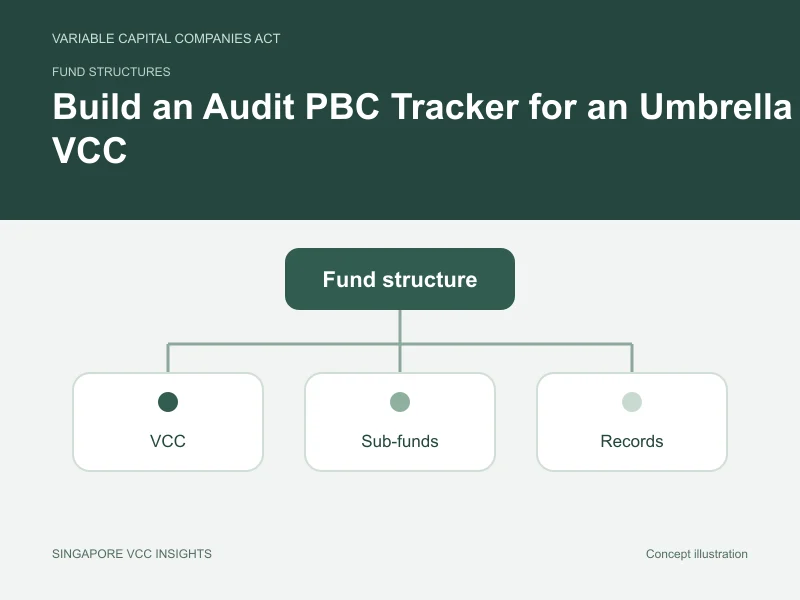
ACRA’s VCC filing guidance calls for financial statements, sub-fund financial statements where applicable, a statement by directors and the auditor’s report. Build the PBC tracker so those outputs are visible from the start. One register avoids competing spreadsheets, but every item needs an explicit umbrella, shared or sub-fund scope so consolidated coordination does not erase compartment-level evidence.
Sources: Accounting and Corporate Regulatory Authority · Accounting and Corporate Regulatory Authority| Field group | Fields | Purpose |
|---|---|---|
| Identity | Item ID, period, VCC, sub-fund, request category and auditor reference | Keeps every request unique and correctly scoped. |
| Ownership | Preparer, reviewer, provider source, approver and escalation owner | Makes responsibility visible across organisations. |
| Evidence | Source system, report parameters, file link, version, as-of date and control total | Lets a reviewer reproduce the delivered output. |
| Workflow | Requested date, internal due date, delivery date, auditor status and next action | Separates upload from acceptance and closure. |
| Queries | Question, response, adjustment, decision, affected statements and closure evidence | Preserves how the final answer changed records or conclusions. |
Agree status definitions with the audit team. “In preparation” means an owner is producing evidence; “internal review” means a specific version is being checked; “delivered” means that version reached the auditor; “query open” means further work remains; and “closed” means the auditor has no outstanding request on that item. Avoid percentages that hide which critical request is blocked.
Sources: Accounting and Corporate Regulatory Authority · Inland Revenue Authority of SingaporeRelated guidance: VCC compliance checklist · VCC books and records location map
Map umbrella and sub-fund scope
Classify each request before assigning it. Umbrella governance, constitution, officers and some provider agreements may apply across the structure. Investor, portfolio, cash, expense, valuation and transaction records often need sub-fund attribution. Shared records should appear once with their scope stated; combined reports should identify the filter or reconciliation that produces each sub-fund view.
Sources: Accounting and Corporate Regulatory Authority · Accounting and Corporate Regulatory Authority · Inland Revenue Authority of Singapore| Evidence family | Typical scope question | Tracker control |
|---|---|---|
| Corporate and governance | Does the record apply to the whole VCC or a named sub-fund decision? | Record governing body, meeting and affected compartments. |
| Investors and capital | Which class and sub-fund owns the subscription, redemption, transfer or distribution? | Link investor register, cash and unit or share movement. |
| Portfolio and custody | Which sub-fund owns the asset, income, liability and related cash? | Reconcile custody, administrator ledger and legal documents. |
| Shared expenses | Which pools benefit and what allocation basis was approved? | Attach calculation, rule, invoice and review evidence. |
| Financial reporting | How does the sub-fund schedule roll into the umbrella output? | Record mapping, elimination, reconciliation and final statement reference. |
Use stable identifiers in file names, ledger dimensions and tracker fields. Names may change, so retain registration numbers or controlled internal codes as well. When a provider supplies a combined report, the finance lead should be able to reproduce the sub-fund totals and explain any umbrella-only or shared line. A visually separated PDF is not enough if the underlying data cannot be reconciled.
Sources: Accounting and Corporate Regulatory Authority · Inland Revenue Authority of Singapore · Inland Revenue Authority of SingaporeRelated guidance: umbrella VCC account architecture
Control high-judgement evidence
Valuation evidence needs more than the final price. MAS has emphasised valuation governance for fund managers, including policies, independence, methodologies, data, overrides and review. The tracker should link the position population, price source, methodology, stale-price or illiquidity flag, model input, independent check, committee or approval record, subsequent-event review and financial-statement effect for each material judgement.
Sources: Monetary Authority of Singapore · Monetary Authority of Singapore- Reconcile the complete position population from custody or legal records to the administrator ledger before sampling valuation support.
- Record the selected methodology and source data for hard-to-value assets, together with changes from the prior period.
- Identify overrides, broker indications, models, stale prices, side letters, impairment indicators and post-period events that need separate review.
- Link every audit adjustment or unadjusted difference to the affected sub-fund, statements, investor or dealing output and approval decision.
- Preserve the exact evidence version reviewed by directors and the auditor rather than replacing it silently with a later file.
Apply the same lineage discipline to cash, investor capital, income, foreign tax, related parties and shared costs. Each schedule should show its source population, transformations, reviewer, reconciling items and final statement destination. If the audit query reveals an operating-record problem, correct the record through its owner and link that remediation, rather than creating an audit-only spreadsheet that will be lost next year.
Sources: Inland Revenue Authority of Singapore · Monetary Authority of SingaporeRelated guidance: MAS valuation findings for a VCC review
Control queries and versions
- ReceiveLog the auditor request or question against a unique item and identify the exact VCC, sub-fund, period, file version and balance affected.
- InvestigateAssign an operating owner, preserve the original evidence and record the source data, analysis, assumptions and proposed response.
- ReviewHave the accountable reviewer approve the response, any adjustment and the precise documents that will be delivered.
- DeliverSend the controlled version, update the tracker link and record who sent it, when and through which secure channel.
- CloseCapture auditor acceptance, remaining difference, financial-statement effect, operating remediation and final evidence location.
Never overwrite a delivered file without preserving its history. If a schedule changes, issue a new version and explain what changed, why, who approved it and which other schedules or statements are affected. The tracker should prevent two providers from answering the same query with different populations or a director from approving a financial statement supported by an earlier evidence set.
Sources: Inland Revenue Authority of Singapore · Accounting and Corporate Regulatory AuthorityClose into filing and next year
- Reconcile the final trial balance and every sub-fund schedule to the signed financial statements and auditor’s report.
- Confirm director statements, approval records and the exact PDF financial statements intended for the VCC annual-return filing pack.
- Archive the final PBC index, delivered evidence versions, open and closed queries, adjustments, representation records and completion communications.
- Move unresolved operating findings into a board or management action register with owners, target dates and evidence of later closure.
- Roll forward stable schedules, data owners, source reports and lessons into the next cycle without carrying stale balances or conclusions.
The completion pack should allow an independent finance lead to reproduce the path from books and provider records to sub-fund schedules, umbrella statements, director approval, audit report and annual-return documents. Keep cross-references stable after archive. A folder arranged only by the order in which emails arrived is not a reusable evidence file.
Sources: Accounting and Corporate Regulatory Authority · Inland Revenue Authority of SingaporeAfter filing, compare the planned and actual request timetable, late items, repeated queries, manual workarounds and provider dependencies. Use that review to change monthly or quarterly controls. The best audit tracker reduces the next audit burden because reconciliations, ownership and evidence are improved during the year, not because the team becomes faster at chasing files.
Sources: Monetary Authority of Singapore · Inland Revenue Authority of SingaporeRelated guidance: VCC financial statements filed as PDF
Frequently asked questions
What does PBC mean in a VCC audit?
PBC commonly means “prepared by client”: the schedules, documents and explanations the VCC and its providers prepare for the auditor. The tracker should control who prepares and reviews each item, which entity or sub-fund it covers, which version was delivered and whether queries are closed.
Should every sub-fund have a separate tracker?
Usually one controlled tracker is easier to govern, provided every request has an explicit umbrella, shared or sub-fund scope. Separate trackers can fragment dependencies and queries. Use filtered views for teams while keeping one unique item register and one status vocabulary.
When is a PBC item complete?
Not when a file is uploaded. Completion means the correct scope and period are confirmed, balances or populations reconcile, the reviewer approved the exact version, the auditor’s request is resolved and any related adjustment or operating remediation is recorded.
How should shared expenses appear in the tracker?
Link the invoice, service period, beneficiary analysis, approved allocation basis, calculation, ledger entries, payment and reviewer evidence. Show how the total splits across sub-funds and how the allocations reconcile back to the umbrella-level source record.
What should roll forward to the next audit?
Roll forward stable request definitions, owners, source reports, reconciliations, data mappings and lessons. Do not carry forward balances, dates, approvals or conclusions without revalidation. Open operating findings should remain in the action register until evidence shows they are closed.
Official sources and further reading
- Steps to file a VCC annual return (Accounting and Corporate Regulatory Authority)
- Post-registration guide for variable capital companies (Accounting and Corporate Regulatory Authority)
- Understanding VCC features, eligibility and requirements (Accounting and Corporate Regulatory Authority)
- Legal obligations of a VCC director (Accounting and Corporate Regulatory Authority)
- Valuation Practices for Fund Management Companies (Monetary Authority of Singapore)
- Governance and Management of Variable Capital Companies (Monetary Authority of Singapore)
- Record Keeping Requirements (Inland Revenue Authority of Singapore)
- Tax Framework for Variable Capital Companies (Inland Revenue Authority of Singapore)
Discuss a Singapore VCC structure
For help coordinating a Singapore VCC setup or corporate administration, contact Raffles Corporate Services.
General information only. This article is not legal, tax, regulatory or investment advice and does not imply affiliation with or endorsement by ACRA, MAS or IRAS.